Sunday, May 31, 2009

the chief end of man...*

Man is dominated by the making of money, by acquisition as the ultimate purpose of his life. Economic acquisition is no longer subordinated to man as the means for satisfaction of his materials needs.

~ Max Weber in The Protestant Ethic and the Spirit of Capitalism

In the words of the English historian E. P. Thompson, time became “currency: it is not passed but spent.” As employers consolidated control over their workforces, the day was increasingly split into two kinds of time: “owners’ time, the time of work”; and “their own time, a time (in theory) for leisure.’ Eventually, workers came to perceive time, not as the milieu in which they lived their life, but ‘as an objective force within which [they] were imprisoned.'”

~ Juliet Schor in The Overworked American: The Unexpected Decline of Leisure

By the sweat of your brow you will eat your food until you return to the ground, since from it you were taken; for dust you are and to dust you will return.

(The source of the last passage should be fairly self-evident. And in case there is any confusion, it is not from Philip Pullman's Golden Compass)


*and a different sort of iron cage.

Friday, May 08, 2009

sharing time

A glimpse into my soul: this is a fitting representation of my computer desktop. Women’s fashion and lifestyle magazines always recommend that if you haven’t worn a piece of clothing for over a year you should throw it out. I am beginning to wonder if the same rule should be applied to half-written blog entries and articles on my computer desktop.

But seriously:

the religious right was not good for religion

when scientists are silenced by colleagues, administrators, editors and funders who think that simply asking certain questions is inappropriate, the process begins to resemble religion rather than science

marriage actually works best as a formative institution, not an institution you enter once you think you're fully formed

laws aren’t supposed to be enforced only when convenient

And not so seriously (or perhaps, more seriously):

interactive knitting

obamanomics

the recession is great!

the course I would someday like to teach

the sociology of scrabble letters

is it uncool to hate on American Apparel?

food is the new sex

and sex still sells. especially in france.

Tuesday, May 05, 2009

when words lose their meaning (5)

I stumbled upon Kasmeneo’s fashion photo stream via the Sociological Images blog. Kasmeneo regularly wears women’s clothing and posts photos of his outfits on flickr. While I have no objection to him wearing women’s clothing**, I am disappointed with his choice of vocabulary to express his opinion on the matter:

Fashion is one of my major hobbies… and mainstream men’s fashion is much too boring. So I take most of my clothes and shoes from the women’s department, as there’s just much more items, styles, colors, and materials to choose from.
That’s also my personal statement regarding equal rights - they include the right of clothing choice. What you see here is what I wear everyday, at work, in town, for shopping, whatever. And I hope that publishing my pics here can convince some men that nice clothes and shoes are not a girl’s privilege. It’s all there, you just have to take it - just like the girls do with our stuff.


The term “rights”, whether “equal rights” or “human rights”, is constantly co-opted for the purposes of demanding or justifying our desires. The line between our postmodern consumer wants and the “basic rights and dignities to which all humans are entitled” is gradually blurred.

I don’t know a single politician who doesn’t mention ten times a day “the fight for human rights” or “violation of human rights.” But because people in the West are not threatened by concentration camps and are free to say and write what they want, the more the fight for human rights gains in popularity, the more it loses any concrete content, becoming a kind of universal stance of everyone towards everything, a kind of energy that turns all human desires into rights.

~ Milan Kundera, quoted in Richard Stivers’ "The Illusion of Freedom and Equality"

If right implies choice, choice suggests desire. Indeed, right as an expansionistic concept is a metaphor for desire… Rights easily become the desires that advertising presents to us as needs, the fulfillment of which is left open to our choices.
~ “The Illusion of Freedom and Democracy” Richard Stivers


* In order to keep up with trendy summer blockbuster movies (Terminator Salvation, Star Trek) I am officially rebooting this series.

** To be fair, he makes the clear point that women do wear men’s clothing and it would be unreasonable to impose a double standard for matters of fashion. Furthermore, he actually pulls off the look fairly well. I really don't think men look that bad in skirts.

Sunday, May 03, 2009

my destiny*

Sometimes I feel like I will spend my entire life longing to go back to Torres del Paine.

It’s been over a year since Matt and I flew halfway around the globe and trekked Torres del Paine National Park in Chile. The memory of being there – instead of fading with time--- has grown to mythical proportions.

I think about the place a lot. I can still hear the thunder of ice breaking off from the glaciers during the night. The stream water still tastes refreshingly cold. And I remember that even though I felt exhausted each night from the hours of hiking, I felt restored and cleansed from breathing the fresh air. But I most vividly remember the sense of awe I felt as I was surrounded by the towering mountains and endless pampas. Confronted with something I had no category to understand, I felt small and frail. And yet, I felt safe and comforted within something so much greater than myself.

There are very few times in my life where I actually behold the immensity of God’s power. And when I do, I long to live those moments again.


* This entry is melodramatic. Except it’s not. I actually feel this way.
** Photos were taken by Matt. More of his photos can be found here. Maybe I'll post some more on my flickr photostream, but it will have to compete against my knitting pictures for bandwidth. It'll be a tough battle.

Saturday, May 02, 2009

late night thoughts

David Brooks' article Genius: The Modern View echoes the great words of wisdom of Thomas Edison: Genius is one percent inspiration and 99% perspiration. Genius is not produced by inherent, divine talent, but by methodical practice. Which is to say, that my aspirations to be come a world-famous writer will not be realized unless I blog more often :P.

But seriously, my knitting has improved significantly since I first started over two years ago, but I spend anywhere from half an hour to three or four hours knitting every day. To be fair, most of those hours are spent knitting during movies or Star Trek The Next Generation episodes, but I am still practicing. It makes me wonder: How would the quality of my ideas and communication improved had I made a similar commitment to writing?

If Edison's words are true, then I am not sure if we are to be encouraged or discouraged. It is encouraging to know that anyone with slightly above-average skill in some area can become a "top performer", but it is discouraging to confront the amount of time and discipline required to develop that excellence. It makes me wonder if it's too late for me to excel in any area and to reverse my current trajectory of becoming jack of all trades and master of none. But it also makes me wonder how much is it worth sacrificing to become the best of the best?*


* A professor once told my friend that she was capable of becoming a leading history scholar. She would just have to pick a good area and master everything written on that topic. Of course, her research may also require her to spend several months away from her family each year. Not an easy price to pay.

Thursday, April 23, 2009

I'm yellow!

and I like yellow butterflies

I have neglected this blog. I suffer from on average month-long writer’s block and this recent one has lasted longer than usual. Perhaps I’ve been distracted by more immediate things—work, house-buying ambivalence, obsessive knitting and hemming my ten gazillion skirts that are too long and hit me at the unflattering mid-calf length. Garbage in garbage out, so I suppose I can complain about nonprofit bureaucracy or ramble at length about the lengths of my dresses, but I won’t put you through that torture. That’s reserved for my husband (who is quite wonderful in case you were wondering).

Today I stumbled upon the Circle Ventures (somehow related to Circle of Hope church) blog post on white guilt concerning this history of the United States with regards to African Americans. It reminded me of how foreign America’s history is to me—the American Revolution, the westward expansion, the Civil War, the Great Depression, WWII, the Vietnam war – all this could be the history of another country. The history of my “nation” is a jumble of Communist and Cultural Revolution stories, the fall of the Berlin wall via our TV set in British Columbia (mildly upsetting because I wasn’t allowed to watch cartoons), Quebec separatism and a president south of the border notable for his extracurricular engagements. When I watch British or American period movies, I might as well be watching a movie about Sri Lanka, or Chile or Malawi.

My ethnicity, my family culture, whatever convenient label you might want to use, pops up in surprising but subtle ways. My husband and I have a now-resolved dispute about the “magic realism” in Garcia Marquez’s One Hundred Years of Solitude (one of my favourite books by the way…), most notably the yellow butterflies that follow around a character in the novel. These yellow butterflies offend my husband’s rational, INTJ sensibilities! For him, they are excessive ornamental flourishes because insufficient information is given to determine what they might mean or symbolize. And I know of a few others who feel the same way. But for me, it completely makes sense that this magic is embedded in the way of narrating a story or of seeing reality and no explanation is needed. While my family did not subscribe to Chinese folk stories, my mother practiced Chinese medicine. In the world where I grew up, sticking needles in a person’s face can relieve paralysis, too much “yang” in my system caused my colds and feeling one’s pulse could discern temperaments and long-term illnesses. And for the most part, I hold that all of this is true. Not true in the Western, rational, scientific sense, but true in another sense. We believe in truths in different ways. And so the fact that the yellow butterflies in the Marquez’s novel didn’t mean anything per se, never bothered me, because it corresponded with my cultural hybrid way of seeing (I can’t believe I just used the word hybrid...).

It’s funny how I’ve come to embrace my Chinese-ness recently, as I generally dislike acknowledging my ethnic background. I’ll smile if someone asks me about China, but the moment someone says something along the lines of: “Maybe you do that because you’re Chinese”, the smile becomes forced and my irritation becomes palpable. I will stiffen even more if someone says something like “You need to understand how being Chinese impacts who you are.”

This annoyance may stem from reading far too many “What’s my identity” “I’m a hybrid” minority novels in college (some of which were actually excellent), but it is primarily a strong reaction against the expectation that I must understand who I am in the context of my ethnicity. White people are not confined to conceive of their identities in terms of their ethnicity, then why must ethnicity be my starting point? What if my race is not the defining characteristic of who I am? Why must we limit the driving factors of our formation to race, gender and class when there may be influences that matter far more?

But I’m lucky. Because though I might occasionally receive awkward comments and rude questions, I have not been significantly marginalized because of my ethnicity. Fortunately for me, the privileges of education and wealth were also handed down to me along with my skin colour at birth. And so I am here and not elsewhere. And this is who I am, not someone else. Mostly Canadian-American well-educated wealthy Christian but with bits of Chinese weaved into the holes.

~

There I did it! My crowning contribution to minority literature. New genre: Chinese Canadian American. CCA literature. Memoirs of my childhood amongst huckleberry bushes, chopsticks, francophones, and ice rinks. Maybe they will even have a CCA studies department!

Saturday, April 04, 2009

another first quarter


I noticed that every book I’ve read this quarter is one that I physically own. Our post-marriage bookshelf (or more appropriately, our bookshelves plus random piles of books), are a gold mine, especially after Christmas, birthdays, routine trips upon my insistence to the Last Word Bookstore and a year of using Paperbackswap. Two books are missing from this photo because they are at my office. I’ve started keeping personal books at my office, because there’s really no space in our current apartment. Sigh. (Wait, three books are missing. I suppose one has just been misplaced....)

Seeing all these books stacked on top of one another reminds me of how much I love the physicality of books—the binding, the texture of the cover, the smell of the pages. Hannah Arendt describes the printed book as the “transformation of the intangible into the tangibility of things,” something that is lost in the gadgetry of Kindles and the liquid crystals of internet text. From Christine Rosen’s People of the Screen:

As he tried to train himself to screen-read—and mastering such reading does require new skills—Bell made an important observation, one often overlooked in the debate over digital texts: the computer screen was not intended to replace the book. Screen reading allows you to read in a “strategic, targeted manner,” searching for particular pieces of information, he notes. And although this style of reading is admittedly empowering, Bell cautions, “You are the master, not some dead author. And that is precisely where the greatest dangers lie, because when reading, you should not be the master”; you should be the student. “Surrendering to the organizing logic of a book is, after all, the way one learns,” he observes.

So for now, no Kindle for me. Let me submit to the mastery of the printed text! I’m already susceptible to skimming. Besides, I don't get along with gadgets-- I drop my cell phone frequently and lose it for days on end...

In any case, in the past, I usually review books right after I read them. This time around, I procrastinated and ended up writing most of these in the last two weeks, so they may be a little lacking in quality. At the very least, I hope they can give you an idea of what the book is about and whether or not you might want to read them. Italicized books are the ones that I did not finish.

Rating scale from Goodreads
* didn’t like it
** it was ok
*** liked it
**** really liked it
***** it was amazing

Fiction

* or ** The Tin Drum (Gunter Grass) ~ I wanted to like this book, as it’s been compared to two of my other favourites: Salman Rushdie’s Midnight’s Children and Gabriel Garcia Marquez’s One Hundred Years of Solitude. With a trip to Europe planned for the summer, I was also excited to learn about Poland and Germany, as the novel recounts a midget drummer’s childhood and coming of age during the Nazi’s rise and fall of power. But what can I say? I didn’t really like the book. The novel’s language lacked the narrative fluidity that made me love the other two novels (perhaps because it was originally written in German?). The novel’s surreal details were less magic realist (which resonates more with me) and more absurdist in the line of Pynchon (which perhaps because of my cultural background, doesn’t make any sense to me). The novel had several funny and/or insightful passages and I can understand why it has been acclaimed as one of the greatest pieces of German literature since World War II, but to be honest, I can’t say I enjoyed reading it very much.

*** China Men (Maxine Hong-Kingston) ~ I didn’t really get into this book as much as I had hoped. I wrote on Maxine Hong-Kingston’s The Woman Warrior as my senior thesis so I am familiar with her work and style. Hong-Kingston weaves together myth and fact as she recounts the stories of Chinese male immigrants to the United States, from as early as the gold rush and railroad construction to the 1990s. The narratives are detailed, vivid and suggest a mythical historical memory. Her descriptions of the railroad construction by Chinese men and the confusion of the Communist revolution are particularly compelling, but some of the latter stories in the novel were less interesting.

**** Beasts of No Nation ~ After reading the first chapter, I wasn’t expecting to like the book. It was very “loud”, full of yelling and violence and what you’d normally expect from a book about child soldiers. Fortunately, the book did not turn out to be the usual narrative about the horrors of war. Instead, the book explores the psychology of a child soldier amidst the violence of war. What does it mean for someone so young to kill? What does it mean to be both perpetrator and victim?

*** Black Hole (Charles Burns) ~ This graphic novel depicts the spread of a mysterious STD amongst high schoolers in Seattle in the 70s. The disease manifests itself in bizarre physical mutations—tails, mouth, peeling skin etc… The graphic novel is as much as about the initial AIDS as it is about high school social politics, isolation, boredom and rebellion. The artwork is also remarkable as the drawings are also entirely done in black and white strokes (no gray-scale). As a warning for those who are sensitive, the novel has graphic depictions of male and female genitalia.

Non-Fiction

**** On Writing Well (William Zinsser) ~ The first section of the book covers general principles for writing well, while the second section describes guidelines for specific types of writing, including business writing, sports-writing, memoir-writing etc.. The book helped me think about how I can better improve both my business writing, my blog writing and my elusive in-my-head magazine articles that have never actually been written. It is also very enjoyable and readable—much less dry than Strunk’s Elements of Style, which I don’t think I ever finished reading.

***** Engaging the Powers (Walter Wink) ~ I haven’t had a five star book in awhile, but this book definitely qualifies as such. Walter Wink writes about the domination system of the world and the spiritual interiority of institutions. Though Wink may fall on the more liberal end of scriptural analysis, his ideas concerning the spiritual core of institutions and the role they play in society, the significance of Christ’s death and the power of nonviolent action provide a much more comprehensive understanding of the world.

*** Reclaiming Capital: Democratic Initiatives and Community Development (Christopher Gunn) ~ Similar to his other book Third Sector Development, Gunn explores ways to reclaim capital for investment and use within a community. To set the context, Gunn describes the way in which capital is internationally mobile and flows to the area of greatest return. Communities who wish to attract firms often do so at their own detriment—lax labour and environmental standards or tax incentives. Frequently, firms who do locate within a community do not provide the benefits promised. For instance, Gunn assesses how little of the economic benefits generated by the opening of a new MacDonald’s restaurant are actually retained by the community. For the rest of the book, he describes the efforts of different community institutions in reclaiming capital for improving their own communities. This book is clear and well-written even for those unfamiliar with economics or development. It is an excellent introduction for thinking more critically about how capital flows in the world and how it affects different communities.

**** Slaves, Women and Homosexuals: Exploring the Hermeneutics of Cultural Analysis (William Webb) ~ Through the examination of three controversial issues in the church historically and/or currently, Webb provides a framework for “the hermeneutics involved in distinguishing that which is merely cultural in Scripture from that which is timeless." He presents a set of 18 or so criteria that can help us determine how scripture texts apply to our current context. He explains each of the criteria and then assesses the three controversial issues in his title in light of those criteria. While his final conclusions on the three controversial issues are important, the book is most valuable for providing anyone with a framework of distinguishing what is cultural and what is transcendent in scripture.

** The Financial Ascent of Money (Niall Ferguson) ~ When I read non-fiction books, I tend to get irritated at the author’s tone after about 100 or so pages. It was a bad sign when I got annoyed at the Ferguson’s writing style after about one paragraph. He writes like a slick modernist, one that firmly believes in greatness of our Western cultural and economic trajectory. However, I decided to give the book a chance and ended up reading/skimming most of it. It turned out to be okay. I expected the book to be focused on currency specifically, rather than all sorts of financial instruments. The book covers the historical development of bonds, stock exchanges, insurance, real estate and derivatives (including the crash of Long Term Capital management). Ferguson’s final chapter describes the influence of finance on the British empire and international relations, including the recent development of Chimerica (China + America). Ferguson goes into great narrative detail describing specific events and/or people—not surprising given that he is a historian. I don’t think he goes into sufficient detail in explaining how the different financial institutions and instruments work. As someone with a business education (is that an oxymoron?), it was okay for me to understand but it may be more challenging for someone who isn’t as familiar with these terms. Not bad, not great. The writer’s tone also became slightly less annoying over the course of the book. He makes a good point of indicating that despite all our mathematical models, our current form of capitalism is subject to extreme volatility—bubbles and crashes—and that history may be as important a lesson as statistics.

*** Eichmann in Jerusalem (Hannah Arendt) ~ I expected this book to be a philosophical and psychological exploration on the nature of evil, but it turned out to be more about the trial of Karl Eichmann in Jerusalem and a historical overview of his rise to power and his orchestration of Jewish deportation in each of the German-occupied nations. The book reads tediously at points, but other sections are fascinating—the Denmark resistance to Nazi orders, the significance of Eichmann’s kidnapping from Argentina by the Israeli Mossad, the desire for Eichmann’s sentence to deliver justice not just for the crimes for which Eichmann was individually responsible but for also for all Nazi crimes against Jews, and the contested fairness of a trial where the judge was Israeli and no defense witnesses were available because no former Nazi would come to testify in Israel. The last chapter provides the best overview and commentary of the trial, with a particular focus on legal and judicial philosophy. If you don’t want to read the whole book, but are interested in the ideas—I would suggest reading the last chapter.

**** Money and Power (Jacques Ellul) ~ From the title, I thought this book would be about people with money and power. However, the book could be more appropriately named the power of money. Ellul first explores wealth in the Old Testament. He examines instances when God used wealth as a reward or blessing, emphasizing that the riches were a gift and a material demonstration of God’s power. Ellul then elaborates on how Jesus completely transforms our relationship to money, especially as He becomes the “Poor One”. Why are the poor amongst us? How must we relate to them? Ellul’s final conclusions are challenging—that Christians should not be in the practice of saving or hoarding, and that everything beyond what they need should be given away. This practice allows one to be freed from serving Mammon (the system of selling and buying) and to “enter” the kingdom of God, where grace and giving reign.

** The People’s History of the United States of America (Howard Zinn) ~ I had read some excerpts from this book earlier and enjoyed them and was hoping for a insightful critique of the mainstream reading of American history. However, the book (or atleast the parts I read) seemed to list the usual liberal grab bag of events and facts combined with a hefty dose of lefty rhetoric. While a decent introduction to the injustices committed by America to its own people and to others, I don’t think the book provided any astute or significant commentary on either American history or the writing of American history.

*** Evil Paradises: Dreamworlds of Neoliberalism (Mike Davis, Daniel Bertrand Monk, editors) ~ This book is a compilation of essays on the urban and spatial developments of the wealthy in the world. I have read about half the essays-- most of them elucidate not just the stark contrast between the rich and the poor, but also the economic, social, environmental and moral cost of these “dreamworlds” to the poor and to humanity.

**** Commager on Tocqueville (Henry Steele Commager) ~ Despite a somewhat self-preoccupied and unenticing title, the book is excellent. Commager assesses American history in the last century through the set of questions raised by Alexis de Tocqueville, the famous French aristocrat who wrote about America in Democracy in America. Tocqueville primarily was concerned with democracy – especially the tensions raised between liberty, order and equality. He examines issues of slavery and justice, centralization and democracy, military vs. civil power and political equality and economic inequality in America.


Thursday, April 02, 2009

fruits of my labour

In the case of the white-collar man, the alienation of the wage-worker from the products of his work is carried one step nearer to its Kafka-like completion. The salaried employee does not make anything, although he may handle much that he greatly desires but cannot have. No product of craftsmanship can be his to contemplate with pleasure as it is being created and after it is made. Being alienated from any product of his labor, and going year after year through the same paper routine, he turns his leisure all the more frenziedly to the ersatz diversion that is sold him, and partakes of the synthetic excitement that neither eases nor releases. He is bored at work and restless at play, and this terrible alternation wears him out.

~ C. Wright Mills, White Collar: The American Middle Classes

As white-collar worker in a nonprofit institution (which inevitably has its bureaucraucies), I understand my craving and my need for my manual creation. A desire to touch and hold the product of my labour—to contemplate it with pleasure. To partake in an activity that is not mere diversion, but creation that eases and releases. A comfort from the haunting sense that my work is disappearing into a labyrinth of papers, emails and electronic files and meetings.*

Finished product:
Collared Wrap from Sally Melville's the Knitting Experience Book 2: The Purl Stitch. Knit as a mother's day gift. I can't say I enjoyed four months of knitting with dull green worsted-weight acrylic wool. But I am so pleased with the final result that I am tempted to make the same item for myself...


Finished product:
Garter Rib socks from Charlene Schurch's Sensational Knitted Socks
Knit as a father's day gift. I am concerned that these socks are going to be too big for him.... but he will probably wear them anyways. Aren't fathers great?


* Though for the record, for the most part, I do believe my work is valuable. I just have occasional melodramatic days. :) Or perhaps, I posted this to have an excuse to present pictures of my knitting-- Why must the intangible justify the tangible? Actually, to be honest, I'm just crazy about C. Wright Mills. Everytime I read something by him, I end up highlighting every other sentence and resisting the urge to type up his entire book in a blog entry...

Thursday, March 26, 2009

the inverse kingdom

Traditionally, creditors wielded more power than debtors. Creditors charged exorbitant interest, resorted to intimidation and violence, and seized land and possessions of their debtors.

Strangely enough, today in America, if you’re willing to take a loose definition of creditor and debtor, the debtors often wield more power than the creditors. This idea was suggested in Jacques Ellul’s Money and Power in application to the modern corporation: … the ancient reality of the superiority of the creditor. Obviously in our society, the debtor is often much more powerful than the creditor. The corporation cannot be compared with the hundreds of shareholders who compose it.

To further complicate matters, the corporation is not an individual and a corporation does not just consist of its shareholders or its board of directors or its employees. It takes on a life and a spirit of its own. And then we find ourselves faced with an unwieldly monster whose actions and decisions can have enormous impact on our lives.

The injustice of the debtors’ superiority is what angers us so much about the AIG bonuses as billions of taxpayer dollars trickle into the banking system.* I feel sympathy for Edward Liddy and those who received bonuses who were not directly responsible for credit default swap transactions that were the downfall of AIG.** Yet I am also outraged at the debtor’s entitlement—but it’s not Edward Liddy nor the bonus recipients who are the actual debtors to America, it’s AIG the corporation. And how do we understand how AIG’s employees are both part of and yet distinct from the corporation? And as a result, though they may have no personal wrongdoing related to the credit default swaps, they may have to uphold the moral responsibility of a powerful debtor before less powerful creditors.

So for better or for worse, the 90% tax may get passed and we may feel a little bit better.*** But the larger problems still remain unsolved…


* Compared to the total amount lent to AIG, the bonuses were a drop in a bucket. Dealing with large amounts of money can have two contrary psychological impacts—either you start penny pinching and counting every little cent or you figure since the debt is so large, little savings won’t make a big difference in the long run. Clearly in this case, the American public as the creditor feels the former. No creditor would like to see a debtor living the good life if there is no evidence of repayment.
** I’m sympathetic to the fact that many of them are the wrong target of the angry mob. That being said, I personally find large bonuses rather distasteful wherever, but that stems from a larger critique of American capitalism and compensation.
*** Has it been passed already? I don’t think I’ve been paying that close attention to the news in the last few days.

Wednesday, March 25, 2009

the tyranny of private enterprise

History has always been one of the hardest subjects of me to understand. It’s either a muddle of events that I cannot understand or a simplistic narrative that I do not believe. Perhaps I relate to how Hayden White sees historical narrative: “translations of facts into fictions” as “the events are made into a story by the suppression or subordination of certain of them and highlighting of others”.

The motives and actions of presidents and prime ministers, of ambassadors and representatives. The handshakes made behind closed doors and the secret chain of command through bureaucractic institutions. What story can you spin out of the sparse paper trail of letters, memos and communiqués? Or out of Obama’s Blackberry log? What do you believe?

I have been making an effort to learn history better, since I have been, historically, rather ignorant of it, precisely because I couldn’t make sense of it. It wasn’t until I read two books, the Sociological Imagination by C. Wright Mills and funny enough, the children’s book , A History of US All the People that history finally began making sense.*

These books presented history or insisted that we study history from a more sociological standpoint—looking at the impact of historical events on the consciousness of individuals in society. I don’t really care about what country was a world power or what conferences and negotiations took place, but I am fascinated about how people living in that country felt amidst the whirlwind of headlines and changes. And recently, I’ve also become intrigued by what history has to say about various philosophical questions: How do you reconcile order and liberty? Equality and freedom? Justice and law?

This newfound fascination came as a result of a book recommended to me by my husband, called Commager on Tocqueville (one of the benefits of marriage is that you get more books and if you’re lucky, your husband has similar tastes to yours). Despite a somewhat self-preoccupied and unenticing title, the book is excellent. Commager assesses American history in the last century through the set of questions raised by Alexis de Tocqueville, the famous French aristocrat who wrote about America in Democracy in America (who I vaguely recall having to read in my US AP History class). Tocqueville primarily was concerned with democracy – especially the tensions raised between liberty, order and equality. In Commager’s words:

Would democratic majorities destroy liberty? Would centralization of power, which democracy made almost inevitable, prove incompatible with liberty? Would individualism—so ruthlessly being exercised on the vast North American continent- be compatible with either democracy or with liberty? And what of justice? There can be no liberty without justice and no justice without order. Can individualism tolerate order? Can democracy be trusted to safeguard justice?

Published in 1993, Commager’s conclusions still speak relevantly to what is happening today:

... in the interaction between two forces that (Tocqueville) himself thought the most powerful: majority rule and individualism. He was fearful that majoritarianism would take over the surrender to its natural propensity for tyranny with catastrophic consequences. In that event, it was not the majority that imposed its will on desperate minorities, but the spirit of individualism and private enterprise that permeated majorities and persuaded or seduced them into supporting even the most extreme manifestations of private enterprise. The danger today is no more from majority tyranny than it was in the 1930s when Tocqueville first sounded the alarm. It is rather in that excess of virtue of individualism that we now call private enterprise, but which is no longer private but public, and which, for that matter, is no longer very enterprising. The operation of military-industrial-financial-labor-academic-scientific complex is an example of this. This group or complex does not constitute a majority, but it appears to represent a majority. And to speak for it, it does not formally exercise what we call tyranny, and as for all its triumphs and conquests, these have been brought about legal means and are not therefore tyrannical. But its character and conduct takes on more and more the character of tyranny. In all this, Tocqueville’s fears may yet be vindicated.

I wonder how history will write this past year—the demise of banking as we know it, the economic crisis, the first black president, the new uneasy alliance between banks and government.... What is happening? What does it mean? And how does all of this make us feel? Do we feel powerless as each company announces its own round of layoffs? Do we feel hopeful because there is now a president who seems to be intelligent and concerned about the people and because we may be able to rebuild new and better institutions? Or do we feel angry, ready to charge forth with our pitchforks and flames, because this military-industrial-financial-labor-academic-scientific-governmental complex has failed to demonstrate that it knows what it is doing, though it has justified its privilege and power on that very basis?


*So I am attempting to link to Goodreads more often, rather than Amazon. After all my ranting and railing about large corporations and all my lamenting about the demise of small bookstores, I really should stop giving Amazon free advertising. At the very least, I should sell out and have them pay me.
** For a progressive/liberal reading of American history, I recommend Commager on Tocqueville over Howard Zinn’s People’s History of the United States of America. This post was originally intended as a rant against Howard Zinn, but I decided to write something more positive instead…

Friday, March 13, 2009

America's welfare state

“the species of oppression by which democratic nations are menaced is unlike anything which ever before existed in the world… multitude of men… incessantly endeavoring to procure the petty and paltry pleasures with which they glut their lives…”

“That power is absolute, minute, regular, provident and mild… It seeks on the contrary to keep them in perpetual childhood: it is well content that the people should rejoice, provided they think of nothing but rejoicing. For their happiness such a government willingly labors, but it chooses to be the sole agent and the only arbiter of happiness: it provides for their security, foresees and supplies their necessities, facilitates their pleasures, manages their principal concerns, directs their industry, regulates the descent of property, and subdivides their inheritances – what remains, but to spare them all the care of thinking all the trouble of living… It does not tyrannize, but it compresses, enervates, extinguishes and stupefies a people, till each nation is reduced to be nothing better than a flock of timid and industrious animals, of which the government is the shepherd.”

~ Alexis de Tocqueville, Democracy in America, 1835

“…everyone wants to be free; everyone wants to eat… Everyone does indeed want to be free: free from bureaucratic control, free from burdensome taxation, free to exercise and enlarge the area of private enterprise. Everyone does indeed want to eat: the poor want welfare, the aged want security, the ill and the handicapped want medical care, parents want education for their children, consumers want protection.. The rich, too, want to be fed. They believe in private enterprise and delude themselves that corporations are somehow private rather than the product of very special privileges granted by the state and to be enforced by the state… When coal miners are in trouble they recommend government takeover. When railroads and airlines are in trouble they persuade the government to subsidize them, at least the bankrupt ones… We have developed not only a welfare state with all of its bureaucracy for the poor, but a welfare state for corporations and business interests as well. Clearly the most completely socialized ingredient in our economy is not the poor who are on welfare, but the complex that President Eisenhower first publicly identified as the military-industrial, which we can now see embraces as well labor, banking, the scientific community, and the academy. If these want governmental protection and aid, as clearly they do, they must take for granted big government, big bureaucracy and centralization. Those who yearn to diminish the powers of government must learn to lower their expectations from government, to restrain their demands on nature, to temper their insistence on endless growth and progress that is almost entirely material.”

~ Henry Steele Commager, Commager on Tocqueville, 1993


*I’m really scraping as far as blog posts are. I just can’t bring myself to write anything. I did, however, like my husband, cave in and start a twitter account. I have yet to determine whether or not I will update it regularly or whether or not I like the whole affair. It feels all a bit too suspiciously trendy to me, but perhaps 150 character posts will be more palatable to my creative tendencies. It also fondly reminds me of those good old AIM profiles and away messages I used to check. I guess Twitter is its syndicated version.

Monday, March 09, 2009

the inflection is near

I feel like I haven't posted anything substantial here in awhile. In any case, Thomas Friedman wrote an excellent Op-Ed in the New York Times about this recession marking an inflection point in the way that we think about the economy. (I suspect that you've already read it since it's currently Number 1 on the popularity list for "Most emailed"). Perhaps in the future, we will no longer measure the health of the economy in terms of growth, but rather in terms of flow (sustainability and reproduction). Friedman has a way of finding witty little catchphrases and analogies to describe current events, which for some reason I find annoying, despite the fact that they are generally intelligent and helpful in explaining the matter at hand. Perhaps I am jealous :P

In any case, now that I am done rambling, here are some notable excerpts from the article:

Let’s today step out of the normal boundaries of analysis of our economic crisis and ask a radical question: What if the crisis of 2008 represents something much more fundamental than a deep recession? What if it’s telling us that the whole growth model we created over the last 50 years is simply unsustainable economically and ecologically and that 2008 was when we hit the wall — when Mother Nature and the market both said: “No more.”

“We created a way of raising standards of living that we can’t possibly pass on to our children,” said Joe Romm, a physicist and climate expert who writes the indispensable blog climateprogress.org. We have been getting rich by depleting all our natural stocks — water, hydrocarbons, forests, rivers, fish and arable land — and not by generating renewable flows.

“We are taking a system operating past its capacity and driving it faster and harder,” he wrote me. “No matter how wonderful the system is, the laws of physics and biology still apply.” We must have growth, but we must grow in a different way. For starters, economies need to transition to the concept of net-zero, whereby buildings, cars, factories and homes are designed not only to generate as much energy as they use but to be infinitely recyclable in as many parts as possible. Let’s grow by creating flows rather than plundering more stocks.

Sunday, March 01, 2009

speedy swallowtail shawl

It’s been hard, but I’m trying to rely less on knitting patterns. Browsing blogs and ravelry and knitting magazines, I am always finding pattern after beautiful pattern that I would like to knit. It's much easier to follow a pattern without thinking, than it is to try to design something on my own..

But I'm trying to challenge myself to design my own patterns. To do the tedious swatching, the fussy calculations and force myself to learn the basic architecture of different garments instead of relying upon printed instruction. My hope is that it can move my knitting more away from the realm of passive consumption (more patterns, more books, more yarn) to the realm of active engagement and creation.*

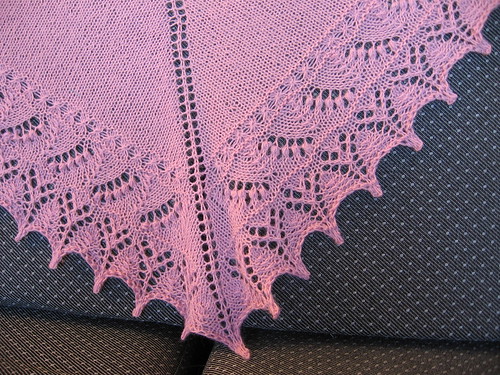
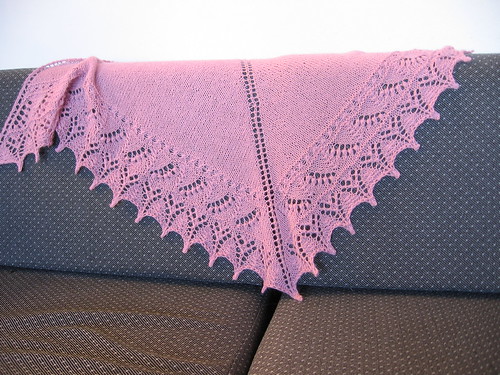
So here’s my first design-- though to be honest, it’s really just a pattern alteration. More photos can be found on its ravelry page. My grandma has been very sick in the hospital and I needed something quick to knit up to give to her as a gift. Taking inspiration from Ysolda’s Ishbel, and the Wool Peddler’s shawl, I kept the majority of this shawl plain, but added in the border and edging from the Swallowtail Shawl, a row of gathered stitches (inspired by the Miranda Triangle Shawl from Knitted Lace of Estonia) and some garter rows for distinguishing the different patterns. I thought this would take me atleast a month but I finished in about 10 days! Thanks to season 1 of Star Trek and my need for distraction from my ongoing crisis about what to do with my life.

The pattern instructions are below. In order to follow them, you also need to download the Swallowtail Shawl pattern from Evelyn Clark's website.

Gathered stitches (worked over 3 stitches)
K3tog but do not slip these stitches from the left needle, yo, then knit the same 3 stitches together again, then slip all 3 stitches from left needle. (From Knitted Lace of Estonia)

Follow Swallowtail instructions up until the end of row 6. Be sure to place marker where indicated on the chart.

Starting row 7:
On all RS rows: Knit 2, YO, Knit until Marker, YO, slip marker, Knit 1 (center stitch), YO, knit until last 2 stitches, YO, Knit 2.
On all WS rows: Knit 2, Purl until last two stitches, knit 2

Knit until you reach 207 stitches, ending on a RS row (207 stitches - 1 middle stitch + 103 stitches on each side)

Next WS row: knit 2, purl 1, knit until 2 before the marker, purl 1, purl 1 (center stitch), Slip marker, purl 1, knit until 3 from the end, purl 1, knit 2

RS row: Knit 2, YO, Knit until Marker, YO, slip marker, Knit 1 (center stitch), YO, knit until last 2 stitches, YO, Knit 2.

WS row: Knit 2, Purl until last two stitches, knit 2 –> you should end with 211 stitches (1 middle stitch + 105 stitches on each side)

RS row: Knit 2, YO, knit 2, make gathered stitches until 2 stitches before the marker, knit 2, YO, slip marker, knit 1 (center stitch), YO, knit 2, work gathered stitches until the last 4 stitches. Knit 2, YO, knit 2. --> you should end with 215 stithces (1 middle stitch + 107 stitches on each side)

WS row: Knit 2, purl until last two stitches, knit 2.

RS row: Knit 2, YO, Knit until Marker, YO, slip marker, Knit 1 (center stitch), YO, knit until last 2 stitches, YO, Knit 2. --> 219 stitches

WS row: knit 2, purl 1, knit until 2 before the marker, purl 1, purl 1 (center stitch), Slip marker, purl 1, knit until 3 from the end, purl 1, knit 2

RS row: Knit 2, YO, Knit until Marker, YO, slip marker, Knit 1 (center stitch), YO, knit until last 2 stitches, YO, Knit 2. --> 223 stitches

WS row: Knit 2, Purl until last two stitches, knit 2

You are now ready to begin the Lily of the Valley Border 2. You should 223 stitches on your needles. The chart has you working the pattern over 219 stitches to begin with. In order to adjust for the extra four stitches in each row, knit an extra stitch in the following places in the chart:
- After the first YO
- Before the YO right before the center stitch
- After the YO right after the center stitch
- Right before the last YO

Purl these extra stitches on the wrong side row and place them in the same locations on the RS row.
The pattern will not be noticeably different.

After completing Lily of the Valley Border 2, you should have 243 stitches on your needles.

RS row: Knit 2, YO, Knit until Marker, YO, slip marker, Knit 1 (center stitch), YO, knit until last 2 stitches, YO, Knit 2. --> 247 stitches

WS row: knit 2, purl 1, knit until 2 before the marker, purl 1, purl 1 (center stitch), Slip marker, purl 1, knit until 3 from the end, purl 1, knit 2

Now you are ready to begin the Peaked Edging chart. You will have 247 stitches on your needles instead of 239 as called for in the pattern. In order to adjust for the 8 extra stitches, make the following adjustments. It helps to mark it on your chart—it will make it a lot more easy to understand.

All WS rows: just purl the extra stitches.

For rows, 1, 3, 5, 7 and 9 of the chart, knit 2 extra stitches:
- After the first YO
- Before the YO right before the center stitch
- After the YO right after the center stitch
- Right before the last YO

From rows 11, 13, 15, work additional stitches as following:
- Knit one extra stitch after the first YO
- Knit one extra stitch after the first sk2p
- Knit one extra stitch before the sk2p right before the center stitch
- Knit one extra stitch before the YO right before the center stitch
- Knit one extra stitch after the YO right after the center stitch
- Knit one extra stitch after the sk2p right after the center stitch
- Knit one extra stitch before the last sk2p of the row
- Knit one extra stitch before the last YO of the row.

This adjustment will make the peaked edging slightly wider on the side and center peaks, but is not very noticeable.

For the RS row before the bind off,
K2, yo, k9, yo, k1, *yo, k7, yo, k1; repeat from * until 11 stitches remain, yo, k9, yo, k2.

Bind off as indicated in the pattern.


*This is not to say that I won’t knit any commercial patterns at all—in fact, there is still a lot I need to learn from them and I will probably still rely heavily on them—but I need to delve into them deeper and understand them better. What exactly distinguishes the different cast-on techniques? How does a short row work? How does this pattern writer construct a sweater? What are alternate ways to do it?
** Speaking of exercises in futility, Yarn Harlots’ multiple attempts at casting on the 600+ stitches for the Miranda Triangle Shawl can only make me cringe. I would have given up after try #2. I still have not had the heart to unravel my rasta fari hat.

Saturday, February 21, 2009

out of ideas

So... it’s the usual link posts, because I’m out of ideas for blog posts, aside from my usual ranting about Wall Street. Perhaps it’s time to give up on idea blog posts and convert this to a full fledged knitting blog? Wouldn’t my blog title “Look at this Tangle of Thorns” be equally applicable? Then again, I've received quite a collection of Mike Davis books for my birthday, which may provide some much-needed blog inspiration.

In any case, I have been collecting these links for a month or so, so some of them may be outdated.

As the Stanford Group’s $8 billion investment fraud was exposed the other day and Madoff’s ponzi scheme remains fresh on our minds and Wall Street’s excesses continue to anger us, this quote from Franklin D. Roosevelt seems appropriate:
“A man who has never gone to school may steal from a freight car, but if he has a university education, he may steal the whole railroad.”

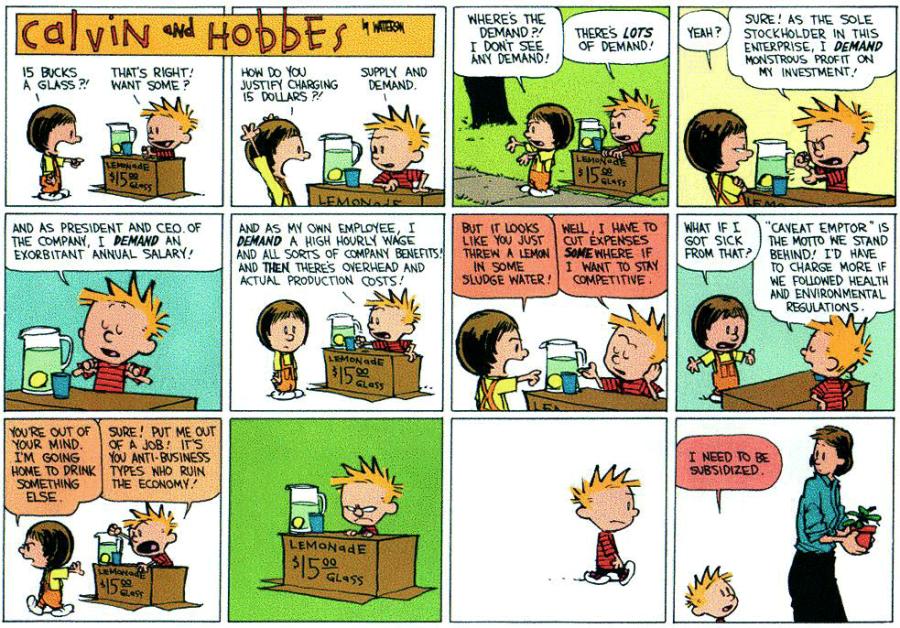
But what better way to describe the American economy than a Calvin and Hobbes comic strip?

However, I do believe, aside from our Dick Fulds and Bernard Madoffs, there are plenty of other people who deserve to be punched in the face.

On a side note, I’m glad Caroline Kennedy did not get nominated to Senator. Kathleen Parker accurately describes my sentiments: “The real rub is that she hasn't earned it. The sense of entitlement implicit in Kennedy's plea for appointment mocks our national narrative. We honor rags-to-riches, but riches-to-riches animates our revolutionary spirit.

Borrowing words from the Oscar-nominated movie The Curious Case of Benjamin Button that I didn’t like so much, “Nothing lasts”. It’s unfortunate that good things don’t last forever. White Dog Café, a model restaurant for socially-responsible business practices was sold earlier this January. While most news sources report a rosy, PR-friendly story, other sources indicate otherwise. I'm not sure if I will be eating there again.

Likewise, this site illustrates the transformation of the organic food industry over the years—as small businesses end up being acquired by large corporations.

But nothing lasts also means that George W. Bush is no longer president. So instead of complaining about what a horrible president he was, we can now remember with endearment his unique patterns of speech.

Oh my gosh! It’s a utility knife for knitters! And I just got it for my birthday thanks to my hubby!

Speaking of hubbies, for those of you in the midst of wedding planning, this blog documents one couple's $2,000 wedding. It also might be nice to determine to see if your interior decorating styles match up and whether or not you want to have children and invest in a few good cookbooks. And if you really want to feel cool at your wedding, you can hire paparazzi to mob you.


* Knitting details. Two sets of socks. The grey speckled pair above is a pair of Garter Rib socks from Charlene Schurch's Sensational Knitted Socks for my dad. I am fretting that I will run out of yarn. The blue/pink pair of socks are a set of baby socks, loosely based on Two at Once, Toe Up sock pattern. I am using size 0 needles and koigu yarn, which has some of the most beautiful colorways that I have ever seen. I am also fretting that the final socks won't fit. How big are newborn baby's feet anyways?

Thursday, February 12, 2009

the life and death of great american corporations

ramblings on the economy

“Around one in ten US companies disappears each year. Between 1989 and 1997, to be precise, an average of 611,000 businesses a year vanished out of a total of 5.73 million firms. Ten per cent is the average extinction rate, it should be noted; in some sectors of the economy, it can rise as high as 20 per cent in a bad year. According to the UK Department of Trade and Industry, 30 per cent of tax-registered businesses disappear after three years. Even if they survive the first few years of existence and go on to enjoy great success, most firms fail eventually. Of the world’s 100 largest companies in 1912, 29 were bankrupt by 1995, 48 had disappeared* and only 19 were still in the top 100.”


In these hard economic times, I doubt it’s any consolation to know that capitalism has been characterized by innovation and failure at the micro-level and cycles of boom and bust at the macro-level.

But we should still remember that it’s not all bad news.* Many of us still have jobs (and are feeling more thankful for them than we ever have before.) It’s also encouraging to see the nation shifting away from consumerism, but the accompanying layoffs are troubling.

That’s the complicated part about fighting against consumerism-- every purchase links back to a job. (And likewise for sweatshops). We stop buying and companies start hurting, which in it of itself doesn’t bother me, but then the layoffs begin. And while this recession has been hard-hitting for well-educated financial professionals, it is still the most hurtful for the least educated and the most vulnerable in our society. (I can’t seem to find the article, but basically decline in employment has affected high school diploma-less men the most).

Bankruptcies and layoffs in a capitalist economy that champions creative destruction technically shouldn’t be something we fear. Nevertheless, when the destruction doesn’t just affect legal entities and the pocket change of the rich, but begins to leave many without jobs, then we do need more consolation than “It’s just the nature of capitalism. Boom and bust. We just have to wait it out.” (“Collateral damage” for a “cyclical adjustment” perhaps? It will just be a matter of mathematical calculations before the supply and demand curves reshift.)

How many days or years or decades of waiting before you can get back on track with your life?

I hope that as we wait out this recession, we will actively care for those who are most vulnerable. I hope that while we may be cautious with our spending, that we can still be generous with our giving. And I hope that as we are trying to fix the economy, we’re building something more sustainable and just, rather than just patching up something that was never that great to begin with.


* Interestingly enough, the longest-existing institutions in our day have been nonprofit organizations such as universities…
** For instance, Amazon is still doing okay and so is Wal-Mart, which obviously makes me happy since you all know how much I love and adore and worship Wal-Mart.

Monday, February 09, 2009

opium of the masses

Whenever we talk about money, we always end up asking, How should we organize the economy? –or even, What economic system should I support? “At the moment,” we explain, “I may not be using money the way I should, but when the new system (whatever it may be) is instituted, when the general money problem is solved, I in turn will become just.

Thus we subordinate moral and individual problems to the collective problem, to the total economic system. If a man is a thief, it is not his fault; his economic conditions were such that he could be nothing else. Let us beware. If we accept this excuse on behalf of a poor person, we must accept it for everyone. Both the capitalist who exploits workers and the farmer who dabbles in the black market are also involved in impersonal economic conditions which leave them no options. As soon as we accept the supremacy of global concerns and of the system, as soon as we agree that material conditions remove our freedom to choose, we absolve all individuals of all responsibility for their use of money.


… human nature (with its lust for money) is corrupting the system. And that is why it is horribly wrong to believe that the problem of money can be solved by a system. It is horribly wrong thus to cheat man’s hopes and thirst for virtue and honesty. “You want justice? Then establish my system.” This is the error of all committed economists and others who think they can solve the problem without considering human nature.

But it is more than an error: it is also hypocrisy and cowardice. For then I ultimately ask no more than to believe the system-builder. It is so convenient. I don’t have to think about what I do. I don’t have to try to use my money better, to covet less, to quit stealing. It’s not my fault. All I have to do is campaign for socialism or conservatism, and as soon as society’s problems are solved, I will be just and virtuous- effortlessly.


But all this activity is a justification for avoiding personal decision making. My money? My work? My life? I don’t have to worry about them because I am involved in such-and-such a movement which will take care of all that for everyone once it comes to power.

~ excerpts from Jacques Ellul's Money and Power

Sometimes you just stumble upon the right book at the right time. Providential perhaps?

Saturday, February 07, 2009

exercises in futility*

Ohhh knitting, you are such an exercise in futility. I spend hours upon hours knotting you with gentle care and love, eagerly anticipating the beautiful final product and then you let me down. And I must resign myself to the fact that I will have to pull out all those individually placed loops and roll you back into a ball.

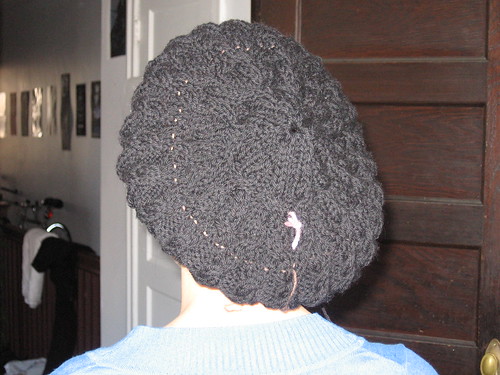
My most recent failure: remember the lovely cabled hat that I was excited about? Well, it turns out that it’s just a tad too big and looks like a rasta hat.

So…. whenever I can muster up the courage to unravel it, I will have to reknit it with smaller needles, but I don’t think I have the persistence to do that before warm spring days roll around. So I will be taking a nice long break from it.

Knitting requires quite a bit of unraveling to fix stitch or sizing mistakes. Luckily, most knitting can be undone and redone, but it can be quite frustrating to spend hours working on something, only to discover that it has to be undone and redone again. Unfortunately, making mistakes doesn’t go away as you become a more seasoned knitter (atleast not in my experience). In fact, I rarely complete a knitting project without some unraveling and re-knitting. I suppose it builds character.

So after a failed project that has required quite a bit of concentration, I’ve been unmotivated to embark on anything new. I’ve been trying to finish up some simple part-tedious, part-relaxing gifts.

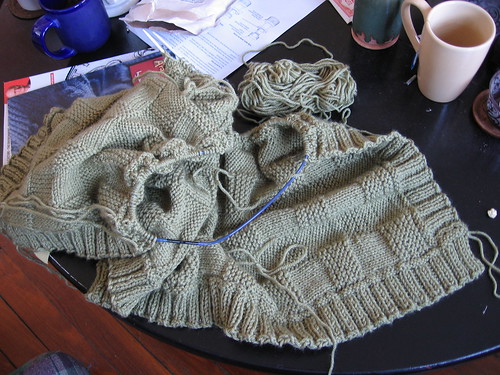
Since November, I have been working on a Collared Wrap for my mother.


It’s in a jumbled mess in this photograph, because the shawl is over 50 inches long and I’m currently doing the edges, which have probably over 300 stitches. (That sounds like a lot, but gorgeous lace shawls with teeny tiny cobweb yarn often have over 1000 border stitches). While easy to knit, it hasn’t been too enjoyable because the yarn is acrylic, (Lion Brand Vanna’s Choice-- I believe that is Vanna White’s Vanna’s Choice) and not as pleasant as wool. I would love to knit my mother something out of nice wool, but she likes to use her washing machine.

I’ve also started on a pair of Garter Rib socks for my dad out of the book Sensational Knitted Socks by Charlene Schurch (a sensational knitting book by the way because it provides charts to help you figure out the sock sizing based on your gauge). Tiny needles, tiny stitches. I have yet to knit my dad anything as a gift and I think these will be nice and useful.


*Or exercises in humility depending on your predisposition towards half-full or half-empty glasses of water.

Friday, February 06, 2009

chariots and horses

Today’s headlines worried me. Growing unemployment. Risk of deflation. As Matt and I consider buying a house this spring, the prospect of losing a job or of deflation are troubling. Suddenly the solid ground of good education, strong work ethic and prudent financial management seems shaky. And with that comes the hope that this economic recession will humble us and remind us where our provision truly comes from.

Thursday, February 05, 2009

the humble social activist and the humble civil servant

Social activists annoy us because they can be so full of it. They tote around their Adbusters magazines, walk in their Blackspot sneakers, wearing thrift store rags like some halo of righteousness. (Sort of like the guy who won’t stop talking about how he doesn’t own a television set)

Unfortunately, the profession naturally lends itself to pride. Being a social activist generally entails that you think you’re right and the rest of the world is not.

So how do we practice humble activism? How do we go about believing that what we stand for is true, while still acknowledge the limitations of our knowledge? How do we go on acting on issues that we care about deeply, while still being open to the possibility that we might be wrong? What would that look like? Would we be so seized with uncertainty that we could not do anything at all? Or, would a more humble spirit emerge? (One that is less concerned with being right and more concerned about loving others)

~

I wonder what happens to people as they climb up the ranks of prestige, power and wealth. In the Senate Banking Committee, it was testified that the treasury may have overpaid by $78 billion for troubled assets in its first round of investments of the TARP Program. How do you mess up $78 billion dollars? I may have overpaid for a shirt from a consignment shop, but that was $10 too much, not $78 billion. But perhaps at those amounts, the numbers cease to be real, especially when you’re sheltered within the comfort of prestige and power.

How does it feel to manage $800 billion? Do you feel confident and smart because only the best and the brightest could ever climb so high in the ranks of government? Or do you move forward with fear and trembling and much prayer?


* I use the word “we”, which seems to imply that I consider myself a social activist. However, I don’t really identify myself as a social activist because my accompanying action seems lacking. All talk, no action. However, Kalle Lasne would argue that words do matter—so perhaps I am just uncomfortable with my hypocrisy.

Saturday, January 31, 2009

I'm just trying to keep up with the trendy topics

Just like everyone else, I have something to say about what our first lady is wearing.

As a knitter, a sewer (the kind that makes things with fabric as opposed to the kind that harbours strange smells and rats), and someone who is attempting to dress better, I appreciate beautifully-designed and well-made clothing. And I appreciate the privilege of being able to choose what I wear in the morning.

That being said, it frustrates me how the media expects Mrs. Obama to wear a new outfit everytime she attends a public function. I would be delighted to see our first lady repeat a prior outfit for her appearances.* Not everyone can, nor needs to, buy something new for every new party, conference or fundraiser. And perhaps if people wore more of the same outfits to these events, we’d talk less about what people wore and more about what the event was about. (Is it frustrating for Mrs. Obama that people seem to talk more about her clothes than what she's accomplished or what she is going to do as the first lady?)

It is sad when so much public effort is dedicated to anticipating, observing and criticizing appearances. Does it say something about our country that we care more about inaugural ball gowns than economic stimulus packages? But to be honest, it’s more interesting to look at pictures of Michelle Obama’s clothing and comment on whether or not I like it, than it is to read the full text of the economic stimulus bill and try to figure out whether or not it will work. I guess I never said I wasn’t part of the problem. Back to knitting I suppose?


*And obviously, given the amount of media attention around her outfits, I would love to see Mrs. Obama buy and wear ethically-produced clothing. She already seems intent on supporting smaller, local designers and I would love to see the same enthusiasm for fair-trade, union-made or cooperative-made clothing.... My opinions are so predictable, aren’t they?
** And related to my previous entry, I am thrilled that Obama called the $20 billion worth of Wall Street bonuses shameful. We need to return towards an ethic of integrity and responsibility towards one another, rather than lowering ourselves to the least common denominator of legality.