Friday, March 13, 2009

America's welfare state

“the species of oppression by which democratic nations are menaced is unlike anything which ever before existed in the world… multitude of men… incessantly endeavoring to procure the petty and paltry pleasures with which they glut their lives…”

“That power is absolute, minute, regular, provident and mild… It seeks on the contrary to keep them in perpetual childhood: it is well content that the people should rejoice, provided they think of nothing but rejoicing. For their happiness such a government willingly labors, but it chooses to be the sole agent and the only arbiter of happiness: it provides for their security, foresees and supplies their necessities, facilitates their pleasures, manages their principal concerns, directs their industry, regulates the descent of property, and subdivides their inheritances – what remains, but to spare them all the care of thinking all the trouble of living… It does not tyrannize, but it compresses, enervates, extinguishes and stupefies a people, till each nation is reduced to be nothing better than a flock of timid and industrious animals, of which the government is the shepherd.”

~ Alexis de Tocqueville, Democracy in America, 1835

“…everyone wants to be free; everyone wants to eat… Everyone does indeed want to be free: free from bureaucratic control, free from burdensome taxation, free to exercise and enlarge the area of private enterprise. Everyone does indeed want to eat: the poor want welfare, the aged want security, the ill and the handicapped want medical care, parents want education for their children, consumers want protection.. The rich, too, want to be fed. They believe in private enterprise and delude themselves that corporations are somehow private rather than the product of very special privileges granted by the state and to be enforced by the state… When coal miners are in trouble they recommend government takeover. When railroads and airlines are in trouble they persuade the government to subsidize them, at least the bankrupt ones… We have developed not only a welfare state with all of its bureaucracy for the poor, but a welfare state for corporations and business interests as well. Clearly the most completely socialized ingredient in our economy is not the poor who are on welfare, but the complex that President Eisenhower first publicly identified as the military-industrial, which we can now see embraces as well labor, banking, the scientific community, and the academy. If these want governmental protection and aid, as clearly they do, they must take for granted big government, big bureaucracy and centralization. Those who yearn to diminish the powers of government must learn to lower their expectations from government, to restrain their demands on nature, to temper their insistence on endless growth and progress that is almost entirely material.”

~ Henry Steele Commager, Commager on Tocqueville, 1993


*I’m really scraping as far as blog posts are. I just can’t bring myself to write anything. I did, however, like my husband, cave in and start a twitter account. I have yet to determine whether or not I will update it regularly or whether or not I like the whole affair. It feels all a bit too suspiciously trendy to me, but perhaps 150 character posts will be more palatable to my creative tendencies. It also fondly reminds me of those good old AIM profiles and away messages I used to check. I guess Twitter is its syndicated version.

Monday, March 09, 2009

the inflection is near

I feel like I haven't posted anything substantial here in awhile. In any case, Thomas Friedman wrote an excellent Op-Ed in the New York Times about this recession marking an inflection point in the way that we think about the economy. (I suspect that you've already read it since it's currently Number 1 on the popularity list for "Most emailed"). Perhaps in the future, we will no longer measure the health of the economy in terms of growth, but rather in terms of flow (sustainability and reproduction). Friedman has a way of finding witty little catchphrases and analogies to describe current events, which for some reason I find annoying, despite the fact that they are generally intelligent and helpful in explaining the matter at hand. Perhaps I am jealous :P

In any case, now that I am done rambling, here are some notable excerpts from the article:

Let’s today step out of the normal boundaries of analysis of our economic crisis and ask a radical question: What if the crisis of 2008 represents something much more fundamental than a deep recession? What if it’s telling us that the whole growth model we created over the last 50 years is simply unsustainable economically and ecologically and that 2008 was when we hit the wall — when Mother Nature and the market both said: “No more.”

“We created a way of raising standards of living that we can’t possibly pass on to our children,” said Joe Romm, a physicist and climate expert who writes the indispensable blog climateprogress.org. We have been getting rich by depleting all our natural stocks — water, hydrocarbons, forests, rivers, fish and arable land — and not by generating renewable flows.

“We are taking a system operating past its capacity and driving it faster and harder,” he wrote me. “No matter how wonderful the system is, the laws of physics and biology still apply.” We must have growth, but we must grow in a different way. For starters, economies need to transition to the concept of net-zero, whereby buildings, cars, factories and homes are designed not only to generate as much energy as they use but to be infinitely recyclable in as many parts as possible. Let’s grow by creating flows rather than plundering more stocks.

Sunday, March 01, 2009

speedy swallowtail shawl

It’s been hard, but I’m trying to rely less on knitting patterns. Browsing blogs and ravelry and knitting magazines, I am always finding pattern after beautiful pattern that I would like to knit. It's much easier to follow a pattern without thinking, than it is to try to design something on my own..

But I'm trying to challenge myself to design my own patterns. To do the tedious swatching, the fussy calculations and force myself to learn the basic architecture of different garments instead of relying upon printed instruction. My hope is that it can move my knitting more away from the realm of passive consumption (more patterns, more books, more yarn) to the realm of active engagement and creation.*

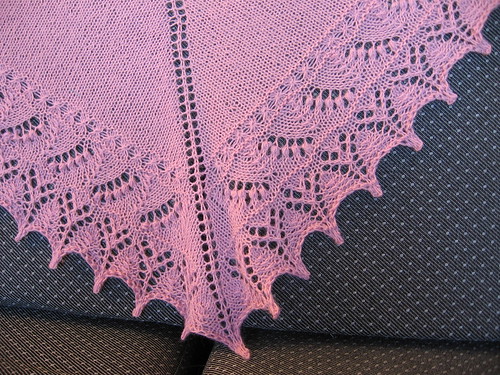
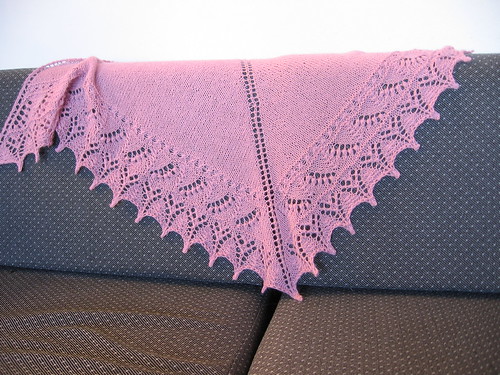
So here’s my first design-- though to be honest, it’s really just a pattern alteration. More photos can be found on its ravelry page. My grandma has been very sick in the hospital and I needed something quick to knit up to give to her as a gift. Taking inspiration from Ysolda’s Ishbel, and the Wool Peddler’s shawl, I kept the majority of this shawl plain, but added in the border and edging from the Swallowtail Shawl, a row of gathered stitches (inspired by the Miranda Triangle Shawl from Knitted Lace of Estonia) and some garter rows for distinguishing the different patterns. I thought this would take me atleast a month but I finished in about 10 days! Thanks to season 1 of Star Trek and my need for distraction from my ongoing crisis about what to do with my life.

The pattern instructions are below. In order to follow them, you also need to download the Swallowtail Shawl pattern from Evelyn Clark's website.

Gathered stitches (worked over 3 stitches)
K3tog but do not slip these stitches from the left needle, yo, then knit the same 3 stitches together again, then slip all 3 stitches from left needle. (From Knitted Lace of Estonia)

Follow Swallowtail instructions up until the end of row 6. Be sure to place marker where indicated on the chart.

Starting row 7:
On all RS rows: Knit 2, YO, Knit until Marker, YO, slip marker, Knit 1 (center stitch), YO, knit until last 2 stitches, YO, Knit 2.
On all WS rows: Knit 2, Purl until last two stitches, knit 2

Knit until you reach 207 stitches, ending on a RS row (207 stitches - 1 middle stitch + 103 stitches on each side)

Next WS row: knit 2, purl 1, knit until 2 before the marker, purl 1, purl 1 (center stitch), Slip marker, purl 1, knit until 3 from the end, purl 1, knit 2

RS row: Knit 2, YO, Knit until Marker, YO, slip marker, Knit 1 (center stitch), YO, knit until last 2 stitches, YO, Knit 2.

WS row: Knit 2, Purl until last two stitches, knit 2 –> you should end with 211 stitches (1 middle stitch + 105 stitches on each side)

RS row: Knit 2, YO, knit 2, make gathered stitches until 2 stitches before the marker, knit 2, YO, slip marker, knit 1 (center stitch), YO, knit 2, work gathered stitches until the last 4 stitches. Knit 2, YO, knit 2. --> you should end with 215 stithces (1 middle stitch + 107 stitches on each side)

WS row: Knit 2, purl until last two stitches, knit 2.

RS row: Knit 2, YO, Knit until Marker, YO, slip marker, Knit 1 (center stitch), YO, knit until last 2 stitches, YO, Knit 2. --> 219 stitches

WS row: knit 2, purl 1, knit until 2 before the marker, purl 1, purl 1 (center stitch), Slip marker, purl 1, knit until 3 from the end, purl 1, knit 2

RS row: Knit 2, YO, Knit until Marker, YO, slip marker, Knit 1 (center stitch), YO, knit until last 2 stitches, YO, Knit 2. --> 223 stitches

WS row: Knit 2, Purl until last two stitches, knit 2

You are now ready to begin the Lily of the Valley Border 2. You should 223 stitches on your needles. The chart has you working the pattern over 219 stitches to begin with. In order to adjust for the extra four stitches in each row, knit an extra stitch in the following places in the chart:
- After the first YO
- Before the YO right before the center stitch
- After the YO right after the center stitch
- Right before the last YO

Purl these extra stitches on the wrong side row and place them in the same locations on the RS row.
The pattern will not be noticeably different.

After completing Lily of the Valley Border 2, you should have 243 stitches on your needles.

RS row: Knit 2, YO, Knit until Marker, YO, slip marker, Knit 1 (center stitch), YO, knit until last 2 stitches, YO, Knit 2. --> 247 stitches

WS row: knit 2, purl 1, knit until 2 before the marker, purl 1, purl 1 (center stitch), Slip marker, purl 1, knit until 3 from the end, purl 1, knit 2

Now you are ready to begin the Peaked Edging chart. You will have 247 stitches on your needles instead of 239 as called for in the pattern. In order to adjust for the 8 extra stitches, make the following adjustments. It helps to mark it on your chart—it will make it a lot more easy to understand.

All WS rows: just purl the extra stitches.

For rows, 1, 3, 5, 7 and 9 of the chart, knit 2 extra stitches:
- After the first YO
- Before the YO right before the center stitch
- After the YO right after the center stitch
- Right before the last YO

From rows 11, 13, 15, work additional stitches as following:
- Knit one extra stitch after the first YO
- Knit one extra stitch after the first sk2p
- Knit one extra stitch before the sk2p right before the center stitch
- Knit one extra stitch before the YO right before the center stitch
- Knit one extra stitch after the YO right after the center stitch
- Knit one extra stitch after the sk2p right after the center stitch
- Knit one extra stitch before the last sk2p of the row
- Knit one extra stitch before the last YO of the row.

This adjustment will make the peaked edging slightly wider on the side and center peaks, but is not very noticeable.

For the RS row before the bind off,
K2, yo, k9, yo, k1, *yo, k7, yo, k1; repeat from * until 11 stitches remain, yo, k9, yo, k2.

Bind off as indicated in the pattern.


*This is not to say that I won’t knit any commercial patterns at all—in fact, there is still a lot I need to learn from them and I will probably still rely heavily on them—but I need to delve into them deeper and understand them better. What exactly distinguishes the different cast-on techniques? How does a short row work? How does this pattern writer construct a sweater? What are alternate ways to do it?
** Speaking of exercises in futility, Yarn Harlots’ multiple attempts at casting on the 600+ stitches for the Miranda Triangle Shawl can only make me cringe. I would have given up after try #2. I still have not had the heart to unravel my rasta fari hat.

Saturday, February 21, 2009

out of ideas

So... it’s the usual link posts, because I’m out of ideas for blog posts, aside from my usual ranting about Wall Street. Perhaps it’s time to give up on idea blog posts and convert this to a full fledged knitting blog? Wouldn’t my blog title “Look at this Tangle of Thorns” be equally applicable? Then again, I've received quite a collection of Mike Davis books for my birthday, which may provide some much-needed blog inspiration.

In any case, I have been collecting these links for a month or so, so some of them may be outdated.

As the Stanford Group’s $8 billion investment fraud was exposed the other day and Madoff’s ponzi scheme remains fresh on our minds and Wall Street’s excesses continue to anger us, this quote from Franklin D. Roosevelt seems appropriate:
“A man who has never gone to school may steal from a freight car, but if he has a university education, he may steal the whole railroad.”

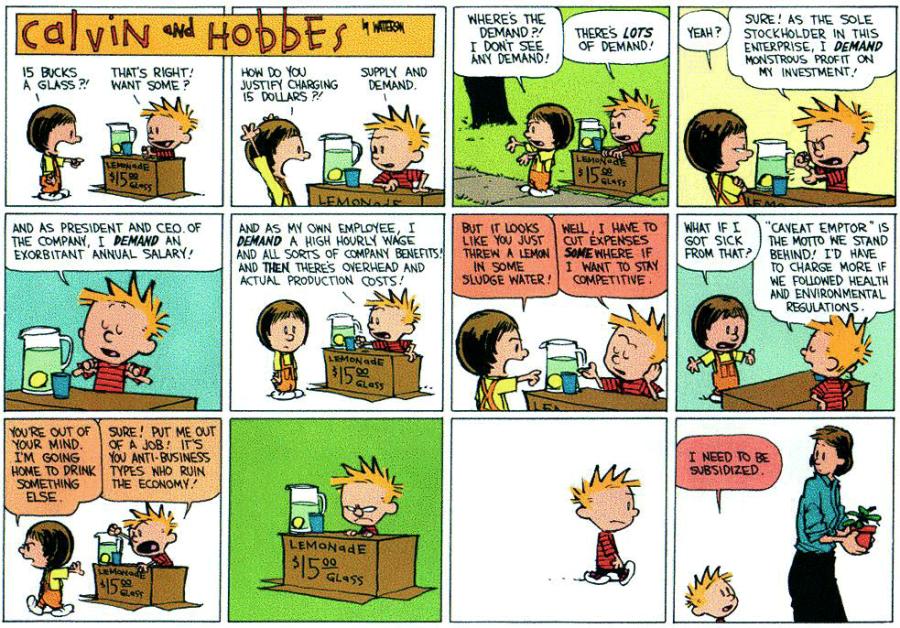
But what better way to describe the American economy than a Calvin and Hobbes comic strip?

However, I do believe, aside from our Dick Fulds and Bernard Madoffs, there are plenty of other people who deserve to be punched in the face.

On a side note, I’m glad Caroline Kennedy did not get nominated to Senator. Kathleen Parker accurately describes my sentiments: “The real rub is that she hasn't earned it. The sense of entitlement implicit in Kennedy's plea for appointment mocks our national narrative. We honor rags-to-riches, but riches-to-riches animates our revolutionary spirit.

Borrowing words from the Oscar-nominated movie The Curious Case of Benjamin Button that I didn’t like so much, “Nothing lasts”. It’s unfortunate that good things don’t last forever. White Dog Café, a model restaurant for socially-responsible business practices was sold earlier this January. While most news sources report a rosy, PR-friendly story, other sources indicate otherwise. I'm not sure if I will be eating there again.

Likewise, this site illustrates the transformation of the organic food industry over the years—as small businesses end up being acquired by large corporations.

But nothing lasts also means that George W. Bush is no longer president. So instead of complaining about what a horrible president he was, we can now remember with endearment his unique patterns of speech.

Oh my gosh! It’s a utility knife for knitters! And I just got it for my birthday thanks to my hubby!

Speaking of hubbies, for those of you in the midst of wedding planning, this blog documents one couple's $2,000 wedding. It also might be nice to determine to see if your interior decorating styles match up and whether or not you want to have children and invest in a few good cookbooks. And if you really want to feel cool at your wedding, you can hire paparazzi to mob you.


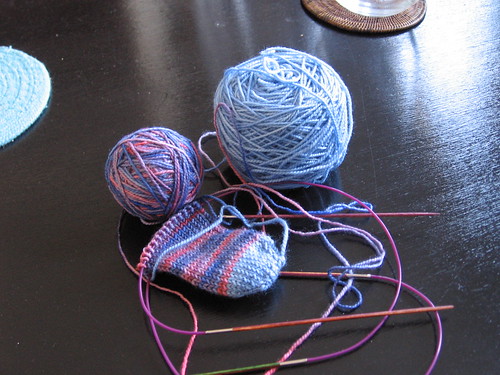
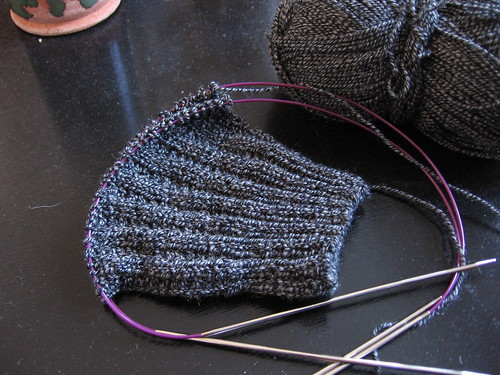
* Knitting details. Two sets of socks. The grey speckled pair above is a pair of Garter Rib socks from Charlene Schurch's Sensational Knitted Socks for my dad. I am fretting that I will run out of yarn. The blue/pink pair of socks are a set of baby socks, loosely based on Two at Once, Toe Up sock pattern. I am using size 0 needles and koigu yarn, which has some of the most beautiful colorways that I have ever seen. I am also fretting that the final socks won't fit. How big are newborn baby's feet anyways?

Thursday, February 12, 2009

the life and death of great american corporations

ramblings on the economy

“Around one in ten US companies disappears each year. Between 1989 and 1997, to be precise, an average of 611,000 businesses a year vanished out of a total of 5.73 million firms. Ten per cent is the average extinction rate, it should be noted; in some sectors of the economy, it can rise as high as 20 per cent in a bad year. According to the UK Department of Trade and Industry, 30 per cent of tax-registered businesses disappear after three years. Even if they survive the first few years of existence and go on to enjoy great success, most firms fail eventually. Of the world’s 100 largest companies in 1912, 29 were bankrupt by 1995, 48 had disappeared* and only 19 were still in the top 100.”


In these hard economic times, I doubt it’s any consolation to know that capitalism has been characterized by innovation and failure at the micro-level and cycles of boom and bust at the macro-level.

But we should still remember that it’s not all bad news.* Many of us still have jobs (and are feeling more thankful for them than we ever have before.) It’s also encouraging to see the nation shifting away from consumerism, but the accompanying layoffs are troubling.

That’s the complicated part about fighting against consumerism-- every purchase links back to a job. (And likewise for sweatshops). We stop buying and companies start hurting, which in it of itself doesn’t bother me, but then the layoffs begin. And while this recession has been hard-hitting for well-educated financial professionals, it is still the most hurtful for the least educated and the most vulnerable in our society. (I can’t seem to find the article, but basically decline in employment has affected high school diploma-less men the most).

Bankruptcies and layoffs in a capitalist economy that champions creative destruction technically shouldn’t be something we fear. Nevertheless, when the destruction doesn’t just affect legal entities and the pocket change of the rich, but begins to leave many without jobs, then we do need more consolation than “It’s just the nature of capitalism. Boom and bust. We just have to wait it out.” (“Collateral damage” for a “cyclical adjustment” perhaps? It will just be a matter of mathematical calculations before the supply and demand curves reshift.)

How many days or years or decades of waiting before you can get back on track with your life?

I hope that as we wait out this recession, we will actively care for those who are most vulnerable. I hope that while we may be cautious with our spending, that we can still be generous with our giving. And I hope that as we are trying to fix the economy, we’re building something more sustainable and just, rather than just patching up something that was never that great to begin with.


* Interestingly enough, the longest-existing institutions in our day have been nonprofit organizations such as universities…
** For instance, Amazon is still doing okay and so is Wal-Mart, which obviously makes me happy since you all know how much I love and adore and worship Wal-Mart.

Monday, February 09, 2009

opium of the masses

Whenever we talk about money, we always end up asking, How should we organize the economy? –or even, What economic system should I support? “At the moment,” we explain, “I may not be using money the way I should, but when the new system (whatever it may be) is instituted, when the general money problem is solved, I in turn will become just.

Thus we subordinate moral and individual problems to the collective problem, to the total economic system. If a man is a thief, it is not his fault; his economic conditions were such that he could be nothing else. Let us beware. If we accept this excuse on behalf of a poor person, we must accept it for everyone. Both the capitalist who exploits workers and the farmer who dabbles in the black market are also involved in impersonal economic conditions which leave them no options. As soon as we accept the supremacy of global concerns and of the system, as soon as we agree that material conditions remove our freedom to choose, we absolve all individuals of all responsibility for their use of money.


… human nature (with its lust for money) is corrupting the system. And that is why it is horribly wrong to believe that the problem of money can be solved by a system. It is horribly wrong thus to cheat man’s hopes and thirst for virtue and honesty. “You want justice? Then establish my system.” This is the error of all committed economists and others who think they can solve the problem without considering human nature.

But it is more than an error: it is also hypocrisy and cowardice. For then I ultimately ask no more than to believe the system-builder. It is so convenient. I don’t have to think about what I do. I don’t have to try to use my money better, to covet less, to quit stealing. It’s not my fault. All I have to do is campaign for socialism or conservatism, and as soon as society’s problems are solved, I will be just and virtuous- effortlessly.


But all this activity is a justification for avoiding personal decision making. My money? My work? My life? I don’t have to worry about them because I am involved in such-and-such a movement which will take care of all that for everyone once it comes to power.

~ excerpts from Jacques Ellul's Money and Power

Sometimes you just stumble upon the right book at the right time. Providential perhaps?

Saturday, February 07, 2009

exercises in futility*

Ohhh knitting, you are such an exercise in futility. I spend hours upon hours knotting you with gentle care and love, eagerly anticipating the beautiful final product and then you let me down. And I must resign myself to the fact that I will have to pull out all those individually placed loops and roll you back into a ball.

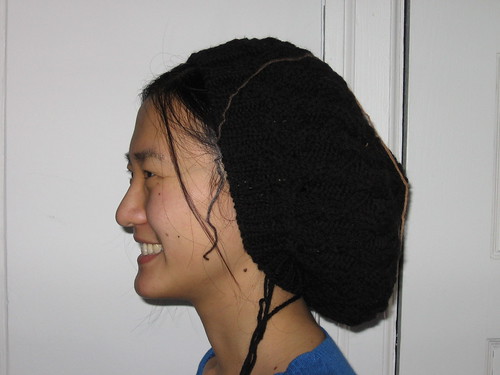
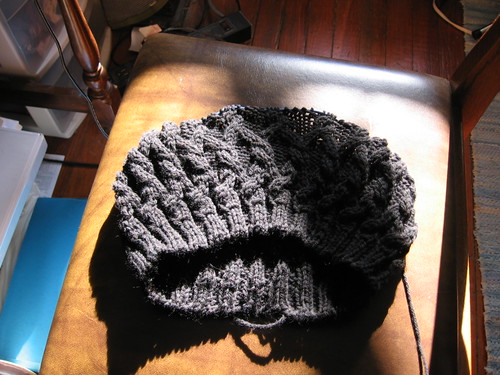
My most recent failure: remember the lovely cabled hat that I was excited about? Well, it turns out that it’s just a tad too big and looks like a rasta hat.

So…. whenever I can muster up the courage to unravel it, I will have to reknit it with smaller needles, but I don’t think I have the persistence to do that before warm spring days roll around. So I will be taking a nice long break from it.

Knitting requires quite a bit of unraveling to fix stitch or sizing mistakes. Luckily, most knitting can be undone and redone, but it can be quite frustrating to spend hours working on something, only to discover that it has to be undone and redone again. Unfortunately, making mistakes doesn’t go away as you become a more seasoned knitter (atleast not in my experience). In fact, I rarely complete a knitting project without some unraveling and re-knitting. I suppose it builds character.

So after a failed project that has required quite a bit of concentration, I’ve been unmotivated to embark on anything new. I’ve been trying to finish up some simple part-tedious, part-relaxing gifts.

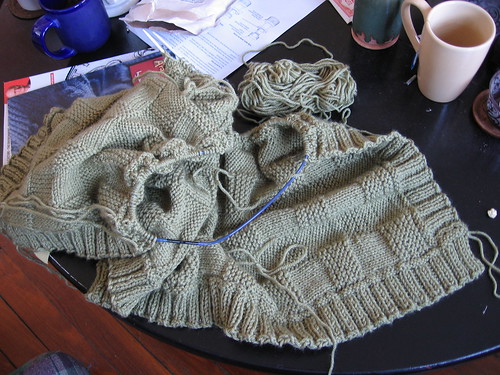
Since November, I have been working on a Collared Wrap for my mother.


It’s in a jumbled mess in this photograph, because the shawl is over 50 inches long and I’m currently doing the edges, which have probably over 300 stitches. (That sounds like a lot, but gorgeous lace shawls with teeny tiny cobweb yarn often have over 1000 border stitches). While easy to knit, it hasn’t been too enjoyable because the yarn is acrylic, (Lion Brand Vanna’s Choice-- I believe that is Vanna White’s Vanna’s Choice) and not as pleasant as wool. I would love to knit my mother something out of nice wool, but she likes to use her washing machine.

I’ve also started on a pair of Garter Rib socks for my dad out of the book Sensational Knitted Socks by Charlene Schurch (a sensational knitting book by the way because it provides charts to help you figure out the sock sizing based on your gauge). Tiny needles, tiny stitches. I have yet to knit my dad anything as a gift and I think these will be nice and useful.


*Or exercises in humility depending on your predisposition towards half-full or half-empty glasses of water.

Friday, February 06, 2009

chariots and horses

Today’s headlines worried me. Growing unemployment. Risk of deflation. As Matt and I consider buying a house this spring, the prospect of losing a job or of deflation are troubling. Suddenly the solid ground of good education, strong work ethic and prudent financial management seems shaky. And with that comes the hope that this economic recession will humble us and remind us where our provision truly comes from.

Thursday, February 05, 2009

the humble social activist and the humble civil servant

Social activists annoy us because they can be so full of it. They tote around their Adbusters magazines, walk in their Blackspot sneakers, wearing thrift store rags like some halo of righteousness. (Sort of like the guy who won’t stop talking about how he doesn’t own a television set)

Unfortunately, the profession naturally lends itself to pride. Being a social activist generally entails that you think you’re right and the rest of the world is not.

So how do we practice humble activism? How do we go about believing that what we stand for is true, while still acknowledge the limitations of our knowledge? How do we go on acting on issues that we care about deeply, while still being open to the possibility that we might be wrong? What would that look like? Would we be so seized with uncertainty that we could not do anything at all? Or, would a more humble spirit emerge? (One that is less concerned with being right and more concerned about loving others)

~

I wonder what happens to people as they climb up the ranks of prestige, power and wealth. In the Senate Banking Committee, it was testified that the treasury may have overpaid by $78 billion for troubled assets in its first round of investments of the TARP Program. How do you mess up $78 billion dollars? I may have overpaid for a shirt from a consignment shop, but that was $10 too much, not $78 billion. But perhaps at those amounts, the numbers cease to be real, especially when you’re sheltered within the comfort of prestige and power.

How does it feel to manage $800 billion? Do you feel confident and smart because only the best and the brightest could ever climb so high in the ranks of government? Or do you move forward with fear and trembling and much prayer?


* I use the word “we”, which seems to imply that I consider myself a social activist. However, I don’t really identify myself as a social activist because my accompanying action seems lacking. All talk, no action. However, Kalle Lasne would argue that words do matter—so perhaps I am just uncomfortable with my hypocrisy.

Saturday, January 31, 2009

I'm just trying to keep up with the trendy topics

Just like everyone else, I have something to say about what our first lady is wearing.

As a knitter, a sewer (the kind that makes things with fabric as opposed to the kind that harbours strange smells and rats), and someone who is attempting to dress better, I appreciate beautifully-designed and well-made clothing. And I appreciate the privilege of being able to choose what I wear in the morning.

That being said, it frustrates me how the media expects Mrs. Obama to wear a new outfit everytime she attends a public function. I would be delighted to see our first lady repeat a prior outfit for her appearances.* Not everyone can, nor needs to, buy something new for every new party, conference or fundraiser. And perhaps if people wore more of the same outfits to these events, we’d talk less about what people wore and more about what the event was about. (Is it frustrating for Mrs. Obama that people seem to talk more about her clothes than what she's accomplished or what she is going to do as the first lady?)

It is sad when so much public effort is dedicated to anticipating, observing and criticizing appearances. Does it say something about our country that we care more about inaugural ball gowns than economic stimulus packages? But to be honest, it’s more interesting to look at pictures of Michelle Obama’s clothing and comment on whether or not I like it, than it is to read the full text of the economic stimulus bill and try to figure out whether or not it will work. I guess I never said I wasn’t part of the problem. Back to knitting I suppose?


*And obviously, given the amount of media attention around her outfits, I would love to see Mrs. Obama buy and wear ethically-produced clothing. She already seems intent on supporting smaller, local designers and I would love to see the same enthusiasm for fair-trade, union-made or cooperative-made clothing.... My opinions are so predictable, aren’t they?
** And related to my previous entry, I am thrilled that Obama called the $20 billion worth of Wall Street bonuses shameful. We need to return towards an ethic of integrity and responsibility towards one another, rather than lowering ourselves to the least common denominator of legality.

Wednesday, January 28, 2009

where’s my $100 million bonus?

Nonprofits get criticized all the time for being inefficient. Our sector is told that we must operate more like for-profits so less money gets wasted.*

So shall we go off and buy jet planes with our donor money? Citigroup did it. Or why don’t we renovate our executive offices with crystal chandeliers and mahogany furniture? Former Merill Lynch’s former CEO certainly thought that doing so would improve his productivity. Or why don’t we give our employees exuberant bonuses? It’s the only way we can make sure they will return to work.

Our sector has had its share of scandals and has not always used donor or government money responsibly, but hardly do we emulate the excesses of Wall Street even in its post-bailout days.** We may sometimes shuffle around paper and spend tons of time trying to get organized (most likely because we’re not funded sufficiently to invest in the proper infrastructure and technology!), but we do a lot with a dollar. And even if every dollar that goes to a nonprofit doesn’t go directly to paying for a bed for a homeless man, it’s at least providing a job and a salary to an employee.

There’s a fear that if more money goes towards “administrative costs”, some nonprofit employee is getting rich. Let me assure you this is rarely the case. Most employees at nonprofits are hardly paid enough for the work that they do, and almost any nonprofit organization stretches each dollar for the maximum benefit possible. Every Fed-Ex mailing, every new printer toner, every maintenance repair is questioned and cut back if possible. Nonprofits can be penny pinching extraordinaires. Buildings with broken roofs, lack of air conditioning, and old donated computers are commonplace.

Wall Street suggests far more wasteful spending and inefficiency than the nonprofit sector. Maybe Wall Street can learn some frugality from the nonprofit sector.

Done rant. (Yes, I have been ranting about Wall Street A LOT. I’ve been meaning to stop, but they just keep doing things that make me angry.)


* Lots of donor advisory articles and websites, such as Charity Navigator tell you to look at the infamous “administrative” vs. “program” expense ratios. The underlying message: Nonprofits should be spending money on program, and not on administrative expenses, because they need to be more efficient with their donor dollars.
** Though this doesn't surprise me -- I remember from my consulting days how we enjoyed food, booze, nice hotels and fancy parties on company dollars, without a thought as to whether we were using shareholder's or our client's dollars responsably. The indoctrination starts at an impressionable age.

Monday, January 26, 2009

a simple twist

how can anyone resist a well-formed cable?
In my first few months as a knitting newbie, I saw my mother-in-law knitting cables on a sweater. Having only knit shapeless charity sweaters and scarves, the cables looked incredibly complex and difficult to me. Much to my surprise, my mother said that they were rather easy and encouraged me to try making the same sweater. So I did. After an hour or two of intense concentration, I was pleasantly surprised to see the same beautiful aran cable pattern emerging:
And that is the wonder of cables, and most knitting in general—beautiful, complex-looking but often only a matter of following instructions to create. As some say, knitting requires learning two types of stitches, and the rest is just a matter of counting. Or to borrow the words of former President George W. Bush, it’s not “rocket surgery”.

Cables are made when stitches are knitted out of order—creating the effect of twisting or traveling strands. Many store-bought sweaters, especially the J. Crew and Gap variety, feature simple cables.

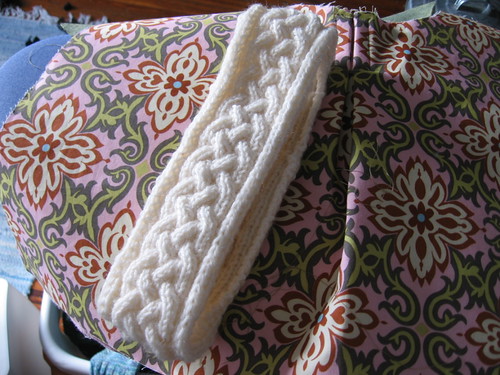
For those of you who would like further eye candy, here are samplings of cable designs that go beyond the Gap/J.Crew/Express variety:And for those of you who do knit (I don’t know how many people who read this blog actually knit…I know that I’ve tried to teach a few people who read this blog how to knit in a rather imposing and imperial fashion…), here are some useful tutorials:As for free cable patterns, the Knit for Kids Aran Sweater that I first made was a bit on the complex side for a beginner, but still doable. However, if you're looking for a shorter project, I would recommend trying a headband, a simple scarf or some fingerless mittens. The headband pictured below may also make a good first cable project, but it's not a free pattern. I used the Cabled Headband pattern from the book Knitter's Book of Yarn.**


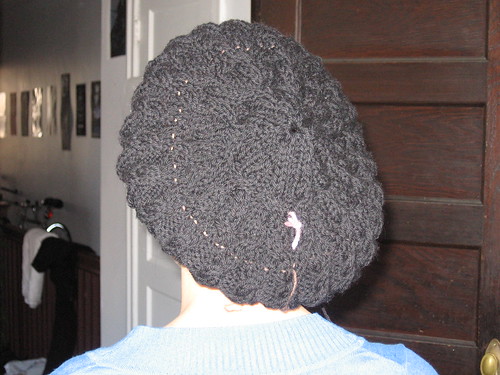
* The black beret is knit with size 8 needles in Cascade 220 100% wool, based on the pattern Gretel
**
The book is actually available from the Philadelphia Public Library, (if any branches still remain open...). I knit this on size 3 needles using Brown Sheep Nature Spun Worsted Yarn. You may see me sporting this around Philadelphia. It looks a bit like a halo because my head is so round.
*** On a side note, does anyone have good recommendations on how to post photos in blogger? I'd like to show more images on my knitting posts but can't seem to get around the annoying blogger interface...

evaluating just wars

This post was conceived earlier this year. Posting it now seems a bit outdated as the Gaza conflict has faded from the headlines, but then again, war and violence continue and so our discussion about their justice must also go on.

In this LA Times opinion article, writer Etgar Keret of the "The Girl on the Fridge and Other Stories,” responds harshly against the proportionality principle. The writer was responding to those who argued that Israel’s main injustice was not in retaliating, but in responding out of proportion. (This Economist article suggests something of that sort, but comes down a bit harsher on Israel).

Is there anything in the proportionality principle that can rationally justify killing of any kind?

The motives of vengeance, which drive us to kill those who have killed people we love, are completely irrational, even if we try to wrap them in rational packaging. We exact vengeance because we hate and are hurting, not because we excel in mathematics and logic. Early in the aerial bombing of Gaza, five young girls from the same family were killed, and many more children have died on both sides of the border in recent years. The attempt to introduce their bodies into an equation that would make their deaths justifiable or comprehensible might be necessary to influence current events, but it is still enraging.

The only equation I can wholeheartedly accept is one whereby zero bodies appear on either side of the equation. And until that time comes, I'll choose outcry and protest that appeal solely to the heart. I shall reserve my appeals to the mind for better times.

Walter Wink wrote over ten years earlier in Engaging the Powers:

Most Christians assume that any war that they feel is just, or merely necessary and unavoidable, is just. The just war criteria, however, are extraordinarily demanding. They presuppose that no Christian should be involved in a war unless it meets all or atleast most of the criteria. The burden of proof is always on those who resort violence.
We can easily kill oppressive rulers, but doing so makes us killers. We want to believe in a final violence that will, this last time, eradicate evil and make future violence unnecessary. But the violence we use creates new evil, however just the cause.

The problem is not merely to gain justice but to end the Domination System. Those engaged in a struggle for liberation may actually achieve a relatively greater degree of justice for their side, yet do so in a way that fails to address the larger issues of patriarchy, domination hierarchies, ranking, stratification, racism, elitism, environmental degradation, or violence. In the struggle against oppression, every new increment of violence simply extends the life of the Domination system and depends on faith in violence as a redemptive means. You cannot free people from the Domination System by using its own methods. You cannot construct the City of Life with the weapons of death. You cannot make peace – real peace- with war.
But we also cannot condemn those who in a desperation resort to counter violence against the massive violence of an unjust order. We must wish them success, even if they are still caught in the myth of redemptive violence themselves. Who knows? Perhaps their victory will usher in a better society able to divest itself consciously of some of its oppressive elements.

A nation may feel that it must fight in order to prevent an even greater evil. But that does not cause the lesser evil to cease being evil. Declaring a war just is simply a ruse to rid ourselves of guilt. But we can no more free ourselves of guilt by decree than we declare ourselves forgiven by fiat. If we have killed, it is a sin, and only God can forgive us, not a propaganda apparatus that declares our dirty wars “just”. Governments and guerrilla chiefs are not endowed with the power to absolve us from sin. Only God can do that. And God is not mocked. The whole discussion of “just” wars is sub-Christian.

Sunday, January 25, 2009

subjecthood vs. objecthood

towards an ethic of integrity
(unfinished*)

I’ve ranted for quite some time about the need for integrity in our professional lives, which has become more evident with the recent economic crisis. Our society has functioned by obeying the letter of the law, with no regard for its spirit. We do what is legal, not what is right.

Martin Buber, a Jewish theologian, provides a principle that may be used to establish a framework of integrity. He describes two modes of relating with word pairs in his book I and Thou. The word pair “I-You” “establishes the world of relation”, which involves encountering the other as a subject, whereas the word pair “I-It” treats the other as an object, a thing to be experienced. This can apply to any sort of relationship, including between human and nature, and between human and God. In Buber's words:

The Life of human beings is not passed in the sphere of transitive verbs alone. It does not exist in virtue of activities alone which have some thing for their object.
I perceive something. I am sensible of something. I imagine something. I will something. I feel something. I think something. The life of human beings does not consist of all this and the like alone.
This and the like together establish the realm of It.
But the realm of Thou has a different basis.
When Thou
is spoken, the speaker has no thing for his object. For where there is a thing there is another thing. Every It is bounded by others; It exists only through being bounded by others. But when Thou is spoken, there is no thing. Thou has no bounds.
When
Thou is spoken, the speaker has no thing; he has indeed nothing. But he takes his stand in relation.

Buber’s "I-Thou" relation suggests Jesus’ bold command to “Love your neighbour as yourself.” To love another as ourselves, we must first behold another as ourselves, not just another thing to serve us. (And Buber later suggests that the “I” in the “I-It’ relationship is not as fully “I” as the “I” in the “I-Thou” relationship. To be fully “I”, we must fully behold “Thou”)

Our modern life is ordered to maximize the “I-It’ relationships and to avoid the discomfort of “I-Thou”. We buy from anonymous employees of large multi-national corporations, sit in front of the plasma screen to receive our daily dose of information and entertainment and travel by enclosed climate-controlled vehicles. Commodification is the theme of our generation and perhaps its most insidious impact is not obscuring people with things, but turning people into things. And as such, we have lost integrity in the professional world and failed to nurture authenticity in life.

How would this past year differ if we had aimed to treat others as subjects, instead of objects in our professional life? "I-Thou" instead of "I-It". The recognition of a common humanity, of the image of God.

Yet the implementation of “I-Thou” does not merely entail treating people we encounter extra nicely, it goes deeper. To fully redeem relations between people, social institutions that structure the relationships between people also require reform. “I-Thou” relationships cannot be created by some elusive ideal social institution, they ultimately require personal transformations. But institutions can be structured to enable “I-Thou” relationships to be more easily established and realized. Could slave-owners, even the really nice ones, truly have been in an “I-Thou” relationship with one of their slaves? Could a CEO making millions of dollars a year truly treat a minimum wage worker in his company as a “Thou”? Could I ever treat a homeless man on the street as a “Thou” rather than an “It”? We do not meet each other in a vacuum—an entire societal structure props up our encounters.

Whether we are traditionals who don’t want to throw out the baby with the bath water, or revolutionaries who’d like to burn everything, or reformers who value gradual change, we should seek to reshape society, its culture and its institutions, so that “I-Thou” can flourish, and integrity and virtue can be recovered.


* I keep a Word document on my computer named dl_MONTH with unfinished blog entries. “DL” stands for “delete later,” suggesting that I will finish using the notes and delete the document. Scrolling through my unwieldy 24-page document, I find this prospect unlikely and am contemplating a less misleading name for the document. In any case, I am attempting to polish up and post some of these unfinished blog entries and atleast reduce the number of pages in the file. Funny enough, I recall having tried this once before without much success—the more reliable alternative is to save the unfinished “DL” file as BlogIdeas_2008 and start a new file called DL. Rinse and repeat!

Friday, January 23, 2009

knitting blog?

Sometimes the knitting bug hits hard and all I want to do is stay at home on the couch, watching some illegally downloaded TV series (LOST or Ugly Betty perhaps?), with my fingers wrapped in yarn.

I might write good reports or interesting blog entries, but nothing compares in quality with the satisfaction of creating fabric. From one dimensional string to two dimensional cloth to three dimensional garment. The pleasure of physical creation is embedded in each stitch of this seemingly repetitive and mundane activity.

I’ve been knitting for over two years and can now handle almost any pattern (aside from extremely thin lace-weight yarn and complex colourwork), and am becoming comfortable with the structure and math that goes into making garments. I find myself daydreaming about being a knitting designer—sitting at home producing patterns and then running around the countryside taking photos, and keeping a knitting blog of course. (Though to be honest, it may be another year or two before I will be able to design something on my own).

Perhaps my love of knitting has grown in recent months, because I finally sense that I might actually be good at something. While my previous delusions of writing grandeur have resulted in the beginnings of silly fantasy novels that I will never show anyone, atleast I have a few hats, socks and sweaters to show for this. But then you also have to wonder if this impractical activity is just a distraction from figuring out more important matters, like what I am actually going to do with my life.

But in the meantime, a few practical matters:
1. Should I start posting more pictures and information about my knitting/sewing projects on this blog? This could result in frequent posts cluttering up your blog feeds with flash photos of awkward poses, strange blogger formatting and chatter about what needles were used and how delightful the yarn was. Or, should I start a separate knitting blog? I fear that would imply too much of a split between my brain and my body… but I may be willing to sacrifice idealism for the sake of practicality and retaining readership (!)…
2. Crochet/Knitting group at my place on Monday night! Please figure out how to contact me if you’re interested. You’re welcome to come if you don’t know how to knit or crochet and would like to learn. You can also come if you’re male.

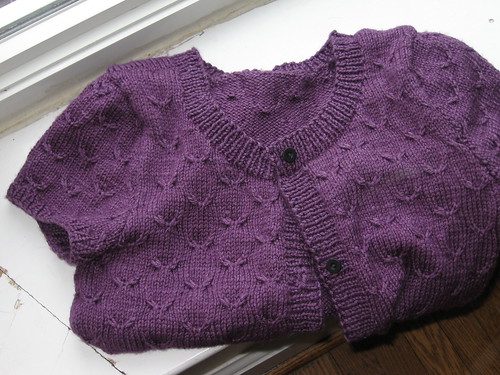
*The cardigan above is from the pattern Cherry, knit with Rowan RYC Silk Wool DK on size 4 needles.

Thursday, January 15, 2009

I posted this excerpt from Walter Wink's Engaging the Powers a few weeks ago as a response to a comment on my entry on afflicting the comfortable. With Obama's inauguration coming up, it's been on my mind:

God did not create capitalism or socialism, but there must be some kind of economic system. The simultaneity of creation, fall and redemption means that God at one and the same time upholds a given political or economic system, since some such system is required to support human life; condemns that system insofar as it is destructive of full human actualization; and presses for its transformation into a more humane order. Conservatives stress the first, revolutionaries the second, reformers the third. The Christian is expected to hold together all three.

Friday, January 09, 2009

lazy blogger

These link posts are the easiest blog entries to produce. Then again, posts consisting entirely of quotations from books are also easy to produce. Perhaps if I continue this trend, I will start twittering, facebook status-ing and then I will need to take this seminar in order to re-writer’s block myself. (I compile these links and comments over time, so some may be a bit outdated):

2008 marked the demise of Wall Street and the humbling of the proud. Mr. Madoff’s ponzi investment scheme further reminds us that we need better monkeys. Meanwhile, rich folk who have lost lots of money may need better matchmakers.

Not that any of this short-term profit-driven excess should surprise us, since we’ve turned a blind eye to corporate abuses for years. In particular, wage theft has been in the rise as the economy tightens. We don’t just need a federal bailout, but an ethical bailout as well.

Until the 111th new Congress passes ethical bailout legislation, let’s read dystopic novels about how the world will end. Some suspect this is already happening:

  • Argentina is experiencing a chronic moneda (coin) shortage. (oh no!)
  • Though some experts fear stagflation (oh no the seventies!), inflation on a standard basket of Christmas goods (based on the 12 days of Christmas) has gone up by 8.1 percent this past year (oh no! inflation!)
  • Colleges need to reconsider tuition rates and how much parents are subsidizing their children’s extracurricular activities (oh no! Penn's only all-freshman all-Californian all-opera-style a capella group won't get its annual funding from the university!)
  • Publishers continue to advance large amounts of money to the likes of Sarah Palin (oh no!)
  • Some are beginning to declare the end of the hipster (oh no! no more irony!)
While some things in this world may change dramatically, other things stay the same. It makes me sad when a man with as much power and influence as Blago could still be hungering for more. But there is hope for those who find themselves hitting rock bottom after climbing high on the ladder of power and influence. Maybe Blago will do something useful with his life after all of this-- maybe he will land a book deal like Joe the Plumber or a Slate column like Eliot Spitzer. America is the land of opportunity!

I’ve only talked about economics and politics and endtimes so far. Looking for something more light hearted? This website chronicles ugly prom dresses. It’s bound to keep you entertained for hours, or atleast a few minutes. If you’re looking for something unexpectedly beautiful, check out these toilet paper wedding dresses. And this knitter suggests some accessible classical music that you can listen to while you endlessly surf the web...

Thursday, January 08, 2009

whoever fights monsters...

... should see to it that in the process he does not become a monster.

~ Fredrich Nietzsche

~

Conquerors have all through history been conquered by those they conquer. Joseph Goebbels, Hitler’s propaganda minister, proved either a shrewd student of history or a prophet when he reputedly said, “Even if we lose, we shall win, for our ideals will have penetrated the hearts of our enemies.”

~

World War II, many still feel, was a just, or atleast a necessary, war. Nonviolence as a means for settling international disputes is so recent—an international nonviolent movement (apart from the “peace churches”) dates only from 1914- that the means were simply not in place inside and outside Germany to mount an effective nonviolent alternative. It may well be that in ten or fifteen years we will be more prepared to respond to conflicts with an international outpouring of nonviolent resistance. So perhaps there was, tragically, no alternative at that time to war.

The point I am making is that even if a war does appear to be just, or atleast tragically necessary and unavoidable, it will inevitably require that relatively more just opponent (if there be such) to become increasingly molded into the likeness of its adversary. The greatest evils are usually perpetrated by people determined to eradicate an evil by whatever means necessary. War is not, then, a mere continuation of diplomacy by other means, as Clausewitz claimed. It marks the abject failure of diplomacy, and the adoption of means that have very little likelihood of achieving desirable ends.

~

“The ultimate weakness of violence is that it is a descending spiral, begetting the very thing it seeks to destroy”

~ Martin Luther King

~

Some of us engaged in struggles for social justice have been incredibly naïve about what has been happening to our own psyches. Our very identities are often defined by our resistance to evil. It is our way of feeling good about ourselves: if we are against evil, we must be good. The impatience of some activists with prayer, meditation and inner healing may itself represent an inchoate knowledge of what they might find if they looked within. For the struggle against evil can make us evil, and no amount of good intentions automatically prevents it from happening.

~

No wonder so many people, gentle and kind people, quiet and unaggressive people, find themselves saying at long last: “There’s only one way to deal with the Marcoses and Enriles. There’s only one way to deal with the Khmer Rouge. There’s only one language these people understand – we say it not joyfully, but reluctantly and sadly—the only thing they understand is the gun.

To such people I say: Welcome home, welcome to the largest consensus the world has ever known: a consensus between east and west, between capitalist and communist, between mosque, church and synagogue. All agree that there comes a time when it is just to kill each other. Welcome home to the consensus on which our world is built.

Ultimately we are faced with two choices: to accept the “myth” of the just war, that as a last resort killing is moral, or to accept the ”myth” of nonviolence: we have no last resort, killing is never right. In the first case, we will come to the moment when the conditions for using violence are verified, when we reach the “last resort”. In the second case, believing in our “myth”, that violence is never justified, having no “last resort,” human beings come up with alternatives from the depths of their creativeness… We can and we will learn to live together, but only when we have closed off that escape route known as the last resort”

~ Niall O’Brien, “Making the Myth Real”

~

All of the above text, including quotes, are from the chapter “On Not Becoming What We Hate” in Walter Wink’s Engaging the Powers (Published in 1992). (Is the history of the world but a narrative of violence where right and wrong is determined by the victors? I suppose the answer is not so simple.)

Tuesday, January 06, 2009

no man's land

Terra nullius. From the Latin terra, earth, ground, land, and nullius, no one's
Thus: no one's land, land not belonging to anyboyd. Or at any rate, not to anybody that counts.
Originally: land not belonging to the Roman Empire.
In the Middle Ages: land not belonging to any Christian ruler.
Later: land to whcih no European state as yet lays claim. Land that justly falls to the first European state to invade the territory.

~ excerpt from Terra Nullius

I am not familiar enough with the Israel/Palestine history to have a strong opinion on the current conflict, but in watching the violence escalate, I am reminded of the near impossibility of forgiveness and redress for land appropriated and lives lost. It reminds me of how deeply our world is still rooted in the power of violence and how much of our world was established on the basis of dispossession.

We can condemn Israel's aggression (or defense, depending on your viewpoint) and condemn Hamas' terrorism, but we also need to be reminded that we have all benefited from violence. And when blood is shed and homes are displaced, it is not always easy to say who is more right or who is more just.

A re-posted excerpt from Terra Nullius, regarding the theft of land from Aborigines in Australia:

According to my Religious Education teacher in at secondary school, ‘contrition’ is at the core of all religions. It’s easy to make mistakes. Anybody can make mistakes, even commit crimes. The important thing is knowing how to feel contrition afterwards. That was why he began every lesson with the same question: ‘What constitutes contrition?’ To this day, I can still rattle off the answer in my sleep:
I realize I have done wrong.
I regret what I have done.
I promise never to do it again.
Today I tend to think these three criteria for contrition are far too introverted. ‘Realize’, ‘regret’ and ‘promise’ can all be done internally, in complete secrecy, without betraying any outward sign of realization of promise. Such an internal contrition process is precious little comfort the victim of the wrong I committed. And the promise is easily forgotten if nobody knows it was made. So the criteria should demand a more public process of contrition. Perhaps like this:
I freely admit that I have done wrong.
I ask forgiveness of those I have wronged.
I promise to do my best to make amends to them.
Here, the third criterion promises not only that I will not repeat the crime, but also that I will make efforts to put things right to the best of my ability. For the victims, redress is the most tangible result of my contrition and a measure of sincerity.
Can we feel contrition for other people’s crimes? Can we feel contrition for crimes we have not committed personally, but have subsequently profited from? How can we formulate the criteria for contrition to make them applicable to collective responsibility for historical crimes? Perhaps like this:
We freely admit that our predecessors have done wrong and that we are profiting from it.
We ask forgiveness of those who were wronged and of their descendants.
We promise to do our best to make amends to those who were wronged for the effects that still remain.
The larger the collective, the more diluted the personal responsibility. The less intimate the contrition, the greater the risk that it will just be hollow ceremony. A representative steps forward on our behalf, admits the wrong committed, apologizes, pays what it takes and appoints a committee to ‘monitor our practices’.
Australia isn't even doing that.

Thursday, January 01, 2009

lists*


I've been digging through boxes of my old diaries, photos and other knickknacks while at my parent's house. They are planning to sell their house in California, so I am trying to throw away more of my stuff stored at their place. Actually, this is not a new activity for me. I go through these boxes twice a year in my semiannual family visits in an attempt to cut down on the pamphlets and trinkets I've collected over the years. Every year, the vast majority of these inanimate objects end up back in their boxes because they are attached to some event or person-- I am afraid that if I throw the stuff away the memories will disappear along with them. I let go of these objects by photographing them. Yet this time, even after photographing old Playbills and movie stubs, I still stuffed a few travel brochures and postcards back into a box for old time's sake. Though I've managed to whittle down the contents of two dressers, two bookshelves, and two closest full, 12 boxes remain as a testament to my packrat qualities.

In glancing through my old diaries, I noticed several “year in review” entries at every New Year’s, birthday and even diary-end. (I used to personify my diaries, like Anne Frank, except I would name them after crushes—some parts of my past are perhaps better forgotten). I would write long reflections about the prior year and interpret my personal life themes. I abandoned that practice of self-contemplation and reflection towards the end of college. But 2008 was an important year, a milestone year in my nearly quarter-of-a-century long life, so perhaps I will inaugurate the new year with some lists.

memories of 2008 (the good, the bad and the ugly):
altar cloth scorch marks.
moving speeches from fathers.
nights climbs by flashlight up rocky slopes.
shiny kitchen gadgets.
warm tights.
hardwood floors, drafty windows and sunlight.
American citizenship and voting.
Martin Buber.
20,000 at 52nd and Locust.
Wall-E.
Phillies World Series Win.
Alan Greenspan.
Sarah Palin.
$700 billion dollars.
Bear Stearns, Lehman Brothers and many others… R.I.P.
$4 gas and $1.50 gas.
Foreclosures
Casino zoning in Philadelphia Chinatown.

hopes and dreams for 2009:
daily journaling and prayer (though I’ll settle for three times a week)
read read read write write write (and actually make submissions!)
knit knit knit sew sew sew
more blogging with more photos
using dried beans instead of canned beans
figure out what to do with my life
a growing awareness in our culture of institutional/systemic guilt and responsibility
executive compensation caps
a better economic system
world peace and an end to hunger and poverty
finish writing our wedding thank-you notes
finding a good pair of black flats
start practicing pilates again (I think the odds are for world peace over this)


* As a result of reading William Zinsser’s On Writing Well, I would like to make a concerted effort to write better. I will be experimenting with different writing styles so my entries may be hit or miss in the next while.