Showing posts with label books. Show all posts

Monday, August 10, 2009

I am falling behind (2nd quarter + July books reviews)


I have read around 10 books in the last quarter + July and have failed to keep up with the reviews after I read them. Buying a house, going on tour to Europe and moving may have had something to do with it. But now I am backlogged, so I will be brief.*

I had briefly considered abandoning the practice of reviewing books, but for an unapologetic skimmer like me (my favourite justification “It just wasn’t worth my time to read more closely”—blame it on the Twitter pace of contemporary life), this is critical in helping me retain atleast some small fraction of what I read.

Sociology/History
**** Forgive and Remember (Charles Bosk) ~ I was delighted to discover that one of the judging criteria (atleast according to Wikipedia) of an ethnography is “aesthetic merit”. While this book is not primarily aesthetic, it is a well-written and compelling scholarly work. It is an ethnography of surgeons-in-training, with a focus on medical error—which errors are considered normative and forgiven, and which errors are not. Bosk also reflects on his research methodology and choices.
** The Protestant Ethic and the Spirit of Capitalism (Max Weber) ~ This is perhaps one of the most quoted and most famous works of social science. Unfortunately, it can be tedious and dense to read as Weber traces the development of the spirit of capitalism from the protestant understanding of work and labour. He spends quite a bit of time explaining the different religious sects of Protestantism, setting up his question and justifying his conclusions. His most compelling chapter is the final one, entitled, “Asceticism and the Spirit of Capitalism”, which traces the transformation of the protestant work ethic into its modern secular instantiation.
*** The Overworked American (Juliet Schor) ~ An approachable, mostly statistics-based analysis on American work habits over the past century. Schor demonstrates that American work hours, both at home and at the workplace, have increased. Though most households have appliances such as washing machines and microwaves designed to save time, Americans now spend more or the same amount of time on housework as they did before. And generally speaking, most employees will prefer higher pay as compensation rather than more flexible or reduced hours. In addition to making these observations, Schor provides reasonable explanations: higher standards (e.g. cleanliness etc...), labour market competition, corporate incentives and consumption habits.
**** White Collar: The American Middle Classes (C. Wright Mills) ~ As always, I enjoy C. Wright Mills. In White Collar, he explores the transformation of America’s middle class from small property-owners or entrepreneurs to white collar workers, cogs in the bureaucratic corporate machine. The introduction is absolutely fantastic to read. The rest of the book is more methodical, but remains enjoyable, informative and thought-provoking. Mills describes the old middle class, the bureaucratic structures of corporations, common white collar professions, but also reflects on the changes in the meanings of work, success and status.
**** The Illusion of Freedom and Equality (Richard Stivers) ~ This book is extraordinarily well-written, easy to read and understand. Yet because of the subject matter, it requires rereading to fully absorb the extent of Stivers’ ideas. Stivers traces the transformation of Freedom and Equality as conceived by 18th century thinkers to its modern day conception. I considered trying to summarize his book in my own words, but using some of his chapter sub-headings would be more helpful. Freedom and Equality as the Modern Ideology: Freedom as Consumer Choice and Abundance, Freedom as Individual Right, Freedom as Technological Possibility, Plural Equality, Cultural and Communicative Equality. The Reality of Freedom and Equality: Freedom as Forced Consumerism, Freedom as Legal Process, Freedom as Technological Necessity, Equality as Group Conformity and Competition, Equality as Uniformity.
**** The Cold War (John Lewis Gaddis) ~ An excellent, well-written and balanced book about the cold war. Gaddis manages to be honest about America’s numerous failures and shortcomings without idealizing other countries or cultures. Gaddis also ties chapters together with thematic interpretations rather than chronological ordering. I found this book enjoyable to read and informative for someone who usually finds history books boring.
** People of Plenty: Economic Abundance and the American Character (David M. Potter) ~ The beginning half of this book addresses the difficulties in assessing and describing “national character”. The second half explores how the specific characteristic of economic abundance has affected some aspects of American character. Potter indicates that his analysis is only a sampling and by no means comprehensive. He explores how the nation’s economic abundance affected democratic ideals, social mobility and consumption practices. The book’s ideas are well-thought out and fairly interesting, but there were several sections that were a bit tedious to read.
*** Organization Man (William Whyte) ~ Written in the 1950s, this book is a classic study of American middle class conformity. Whyte describes the organization man—his aspirations, his training, his workplace and his residence of choice—the suburbs. Whyte’s journalist background is evident—the book reads well, with the exception of the first section, a theoretical reflection on individualism and conformity.
*** The Power Elite (C. Wright Mills) ~ Mills describes the various cross-sections of the American elite. He explores each group’s characteristics, but focuses mostly on the influence they have in decision-making. Mills particularly highlights the close connections between corporate, military and executive power as well as the gridlock of Congressional, representative government. He asserts that most decisions that affect American lives, are made without democratic assent.
*** The Body Project: An Intimate History of American Girls (Joan Jacobs Brumberg) ~ A historian explores the changing attitudes of girls towards their bodies by reading diaries from the 1830s to the present day. Brumberg particular highlights how girls’ relationships to their bodies were once primarily mediated by their family and relatives, while now it is mostly affected by the media and their peers.

Christian
*** Courage and Calling: Embracing Your God Given Potential (Gordon Smith) ~ I read this book over a 24-hour women’s retreat and remember that it was calming and reassuring in my never-ending struggle to figure out what to do with my life. If I remember correctly, the book explored the idea of vocation—that God calls us to specific tasks (not necessarily in the form of career) in different seasons of our life.
*** The Biblical Vision of Sabbath Economics (Ched Myers) ~ A set of essays on economics in God’s kingdom, reflecting particularly on what regular debt forgiveness and repatriation of land would mean in today’s society. It’s nothing out of the ordinary, but it’s an excellent introduction for those interested in the topic.

Fiction
? Chronicle of a Blood Merchant (Yu Hua) ~ Sometime in April, I felt compelled to read a novel about China. There was nothing available in English so I picked up Chronicle of a Blood Merchant in Chinese, because the author Yu Hua, is known to write in very simple Chinese. Yu Hua’s other novel, To Live, which has been adapted into a movie, is one of the most depressing books I have ever read. So far, Chronicle is much more light-hearted, though not as good…. Then again, I haven’t finished reading it yet… and I’m not sure when I will. I guess I will re-review it later.
** Persepolis (Marjane Satrapi) ~ This graphic novel narrates the childhood of a girl living in Iran during the political unrest of the 1970s to 1980s. I wanted to like the novel but to be honest, I was disappointed. If this wasn’t a graphic novel written about Iran by a female, I doubt it would have gained quite as much acclaim. The story is simple narration via a child’s perspective. I found it interesting from a factual and historical perspective, but did not find it emotionally moving. It reminded me of Art Spiegelmann’s Maus, a graphic novel about the Holocaust, but not quite as compelling.

* After completing these reviews, I noticed that very few of them were actually brief. Once I started, I guess I couldn’t stop. But I did use the same words over and over again: "enjoyed", "well-written", "tedious" etc...
** Enough with the computer screen, off to read and contemplate. I am currently munching on: Habits of the Heart.

Saturday, April 04, 2009

another first quarter


I noticed that every book I’ve read this quarter is one that I physically own. Our post-marriage bookshelf (or more appropriately, our bookshelves plus random piles of books), are a gold mine, especially after Christmas, birthdays, routine trips upon my insistence to the Last Word Bookstore and a year of using Paperbackswap. Two books are missing from this photo because they are at my office. I’ve started keeping personal books at my office, because there’s really no space in our current apartment. Sigh. (Wait, three books are missing. I suppose one has just been misplaced....)

Seeing all these books stacked on top of one another reminds me of how much I love the physicality of books—the binding, the texture of the cover, the smell of the pages. Hannah Arendt describes the printed book as the “transformation of the intangible into the tangibility of things,” something that is lost in the gadgetry of Kindles and the liquid crystals of internet text. From Christine Rosen’s People of the Screen:

As he tried to train himself to screen-read—and mastering such reading does require new skills—Bell made an important observation, one often overlooked in the debate over digital texts: the computer screen was not intended to replace the book. Screen reading allows you to read in a “strategic, targeted manner,” searching for particular pieces of information, he notes. And although this style of reading is admittedly empowering, Bell cautions, “You are the master, not some dead author. And that is precisely where the greatest dangers lie, because when reading, you should not be the master”; you should be the student. “Surrendering to the organizing logic of a book is, after all, the way one learns,” he observes.

So for now, no Kindle for me. Let me submit to the mastery of the printed text! I’m already susceptible to skimming. Besides, I don't get along with gadgets-- I drop my cell phone frequently and lose it for days on end...

In any case, in the past, I usually review books right after I read them. This time around, I procrastinated and ended up writing most of these in the last two weeks, so they may be a little lacking in quality. At the very least, I hope they can give you an idea of what the book is about and whether or not you might want to read them. Italicized books are the ones that I did not finish.

Rating scale from Goodreads
* didn’t like it
** it was ok
*** liked it
**** really liked it
***** it was amazing

Fiction

* or ** The Tin Drum (Gunter Grass) ~ I wanted to like this book, as it’s been compared to two of my other favourites: Salman Rushdie’s Midnight’s Children and Gabriel Garcia Marquez’s One Hundred Years of Solitude. With a trip to Europe planned for the summer, I was also excited to learn about Poland and Germany, as the novel recounts a midget drummer’s childhood and coming of age during the Nazi’s rise and fall of power. But what can I say? I didn’t really like the book. The novel’s language lacked the narrative fluidity that made me love the other two novels (perhaps because it was originally written in German?). The novel’s surreal details were less magic realist (which resonates more with me) and more absurdist in the line of Pynchon (which perhaps because of my cultural background, doesn’t make any sense to me). The novel had several funny and/or insightful passages and I can understand why it has been acclaimed as one of the greatest pieces of German literature since World War II, but to be honest, I can’t say I enjoyed reading it very much.

*** China Men (Maxine Hong-Kingston) ~ I didn’t really get into this book as much as I had hoped. I wrote on Maxine Hong-Kingston’s The Woman Warrior as my senior thesis so I am familiar with her work and style. Hong-Kingston weaves together myth and fact as she recounts the stories of Chinese male immigrants to the United States, from as early as the gold rush and railroad construction to the 1990s. The narratives are detailed, vivid and suggest a mythical historical memory. Her descriptions of the railroad construction by Chinese men and the confusion of the Communist revolution are particularly compelling, but some of the latter stories in the novel were less interesting.

**** Beasts of No Nation ~ After reading the first chapter, I wasn’t expecting to like the book. It was very “loud”, full of yelling and violence and what you’d normally expect from a book about child soldiers. Fortunately, the book did not turn out to be the usual narrative about the horrors of war. Instead, the book explores the psychology of a child soldier amidst the violence of war. What does it mean for someone so young to kill? What does it mean to be both perpetrator and victim?

*** Black Hole (Charles Burns) ~ This graphic novel depicts the spread of a mysterious STD amongst high schoolers in Seattle in the 70s. The disease manifests itself in bizarre physical mutations—tails, mouth, peeling skin etc… The graphic novel is as much as about the initial AIDS as it is about high school social politics, isolation, boredom and rebellion. The artwork is also remarkable as the drawings are also entirely done in black and white strokes (no gray-scale). As a warning for those who are sensitive, the novel has graphic depictions of male and female genitalia.

Non-Fiction

**** On Writing Well (William Zinsser) ~ The first section of the book covers general principles for writing well, while the second section describes guidelines for specific types of writing, including business writing, sports-writing, memoir-writing etc.. The book helped me think about how I can better improve both my business writing, my blog writing and my elusive in-my-head magazine articles that have never actually been written. It is also very enjoyable and readable—much less dry than Strunk’s Elements of Style, which I don’t think I ever finished reading.

***** Engaging the Powers (Walter Wink) ~ I haven’t had a five star book in awhile, but this book definitely qualifies as such. Walter Wink writes about the domination system of the world and the spiritual interiority of institutions. Though Wink may fall on the more liberal end of scriptural analysis, his ideas concerning the spiritual core of institutions and the role they play in society, the significance of Christ’s death and the power of nonviolent action provide a much more comprehensive understanding of the world.

*** Reclaiming Capital: Democratic Initiatives and Community Development (Christopher Gunn) ~ Similar to his other book Third Sector Development, Gunn explores ways to reclaim capital for investment and use within a community. To set the context, Gunn describes the way in which capital is internationally mobile and flows to the area of greatest return. Communities who wish to attract firms often do so at their own detriment—lax labour and environmental standards or tax incentives. Frequently, firms who do locate within a community do not provide the benefits promised. For instance, Gunn assesses how little of the economic benefits generated by the opening of a new MacDonald’s restaurant are actually retained by the community. For the rest of the book, he describes the efforts of different community institutions in reclaiming capital for improving their own communities. This book is clear and well-written even for those unfamiliar with economics or development. It is an excellent introduction for thinking more critically about how capital flows in the world and how it affects different communities.

**** Slaves, Women and Homosexuals: Exploring the Hermeneutics of Cultural Analysis (William Webb) ~ Through the examination of three controversial issues in the church historically and/or currently, Webb provides a framework for “the hermeneutics involved in distinguishing that which is merely cultural in Scripture from that which is timeless." He presents a set of 18 or so criteria that can help us determine how scripture texts apply to our current context. He explains each of the criteria and then assesses the three controversial issues in his title in light of those criteria. While his final conclusions on the three controversial issues are important, the book is most valuable for providing anyone with a framework of distinguishing what is cultural and what is transcendent in scripture.

** The Financial Ascent of Money (Niall Ferguson) ~ When I read non-fiction books, I tend to get irritated at the author’s tone after about 100 or so pages. It was a bad sign when I got annoyed at the Ferguson’s writing style after about one paragraph. He writes like a slick modernist, one that firmly believes in greatness of our Western cultural and economic trajectory. However, I decided to give the book a chance and ended up reading/skimming most of it. It turned out to be okay. I expected the book to be focused on currency specifically, rather than all sorts of financial instruments. The book covers the historical development of bonds, stock exchanges, insurance, real estate and derivatives (including the crash of Long Term Capital management). Ferguson’s final chapter describes the influence of finance on the British empire and international relations, including the recent development of Chimerica (China + America). Ferguson goes into great narrative detail describing specific events and/or people—not surprising given that he is a historian. I don’t think he goes into sufficient detail in explaining how the different financial institutions and instruments work. As someone with a business education (is that an oxymoron?), it was okay for me to understand but it may be more challenging for someone who isn’t as familiar with these terms. Not bad, not great. The writer’s tone also became slightly less annoying over the course of the book. He makes a good point of indicating that despite all our mathematical models, our current form of capitalism is subject to extreme volatility—bubbles and crashes—and that history may be as important a lesson as statistics.

*** Eichmann in Jerusalem (Hannah Arendt) ~ I expected this book to be a philosophical and psychological exploration on the nature of evil, but it turned out to be more about the trial of Karl Eichmann in Jerusalem and a historical overview of his rise to power and his orchestration of Jewish deportation in each of the German-occupied nations. The book reads tediously at points, but other sections are fascinating—the Denmark resistance to Nazi orders, the significance of Eichmann’s kidnapping from Argentina by the Israeli Mossad, the desire for Eichmann’s sentence to deliver justice not just for the crimes for which Eichmann was individually responsible but for also for all Nazi crimes against Jews, and the contested fairness of a trial where the judge was Israeli and no defense witnesses were available because no former Nazi would come to testify in Israel. The last chapter provides the best overview and commentary of the trial, with a particular focus on legal and judicial philosophy. If you don’t want to read the whole book, but are interested in the ideas—I would suggest reading the last chapter.

**** Money and Power (Jacques Ellul) ~ From the title, I thought this book would be about people with money and power. However, the book could be more appropriately named the power of money. Ellul first explores wealth in the Old Testament. He examines instances when God used wealth as a reward or blessing, emphasizing that the riches were a gift and a material demonstration of God’s power. Ellul then elaborates on how Jesus completely transforms our relationship to money, especially as He becomes the “Poor One”. Why are the poor amongst us? How must we relate to them? Ellul’s final conclusions are challenging—that Christians should not be in the practice of saving or hoarding, and that everything beyond what they need should be given away. This practice allows one to be freed from serving Mammon (the system of selling and buying) and to “enter” the kingdom of God, where grace and giving reign.

** The People’s History of the United States of America (Howard Zinn) ~ I had read some excerpts from this book earlier and enjoyed them and was hoping for a insightful critique of the mainstream reading of American history. However, the book (or atleast the parts I read) seemed to list the usual liberal grab bag of events and facts combined with a hefty dose of lefty rhetoric. While a decent introduction to the injustices committed by America to its own people and to others, I don’t think the book provided any astute or significant commentary on either American history or the writing of American history.

*** Evil Paradises: Dreamworlds of Neoliberalism (Mike Davis, Daniel Bertrand Monk, editors) ~ This book is a compilation of essays on the urban and spatial developments of the wealthy in the world. I have read about half the essays-- most of them elucidate not just the stark contrast between the rich and the poor, but also the economic, social, environmental and moral cost of these “dreamworlds” to the poor and to humanity.

**** Commager on Tocqueville (Henry Steele Commager) ~ Despite a somewhat self-preoccupied and unenticing title, the book is excellent. Commager assesses American history in the last century through the set of questions raised by Alexis de Tocqueville, the famous French aristocrat who wrote about America in Democracy in America. Tocqueville primarily was concerned with democracy – especially the tensions raised between liberty, order and equality. He examines issues of slavery and justice, centralization and democracy, military vs. civil power and political equality and economic inequality in America.

Monday, December 22, 2008

book reviews last quarter 2008


I seem to be at a blank with trying to write blog entries so I decided to post my book reviews for this quarter early, though I will probably end up reading quite a few additional books in this last week of December as I will be on vacation. I'm excited about having some time to read since I have some really fascinating books lined up. A semester of assigned reading has awakened a desire for further exploration of different topics. I’m currently reading Engaging the Powers by Walter Wink as I have been reflecting on individual responsibility in systems of oppression. The book is so far absolutely fascinating….


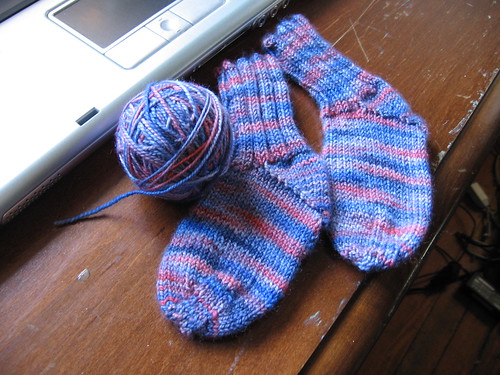
I seem to be similarly stalled with my more tangible crafting pursuits. Here's a photo of a pair of baby socks I've knit up recently for an undisclosed recipient. I have plenty of "stash" yarn still sitting around, but nothing seems to be inspiring me to knit...


In any case, here are the reviews. I use the lovely non-pretentious rating scale from Goodreads
*didn’t like it
**it was ok
***liked it
**** really liked it
***** it was amazing

Fiction

*** The Brief Wonderous Life of Oscar Wao (Junot Diaz) ~ Having studied minority and postcolonial literature in college, I’ve been wary of reading “minority fiction” since much of it follows a similar narrative format. However, after attending a very interesting reading by the author, I decided to read the book. Using references to popular American science fiction and fantasy and to Dominican culture, the book narrates the life of Oscar Wao, a nerdy boy who cannot seem to get a girlfriend. The book also traces the history of his mother and his mother’s family during the Trujillo dictatorship in the Dominican Republic. The ending was a slight letdown but by no means ruined the book. Diaz is a phenomenal writer—his style is engaging and funny and this novel is a fresh take on the traditional immigrant narrative. It is not obsessed with identity, but rather concerned with presenting a story and a history for its characters and the Dominican Republic.

*** Migritude (Shailja Patel) ~ This continues my respect for relatively unknown authors that we never see grace the display tables of Barnes and Nobles. Shailja Patel is a Kenyan poet, playwright and theatre artist. Migritude is the transcript from one of her spoken word performance peaces. In poetic form, it traces the impacts of colonialism and postcolonialism and her own migration around the world. I’m not much of a reviewer or connoisseur of poetry, but I enjoyed reading the poems very much and found the images and phrasing powerful, beautiful and memorable.


Non-Fiction

*** Theories of Development (Richard Peet and Elaine Hartwick) ~ This book presents an overview of major theories of development (a.k.a. why some countries are poor and some are rich and what to do about it)—neoclassical, sociological, dependency, feminist etc… It does an excellent job of describing the different intellectual assumptions that underly these theories and how it influences the solutions that they advocate. Throughout all of this, the authors present their own view on development. While this book is an great primer on development, it can be at times a bit dull and confusing. The authors try their best to coin the development of these different theories, but sometimes end up listing a bunch of scattered conferences, papers and ideas.

** The Mystery of Capital (Hernando de Soto) ~ De Soto argues that what prevents poor countries from becoming rich is the lack of property law that enable individuals to transform their fixed assets into capital. He explores the history of property rights in America and examines the untapped wealth owned by the poor. De Soto’s assessment of the situation may be too idealistic and overromanticizes the potential of the small micro-businesses but his book still provides an accurate assessment to one of the significant reasons why the poor are still poor.

**** Third Sector Development (Christopher Gunn) ~ This book provides an excellent overview of various third sector organizations—credit unions, community land trusts, traditional nonprofit organizations and cooperatives. It highlights their role in American society and in particular focuses on how these organizations increase and create social surplus in their communities and contribute to development efforts.

*** Culture Jam (Kalle Lasn) ~ Written by the founder of Adbusters, this book describes and critiques our consumer and marketing oriented culture in America. The book explains concepts in a conversational and easy-to-understand tone, though at times it appears to be trying too hard to be cool. In particular, the book emphasizes meme warfare, and the importance of changing American consciousness and attitudes.

*** The Meaning of the City (Jacques Ellul) ~ From Cain’s first city to the new Jerusalem, Jacques Ellul traces the role that the city plays in the Biblical narrative. He highlights the city as a symbol and source of man’s pride, the city’s significance as a work of man’s hands and its importance in the new heavens and earth. While conversational, Ellul’s style and arguments can be hard to follow at times. There were definite sections of the book that were skimmed or “zoned” out as I was reading. That being said, Ellul has some real fire in his prose and his ideas were very provocative and insightful. His Biblical exposition of the city definitely provided a better framework for how I should relate to the city.

*** Not Just the Levees Broke (Phyllis Montana-LeBlanc) ~ Phyllis Montana-LeBlanc is from a working class family whose house and home were destroyed in Hurricane Katrina. The first part of this memoir narrates her family’s experience of the disaster, including the multiple day grueling aftermath of waiting to be rescued. The remaining portion of the memoir recounts Phyllis’ emotional life after the hurricane as she copes with her trauma and continues to grow in her faith in God and love and forgiveness for others. This memoir is no literary masterpiece but it manages to be very real, moving and powerful.

Friday, September 26, 2008

book reviews (the third quarter is over already!)


Those who have visited our living room (and if you have not, you are most welcome to come visit) have noticed that we have a bit of a capacity problem as far as books are concerned.


Marriage has been a rather distressing affair as far as books are concerned—I no longer seem to know what books I have or what the books on our shelves are about. And though the books we own that I have not read are quite numerous, I always seem to want what I cannot have. So I end up borrowing books from the library instead of reading what I have on hand. But this last quarter, I’ve finally decided to dig into the books that are now overflowing onto our floors.


As a side note, I have also decided that I am tired of Amazon/Borders/B&N’s domination of the book market, and despite the fact that I have enjoyed their low prices for many years, I think I will try to buy from independent book sellers from now on. Let’s see if I can resist the 30%-40% price slashes at Amazon. (I continue to be content with Paperbackswap though the selection often isn't great)

But enough with pictures and mundane chatter, and onto the reviews. My husband complained in my last set of book reviews that he wanted a thesis for why I rated each book with the number of stars that I did. It is not that deep. I write these reviews, not to pretend to be some professional reviewer, but simply to help me remember each book, its contents and what I liked or disliked about it. In doing so, I hope to give others some guidance as to whether or not they would like to read the book themselves. I do not assess these books in terms of its quality of writing or judge them as a piece of work or a contribution to humanity or whatnot; I am merely rating my enjoyment of the book in my little subjective world. :)

Rating scale from Goodreads
* didn’t like it
** it was ok
*** liked it
**** really liked it
***** it was amazing

Fiction

**** The Road (Cormac McCarthy) ~ This book traces the journey made by a father and his son as they attempt to reach the coast. The world has been destroyed by presumably what resembles a nuclear apocalypse. Major cities were burned, nearly all vegetation and animal life were destroyed, and everything was covered in ashes. As food became scarce, violence and murder increased until even humans were far and few between. McCarthy writes very simply and very calmly, but manages to recreate the bleakness and constant fear that permeates the father and his son’s journey. His novel highlights the extremes of human depravity, explores the tensions between compassion and survival, and offers a somber picture of hope.

**** Out of the Silent Planet (C.S. Lewis)~ C.S. Lewis never fails to satisfy me. This is the first volume of his science fiction Space Trilogy, and in many ways, reverses the elements of a traditional science fiction alien civilization plot. This novel functions at many levels—a beautiful exposition of life on another planet, an exploration of human nature and fear, and a critique of modernism. (PLOT SPOILERS AHEAD). A man named Ransom is captured by two humans and taken to Mars, a planet whose civilization has not “fallen” into original sin. Unlike a traditional science fiction plot, this alien civilization is peaceful and is not intent on invading other planets, even though their own is dying. The two humans, who captured Ransom, because of their own fear (based on their own knowledge of human nature), misunderstand the alien civilization’s good intentions for the worse. One of the most poignant passages occurs at the very end, when one of the humans who captured Ransom stands before the Oyarsa defending his modernism vision of taking over other planets “for the sake of humanity”. His speech is translated into a language that is intelligible to a society that knows not war, violence or oppression. In the translation, the contradictions and foolishness of modernism are revealed.

**** Peralandra (C.S. Lewis) ~ This novel reads nothing like the typical interplanetary travel and discovery we expect in science fiction novels, but is rather intensely mythical and philosophical. This is not to say that C.S. Lewis does not describe a beautiful, enchanting and strange vision of the planet Venus— covered in water, where the patches of solid land float on the ocean like water lilies, shifting great distances and undulating according to the water movement. The main character Ransom is sent to Venus in order to play role in the “Garden of Eden” mythological equivalent. Humanity has just begun on the planet Venus, with Adam and Eve in a state of innocence, and forbidden from sleeping overnight on the “Fixed Land”. Satan has shown up as and continuously tempts “Eve” to disobey God’s order. What follows is an intense philosophical reflection on the choice presented to Adam and Even in the Garden of Eden.

** Invitation to a Beheading (Vladmir Nabokov) ~ This is one of Nabokov’s earlier works, composed in Russian and translated by his son into English. It narrates the imprisonment leading up to the execution of Cinncinnatus C., accused of “gnostic turpitude”. The novel offers commentary on totalitarianism, authority, conformity as well as the nature of fiction. I was a little disappointed with the novel—I had high expectations of the novel because it was so intriguingly described in “Reading Lolita in Tehran”. But I don’t do well with “absurd” stories, and this novel was full of irrational and crazy scenes that defied expectation and made no sense. The prose style, though suggestive of Nabokov’s masterpiece Lolita, was underdeveloped in comparison. There were a few notable passages on Cinncinnatus’s emotional reaction to the absurdity and surrealist that surrounded him, but otherwise, the novel is interesting only for the theoretical questions it poses and as a work of Nabokov, but not so much for holiday reading enjoyment.

*** Invisible Cities (Italo Calvino) ~ In this novel, Marco Polo describes to emperor Kubla Khan (spelling?) the various cities in the kingdom that he has conquered. What follows are short vignettes describing various cities, that hover somewhere in between real physical cities and ethereal metaphysical cities. Calvino seeks to describe different aspects of the personality, character and scope of cities—their changes, the way they make people interact, their relationship with other cities, with poverty, with corruption etc… This doesn’t quite carry the narrative cohesiveness or thematic clarity of say, Ray Bradbury’s Martian Chronicles. It is another case of a novel that reads better as poetry, or perhaps, as paintings or sketches. Calvino writes fairly well, and some of the vignettes are quite thought-provoking and beautiful but others resemble more frustrating art for art’s sake.

*** Atonement (Ian McEwan) ~ I was interested in reading this novel as several of my friends have absolutely loved it (and not because there’s a Keira Knightly film!). However, while I enjoyed the novel, I didn’t find myself loving it, primarily because I tend not to be that into period novels, or more “emotional” or “sentimental” fiction. I’m more into “idea” novels or novels that play with language. That being said, I will attest that the novel is very well-written. McEwan narrates his plot and characters with a melodramatic and psychological approach, that sometimes borders on humourous. I was especially amused with his descriptions of Briony, a 12-year old (?) aspiring writer who reminded me much of myself. The ending really distinguished the novel beyond a simple period piece (at times, the novel reminded me of Jane Austen)—it was surprising, moving and thought-provoking. (PLOT SPOILERS AHEAD) At the end, it is revealed the novel was written by Briony and that her sister Cecilia and her lover Robbie Turner actually both died in the war as opposed to reuniting happily in the novel. The novel serves as an atonement for what actually happened, giving her Cecilia and Robbie an opportunity to live together happily in fictive memory. “When I am dead, and the Marshalls are dead, and the novel is finally published, we will only exist as my inventions… No one will care what events and which individuals were misrepresented to make a novel. I know there’s always a certain kind of reader who will be compelled to ask, But what really happened? The answer is simple: the lovers survive and flourish. As long as there is a single copy, a solitary typescript of my final draft, then my spontaneous, fortuitous sister and her medical prince survive to love.”

***** That Hideous Strength (C.S. Lewis) ~ One of the most telling ways to determine if I have been reading a good book is to examine my reading space. Am I surrounded by little shreds of ripped paper, the remnants of make-shift bookmarks used to mark passages that I like? This certainly was the case with this book. The novel is set in England and recounts a marriage between two academics and the rise to power of the modernist organization, N.I.C.E., the National Institute for Controlled Experiments. This was probably my favourite book out of the Space Trilogy, because of its chilling portrayals of marriage, academic life and institutional life were so realistic (realistic in the sense that it touches upon the real spiritual core of these institutions, not in the sense that it is “probable” and likely to happen in this world). Despite the realism, or perhaps because of this realism, the novel also provides a brilliant exposition at the level of ideas, relating to the history of mankind, the nature of gender and the character of obedience, power and love. Couple that with humorous, sharp and yet beautiful prose, and you have one spectacular book. Read with care. Even I did and I’m the queen of skimming.

Non-Fiction

** Mindless Eating (Brian Wansink) ~ I picked up this book at the library while in California visiting my family. I skimmed through it one afternoon. It is part interesting and entertaining facts and research relating to the psychology of eating and part “easy diet”/healthy eating advice. The book provides simple ways of reducing calorie intake by taking advantage about how we psychologically relate to food. The diet/healthy eating tips were mostly common sense, but helpful to a certain extent (I have a terrible office snacking habit). Of all the research studies, I most enjoyed the experiment where participants ate day-old chocolate cake. Despite having eaten the same cake, participants who received menus that noted the cake as “chocolate cake” rated the cake taste as mediocre or poor, whereas those who received menus with “Fine Belgian Double Chocolate Cake” rated the cake as amazing and very good. Interestingly enough, in this study and many others participants always noted that they didn’t believe they would be affected by such marketing tactics.

*** Ways of Seeing (John Berger) ~ This book compiles seven (?) essays, three visual, four written relating to art history, visual studies and capitalism. I didn’t really understand the visual essays, but I did find the four written ones enjoyable and thought-provoking. The first reflects upon the different ways of seeing, and reflects upon the impact of reproduction of art on art (based on Walter Benjamin’s essay Art in the Age of Mechanical Reproduction). The second essay related to the depiction of male and female, naked and nude. The last two essays were on oil painting and its relation to capitalism and art ownership, and the role of the image in advertising. The essays were very readable and prompted thought relating to the role of economics and social class in the production of art.

** Philadelphia 300-Year History (editor Russel Weigley) ~ History has historically been my worse subject, so please be aware of my bias in this review. Despite being averse to history, I’ve recently decided to start learning more about both Philadelphia and the United States. This book assembles essays from a variety of authors and covers Philadelphia’s colonial period to around 1975. I started reading this 750 page tome (sp?) with much interest, especially in seeing how the initial plan of this city was laid out, started skimming when I reached the 18th and 19th century, and by the 20th century, I was rapidly skimming. Though the essays are decent and informative—most of them lack a strong narrative arc or argument and read more as laundry lists of facts about the development of various aspects of Philadelphia (e.g. demographics, crime, civil institutions, government reform etc…). As someone who is interested in the “spirit” of cities, this book was more just about the bones and though providing me with a few facts about the city’s history, failed to provide a cohesive vision for understanding it. Perhaps I should not expect history to be written this way, but I want to read history as a story, not a chronological date list.

*** An Introduction to Marx (Peter Singer) ~ This was an interesting and easy to understand introduction into Karl Marx’s life, ideas and influence. Singer particularly highlighted Karl Marx’s biography (his surprisingly unproletariat life), his evolution of thought, key concepts and his influences.

**** Terra Nullius: A Journey Through No One's Land (Sven Lindqvist) ~ I think sometimes I tend to be prejudiced against obscure books—thinking that most of them are probably not very good since they are not well-acclaimed or well-known. Reading excerpts from Terra Nullius for my Community Economic Development class definitely proved my prejudice wrong (To be honest-- should I really allow my reading tastes to be dictated by Barnes & Nobles?). This is a beautiful mixture of narrative and history, describing the devastating deaths and injustices that resulted from colonization. It covers the historical conquest, recent political developments and the academic study of aborigine culture. It questions the rational justifications for these actions and reflects upon what it means to make amends on an historical injustice. The novel does not follow a linear progression, but jumps from sections of a few pages each that touch upon related topics. The book is beautifully written and clear, and incredibly informative.

Monday, September 01, 2008

simulating knowledge (2)

knowledge is not knowing

If today’s institutions of higher education are the factories for the “production of knowledge,”* then the assembly lines are lined with hunched over graduate students and junior faculty, managed over by tenured professors, journal publications and academic deans. Conferences, papers, books and other publications roll off the conveyor belt into this nebulous expanse known as “knowledge”.

The research, or perhaps more precisely, the knowledge produced, is not a result of some objective process, but a product of a certain set of assumptions, procedures and methodologies that are generally accepted by the said management of the university assembly line. That is not to say that none of the research is valid, but that it is subject to assumptions and processes particular to its academic field—generally accepted principles for how to conduct research and come up with conclusions.

Likewise, the knowledge produced within the walls of the ivory tower, is not necessarily more relevant, more important or more valuable than our own “knowing” as individuals. It is easy to get caught up in the abstractions of statistics, theories and categories to the extent that they become more real than the world they were supposed to study.

Case in point in these two excerpts. Excerpt one comes from Jane Jacobs Life and Death of Great American Cities, where she recounts the recounts the then prevalent urban planning mindset of privileging park space:

When I saw the North End again in 1959, I was amazed at the change. Dozens and dozens of buildings had been rehabilitated. Instead of mattresses against the windows there were Venetian blinds and glimpses of fresh paint…

But I could not imagine where the money had come from for the rehabilitation, because it is almost impossible today to get any appreciable mortgage money in districts of American cities that are not either high-rent or else imitations of suburbs. TO find out, I called a Boston planner I know.

“Why in the world are you down in the North End?” he said. “Money? Why, no money or work has gone into the North End. Nothings’ going on down there. Eventually, yes, but not yet. That’s slum!”

“It doesn’t look like a slum to me,” I said.

“Why, that’s the worst slum in the city. It has two hundred and seventy-five dwelling units to the net acre! I hate to admit we have anything like that in Boston, but it’s a fact.”

“Do you have any other figures on it?” I asked.

“Yes, funny thing. It has among the lowest delinquency, disease and infant mortality rates in the city. It also has the lowest ratios of rent to income in the city. Boy, are those people getting bargains. Let’ see… the death rate is low, 8.8 per thousand, against the average city rate of 11.2. The TB death rate is low, less than 1 per ten thousand, can’t understand it, it’s lower even than Brookline’s. In the old days the North End used to be the city’s worst spot for tuberculosis, but all that has changed. Well, they must be strong people. Of course it’s a terrible slum.”

“You should have more slums like this, “ I said, “Don’t tell me there are plans to wipe this out. You ought to be down here learning as much as you can from it.”

“I know how you feel, I often go down there myself just to walk around the streets and feel that wonderful, cheerful street life. Say, what you ought to do, you ought to come back and go down in the summer if you think it’s fun now. You’d be crazy about it in the summer. But of course, we have to rebuild it eventually. We’ve got to get those people off the streets.”

Here was a curious thing. My friend’s instincts told him that North End was a good place, and his social statistics confirmed it. But everything he had learned as a physical planner about what was good for people and good for city neighborhoods, everything that made him an expert, told him that North End had to be a bad place.

This other excerpt comes from C.S. Lewis’s novel That Hideous Strength, recounting the mind of a sociologist:

..his education had had the curious effect of making things that he read and wrote more real to him than things he saw. Statistics about agricultural labourers were the substance; any real ditcher, ploughman or farmer’s boy, was the shadow. Though he had never noticed it himself, he had a great reluctance, in his work, ever to use such words as “man” or “woman.” He preferred to write about “vocational groups,” “elements,” “classes” and “populations”: for, in his own way, he believed as firmly as any mystic in the superior reality of things that are not seen.


* Though this I suspect is changing with the growing role of the internet. In fact, Wikipedia is still bookmarked as TRUTH on my internet toolbar.
** For awhile, I think I was doing pretty well on writing entries that weren’t entirely based on quotes. I guess I’m finally breaking that streak now. It’s hard to say things when you keep finding people who write everything you would want to write, but do it much better than you ever would.

Sunday, July 06, 2008

book reviews second quarter 2008

Married life has certainly ushered in different rhythm of life. I was hoping that with no wedding to plan anymore, I’d have more time to read, but other things (of the nature of arts and crafts, cooking and household chores) have filled that space. That being said, I am quite glad that wedding and honeymoon planning is done and over with—everything except photos and thank you notes that is. And I’m hoping to continue to make more time to read over the next little while, especially as I may be taking a class at Penn this fall, and may no longer have the luxury of reading whatever I feel like reading.

In any case, of late, I’ve been digging my elbows deep in sociology and urban studies non-fiction (prompted perhaps by Planet of the Slums and Bowling Alone), but I think I may spend the summer months with a bit more fiction. Next on the list: The Road by Cormac McCarthy, and perhaps C.S. Lewis’ Space Trilogy. Reviews are also posted on Goodreads.com.

Fiction

*** The Watchmen (Alan Moore)
Heralded as one of the best graphic novels ever, The Watchmen is a very intense and dark story of the lives of former costumed vigilantes (superheroes without superpowers). It begins with the investigation into the mysterious murder of one of them. It’s extremely well-written and well-told, but requires quite a bit of thought and attention to follow along. I won’t say too much, but I will say that the Watchmen defies the genre, by being an anti-superhero story.

** Straight Man (Richard Russo)
This book recounts a week in the life of a professor of English in Railton, Pennsylvania. It is focused on the drama of his department, the university (facing extreme budget cuts), and his family. The book is meant to be humorous, and succeeds most of the time, though sometimes the events end up being a bit absurd. It was decently/mildly entertaining to read, especially as it mocks academic culture. Summed up, the book is about: “Only after we’ve done a thing do we know what we’ll do, and by then whatever we’ve done has already begun to sever itself from clear significance, at least for the doer.” It’s nothing life changing but if you’re looking for a light, quick, funny read, and you have a soft spot for the university, this might work out well.

*** Housekeeping (Marilynne Robinson)
This is a beautifully written novel about two sisters coping with the death (apparent suicide) of their mother in the small town of Fingerbone. The prose reads like poetry and the quiet, somber, dreamy reflections on life and death weave their way into the narrative. However, that very reverie-like prose made it difficult to connect more deeply with the characters—they seemed like beautiful ghostly abstractions rather than real flesh and blood individuals (but I suspect that may be the author’s intentions). In any case, it was enjoyable to read, and perhaps can be very inspiring to an aspiring writer.

Non-Fiction

*** Bowling Alone: The Collapse and Revival of American Community (Robert Putnam)
This book summarizes substantial amounts of empirical studies on American community, which is broadly defined to include civic engagement, participation in different interest groups, church attendance, philanthropic giving, volunteering, or simply hanging out with friends. After Putnam clearly demonstrates the decline of American community since the 1950s, he spends a good portion of time investigating the various factors that may have caused it, including suburban sprawl, television, less free time, generational change etc… He spends the last few chapters on a hopeful note, mentioning the spurt in community involvement after the growing injustices of the late 1800s.
Though he didn’t leave me entirely convinced, Putnam posits a series of societal changes that could have substantial impact on community involvement, ones that are very well in the realm of possibility. Putnam does spend quite a bit of time detailing methodology, but overall the book is not technically bogged down. My favourite chapter was probably the one detailing the detrimental effects of television.

*** The Sabbath (Abraham Heschel)
Heschel is a Jewish theologian and this short book is his reflection on the role of Sabbath in Jewish religious life. The Sabbath is a day of holiness, a palace of time, a way to commune with God. While I found most of this book less applicable to me as a Christian (though it did help me start to understand better Jewish culture), the first two chapters and the last one are absolutely phenomenal. In these chapters, Heschel reflects on society’s tendency to devalue time, which it cannot so easily control, in order to acquire more of space, that which seems so much easier to possess.

**** Final Exam: A Surgeon’s Reflections on Mortality (Pauline Chen)
This is a beautifully written book by a surgeon. Chen recounts her training and her practice as a doctor, narrating the ways in which she and her fellow medical students or doctors confronted or avoided confronting death. While Chen touches upon policy-oriented issues, such as the need for palliative care, better M & M conferences, better medical training, her book reads best as a memoir of her own personal and emotional struggles. I found most moving Chen’s narrations of how she responded to a husband or a wife dying to a chronic disease, while his or her partner watched and waited. Chen writes both vividly and compassionately. This book touched me more personally than most, perhaps as I have been reflecting more on how hard it would be to lose my husband (or for him to lose me) after the recent death to cancer of a church member with a husband and young children.

**** The Death and Life of Great American Cities (Jane Jacobs)
Written in the 1960’s, Jane Jacobs revolutionized the way we viewed and studied the city. She summarizes her approach in her final chapter—cities are not to be studied as objects of simplicity (e.g. simple relationships, more open space = better neighborhoods), nor objects of disorganized complexity (e.g. statistical approaches), but are to be treated as a living organism—incredibly complex yet organized and interrelated. She advocates the “microscopic” approach to looking at the city—digging in very deeply, instead of relying on high flying theories. She concludes that the success of a city is not dependent on any single component (e.g. open space, broken windows, etc…), but on a complex interaction of various factors, which she outlines in her book.
However, for most of the book though, Jacobs rarely talks to high-brow metaphor, but remains incredibly practical, concrete, realistic and easy to understand. She relies heavily on examples from Boston, New York, Philadelphia and Chicago. She focuses on several elements that in combined, including mixed and diverse uses (e.g. commercial and residential areas mixed together), shorter blocks, ideal density and lack of large borderlands/abandoned spaces (which can be parks!), and diversity. Her book was long to read, but definitely provided me with a new framework with which to observe and understand the city.

***** Sociological Imagination (C. Wright Mills)
The first 100 pages of this book were really hard to get through, and even after that, the book was very dense and took quite a bit of effort to understand. All that being said, this has been one of the most thought-provoking and academically-inspiring books I have read in the past year. Mills was a prominent sociologist of the earlier half of the twentieth century (if I’m not mistaken, he coined the phrases “WASP” and “white collar”).
In this book, Mills criticizes the two dominant methods of studying sociology (grand theory and abstracted empiricism), and then goes on to delineate the sociological imagination—a way of studying society that factors in historical, political and individual factors, that does not get too lofty with grandiose theories and abstractions nor too mired in the numbers and statistics of abstracted empiricism. He then writes about the need for the sociological imagination in today’s society, in relation to our reason and freedom, our democracy and politics. The appendix provides some guidance on how to conduct such research. Though Mill had a few touches of elitism to him, it was so refreshing to read someone who had a vision for social sciences (and for the academy) that mandates relevance to society at large and the individual.
To summarize his stance on the subject: “Our public life now often rests upon such official definitions, as well as upon myths and lies and crackbrained notions. When many politics- debated and undebated – are based on inadequate and misleading definitions of reality, then those who are out to define reality more adequately are bound to be upsetting influences. … Such is the role of mind, of study, of intellect, of reason, of ideas: to define reality adequately and in a publicly relevant way. The educational and the political role of social science in a democracy is to help cultivate and sustain public and individuals that are able to develop, to live with, and to act upon adequate definitions of personal and social realities.

Rating scale
* didn’t like it
** it was ok
*** liked it
**** really liked it
***** it was amazing

Monday, April 07, 2008

book reviews first quarter 2008

this is my “quarterly earnings report"

(implicit question, if I were a stock, how much would I be worth?)

I thought I should post quarterly instead of twice a year, because the entries were getting a little unwieldly. Does anyone actually read through all of these? Please note that there are a few five star rated books! Given that I’m always complaining about how annoying writers’ tones are, or how I always find myself distracted because I read them on the trolley, this is something quite notable!

I’ve also stumbled upon PaperBackSwap, which allows you to mail swap paperbacks via mail with other people. I've just started using it, but it seems promising. Everytime you mail out a book, you get a credit, which you can then use to request a book to be mailed to you. I have on my way: Beasts of No Nation by Uzodinma Iweala and Money and Power by Jacques Ellul.

I follow the Goodreads (which still has horrible navigation) rating system:
* didn’t like it
** it was ok
*** liked it
**** really liked it
***** it was amazing


Fiction

** Wide Sargasso Sea (Jean Rhys) ~ I was drawn to this book when I heard about its premise—it is about Bertha, the crazy wife of Mr. Rochester who is held captive in the attic in Charlotte Bronte’s Jane Eyre. The novel explores her life in the Carribean and her subsequent existence in England, as a way of uncovering untold narratives. As fascinating the premise was, the book was disappointing. The prose was very lyrical, with a dreamy and dazed tone, which made it beautiful but also very confusing to follow. Despite the strength of the prose, the story did not seem to hold that much emotional power—though the characters were at times vivid, you never got very attached to them. Perhaps one could argue that I’ve already participated in my own oppression by adapting the preferences of the colonizer—a Western imperial taste for reason, expressed in my fondness of the straight forward narrative of Jane Eyre, instead of the fragmented structure of Wide Sargasso Sea. I’m just kidding. Let’s not read into everything.

*** Left Hand of Darkness (Ursula LeGuin) ~ This book gained critical acclaim after its publishing because it was a “thought experiment” on what a society would be like if there was no gender. In this book, Ai Genly arrives as an ambassador from the galactic federation of planets, Ekumen, to the planet Gethen, where the humans that inhabit are hermaphrodites, able to take on either gender at monthly intervals. However, the book isn’t really explicitly about gender—the genderless society only serves as a background, a quiet meditation that appears here and there, rather than a driving plot element. I found it to be much more effective that way—instead of having commentary about gender thrusted at you awkwardly, the questions and thoughts surrounding a genderless society are embedded in the narrative, and appear in your mind here and there as you read the book. The novel’s been criticized for not elaborating sufficiently on this genderless society— for instance, how does child-rearing work exactly? For me, it seemed that LeGuin was less concerned with the practical considerations, but more with the abstract impacts of not having gender (e.g. does that society think less in binaries?) In any case, this is a well-written novel concerning trust, friendship and long journeys across cold landscapes. Despite some pretty awful cover designs, this is not trashy sci-fi. LeGuin is an excellent writer and this book was thoroughly enjoyed 

*** The Time Machine (H.G. Wells) ~ I heard the entire plot of this novel before I read it, but it was still very enjoyable. Contrary to what the title suggests, the focus of this book is not on time travel, but rather a commentary on class, and economic and social structures. I don’t want to give the plot away, but it’s a quick and excellent read, and gives plenty of food for thought.

*** The Day in the Life of Ivan Denosovich (Alexander Solzhenitsyn) ~ I should not have read this book while riding on the trolley, because it probably distracted me from being more immersed in Denosvisch’s world. This book traces a day in the life of a political prisoner in a Soviet gulag. This book is not a gory sensational horror novel as it is more concerned with the mundane repetition of everyday prison life, rather than any extreme situations of abuse and punishment. Solzhenitsyn describes vividly yet subtly the hunger, the cold, and the sensations and thoughts of Ivan as he goes through his day. The book explores the psychology of a man who must endure over 3650 days, which are all more or less, variations of a single theme; the book investigates where the prisoner derives, if any, comfort and hope.

*** Undying Fire (H.G. Wells) ~ This book is H.G. Wells’ rewrite of the Book of Job. This book is extremely well-written, extremely philosophical and extremely dense. Job and his friends debate (or rather, orate) on the destiny and intrinsic nature of humankind and of God, and the purpose and role of education. It wasn’t that pleasant to read on the trolley, nor is it a particular page-turner, but it does offer some really beautiful and thought-provoking prose to the reader.

***** Bone (Jeff Smith) ~ I burned through this graphic novel (aka, fancy term for comic book)in 3 days, struggling to resist the urge to stay up until wee hours of the night in order to finish it. It is absolutely delightful! The characters are so memorable—the protagonist loves Moby Dick, the greedy Phoney Bone, a rat creature obsessed with quiche, and a talking leaf bug just to name a few. While managing to be extraordinary cute, corny and funny, the novel is also incredibly thought-provoking, particular on the subjects of relativism, cultural imperialism and power. The drawings are beautiful. The dialogue is excellent. And the story a definite page-turner—the start of the novel can be a bit slow, but hopefully the wackiness of it will keep one’s interest. Three cousins are driven out of a town which resembles something of early 20th century and stumble into a valley that appears to be from the middle ages, complete with vicious rat creatures who are searching for one of the cousins and a mysterious guardian dragon who always seems to appear at just the right moment, and then disappear. Think Disney meets Lord of the Rings.

Non-Fiction

** How Luxury Lost its Luster ~ I probably shouldn’t review this book, as I’ve never actually been in possession of it. I read or skimmed through about 50-70 pages of it while going to Barnes and Nobles at lunchtime. In any case, the book traces the development of the luxury brand corporations, all the while lamenting the loss of fine artisan craftsmanship that once characterized brands like Louis Vuitton or whatnot. The author focuses a lot on the founding of various large fashion corporations, and the profit-driven motives that led them to become the mass market giants that they are today. While presenting plenty of information, the author ends up jumping around a lot and listing tons of dates, events and people without drawing a compelling narrative (a similar weakness of Fast Food Nation). However, what was more annoying was the author’s own snobbishness about conspicuous consumption, as she constantly laments that the luxury products once finely made for the aristocrats are no longer available. She’s ultimately still interested in upholding the social status that luxury brand products can confer to their owners, rather than dissolving the mystique and the power that they hold over us. In any case, maybe worth skimming but definitely not worth buying, and for me at this point, probably not worth hunting down from the library.

*** The Sandman Papers ~ As much as I enjoy reading literary criticism, sometimes this book reminded me of why the English department in universities seem mostly useless to me—petty debate and interesting observations that never seem to actually answer any questions. The wrong questions are asked. The answers are never satisfying, just good fodder for cocktail conversation. I read through about two thirds of this book (a collection of academic essays written about Neil Gaiman’s acclaimed comic book series the Sandman)—it was fun and entertaining, but not much more than that. And I think part of the enjoyment was derived from recalling and remembering parts of the original Sandman series.

***** Planet of the Slums (Mike Davis) ~ I was very deeply impacted by this book—it left me crying pretty violently numerous times, both as I read it and afterwards when I thought of it. Mike Davis writes about the situation of urban peripheral poverty in Third World Countries, illustrating their historical development and inhumane living situations (sanitary and physical dangers aside, Davis writes of diminishing solidarity, growing exploitation and competition; governments have also pretty much abandoned them, instead opting to criminalize these neighborhoods, and seeking to hide them, destroy them or relocate them) Davis draws on numerous other authors, studies and statistics to illustrate his point (though unfortunately, very few first-hand interviews). Unfortunately, this book offers no hope or no policy solutions, only a bleak vision of an impoverished and chaotic future (an appropriate question to ask though—is hope an appropriate timber of emotion when faced with the bleakness of the facts?). This book left me feeling both incredibly privileged in my situation, but also incredibly helpless. I hope that my raw emotions can be channeled into some meaningful action and direction. And perhaps this is what this book is most valuable for: opening your eyes to the reality of the world in such a way that it becomes very difficult to ignore or forget.

***** The Screwtape Letters (C.S. Lewis) ~ I first read this book my freshman year, after receiving it as a gift from a roommate, a sweet and wonderful atheist. I’m now returning to this book after attending a play of this novel. I think I had a brief period where I didn’t really read C.S. Lewis—perhaps a slight aversion to his extreme trendiness in Christian circles—but sometimes trends are not always bad, and at this point, I’d call C.S. Lewis a classic, not a trend. His writing is so clear and concise (something that so many modern writers lack). His insight both into the kingdom of God and the kingdom of this world, and us humans who are stuck navigating between the two, is incredible. This book is a compilation of letters written by a senior demon to his nephew, giving him advice on how to tempt a recent convert to Christianity back into Satan’s camp.

Monday, December 24, 2007

suggestions for holiday reading

book reviews for the second half of 2007
(though judging by the length of this, I think I will have to do this on a quarterly basis, the way big corporations announce their earning growth)

Since I’ve graduated from college, it’s been much harder to make time for reading. When there isn’t the pressure of papers to write or the fear of appearing stupid in class, I can easily waste my time surfing the internet or looking at knitting patterns (sometimes I feel like I spend more time looking at other people’s knitting than I actually spend knitting). I’ve also lost my subway reading time as I commute by bike on most days (I also find the trolley a bit too shaky to read seriously).

The past month or so, I feel like I’ve been swamped with packing/moving and wedding planning that have pushed reading to the backburner. I don’t think I’ve read a single book since mid-November and I miss it. If long plane rides to California have any benefit, that is that they give me plenty of time to read.

Once again, I post all my reviews to GoodReads.

* didn’t like it
** it was ok
*** liked it
**** really liked it
***** it was amazing

Fiction

** or *** American Pastoral (Phillip Roth) ~ It’s very hard for me to rate this book—I have a lot of stylistic and thematic appreciation for this book, but reading it at times was torturous. There were so many times while reading the book that I just wanted to put it down and give up on it, because it got long-winded. Roth is a brilliantly talented prose writer and can go on for pages and pages for just one thought, one idea or one scene, which can be delightful or a total a drag that doesn’t seem to go anywhere. I’m not sure whether that was a failure of the novel itself or just the situations where I was reading it (a.k.a. Philadelphia’s trolley system). I would give this book 3 or 4 stars, had I been able to really get into the book. I want to give the book 2 stars based on my actual experience reading it. All that being said, I thought the book had some really hilarious/insightful/beautiful passages, and its overall story reflected several narrative strands of meaning --- of immigrant life, of an American life, of America’s own consciousness as a nation. Roth writes about the Jewish American Swede Levov, high school sports star, who marries Miss New Jersey, inherits his father’s glove factory and appears in everyway to have achieved the American dream. Yet his “perfect life” disintegrates after his daughter bombs a post office and kills a man in protest of the Vietnam war. The last section of the book “Paradise Lost” highlights the aftermath and the downfall of Levov, and in doing so, paints a picture of America’s own decline.

* Brideshead Revisited (Evelyn Waugh) ~ So I've heard many good things about this book before reading it, but I just didn't like it that much. Maybe I just didn't get it? It's supposed to be funny but I didn't pick up that much humour. The book recounts the memories of Charles Ryder, his college year friendship with Sebastien (who carries around a delightful teddy bear named Aloysius), and his later affair with Sebastien's sister, Julia (and in the course of that, retells the story of their entire family). Though Waugh's prose is smooth, reflective and at times high-brow, the storyline tends to drag. The novel felt like a series of little witty conversations and indulgent descriptions of the upper class in pre World War II England. The ending, with its potentially redeeming characteristics, appeared rather trite and out of the blue, a feeling of Deus Ex Machina (which I guess in many ways may be the point if the novel is about divine grace).

** or *** Beloved (Toni Morrison) ~ If it weren't for a long plane ride, I probably wouldn't have gotten past the first 30 or so pages of this novel. But I'm glad I did because the novel is very beautifully written and well-constructed, though not necessarily a page-turner. The prose is very lyrical and dream-like, as it weaves the reader in and out of the past, but can also be confusing, especially if you read the novel in short chunks on the subway. The book basically explores the return of Paul D., a slave who once worked for the same owners as Sethe, and the return Sethe’s dead daughter, Beloved, as a physical (and sexually mature) young adult, and the accompanying memories that they stir.
As a book about slavery and life after slavery, it is not a "explicitly physical" account, recounting the physical horrors of the oppression. Rather, it explores the subtle psychological impact. (It makes me think of a quote I saw at the Church of the Advocate in Philadelphia: "We believed we were made to be slaves"). The novel poses the question of identity, but not primarily in terms of ethnic identity. The novel is not concerned with what it means to be "African-American" so much as it is concerned with what does it mean to be human. As it narrates the lives of former slaves, it is intimately and constantly exploring the questions associated with entering the territory of freedom. How do you belong to yourself when you've always belonged to someone else? How do you learn to love when your whole life you've tried not to love too much, since whoever you loved could always be taken away? What does it mean to suddenly wake up one morning and be able to decide what you want to do?

*** Jane Eyre (Charlotte Bronte) ~ I absolutely devoured this book in a week when I first read it in sixth grade (or “grade six” since I was still in Canada at that point). As a melodramatic pre-teen who already to claimed to have “fallen in love”, and already submerged in unattainable celebrity crushes, I was absolutely captivated by the “love” and the “passion” in the book. The book was still highly enjoyable and a page-turner this time that I read it, but perhaps for different reasons. I found the book much funnier than before, with its hints of satire and exaggerated characters. I also laughed because Mr. Rochester reminded me of my fiancĂ©’s personality. Jane Eyre’s character was still the biggest draw of the book—her defiance of social norms, and her firm hold on what she believed to be right makes her extremely memorable. I think the best section of the book are the initial chapters on the early years of Jane Eyre’s life, where the reader gains a vivid picture of Jane’s strong and proud character.

Non-fiction

*** Nickel and Dimed: On (Not) Getting by in America (Barbara Ehrenreich) ~ This book documents writer Barbara Ehrenreich's short-lived descent into the life of a minimum-wage earner. Though she bears no pretense of actually "experiencing poverty" (given her safety net of assets, education, connections etc...), she attempts to see how she will survive a minimum wage (or slightly higher than minimum wage-- up to $7.50 an hour). This book reads as a documentary with attitude, as Barbara recounts her adventures of finding a job, finding housing and working a job (her coworkers and bosses). She barely gets by, having to resort at times to a food bank, and almost ends up in a shelter. The book's strength lies in its ability to illustrate the sheer difficulties of surviving on minimum wage. The book only really has one point (it doesn't necessarily offer a full-scaled comprehensive analysis nor does it purport to do that), but makes that one point extremely clearly. Something needs to be changed, if hard-working people, laboring 40-70 hours a week, cannot afford decent housing and nutritious food, much less properly raise children and accrue savings. Minimum wage full time, or even more than full time, just doesn't cut it.

**** Why the Rest hates the West (Meic Pearse) ~ Even if I did not agree with everything in the book, I found it extremely thought-provoking. It revealed many assumptions I have that I have held as universally true as being assumptions of my culture. The book examines Western culture, explaining why the rest of the world often seems to bear so much animosity (and yet also envy) of our way of life. Pearse questions values that Westerners hold as universally good (human rights, democracy, freedom), showing the cultural context in which they arose, as well as illustrating the costs for other cultures to become more like ours. Pearse shows us our own intolerance and the continuation of our cultural imperialism. (He generally does this, without revering or idealizing other cultures. He criticizes the West really hard, because we’re so used to accepting the way that we think as true.)
Pearse’s last chapter is perhaps the most peculiar. He argues that our declining birthrate is the ultimate indicator of the unsustainability of our current cultural climate, because our focus on consumption and individual “freedom” has greatly reduced our desire to have children. (In fact, when it comes to caring for the environment, we advocate less children rather than cut consumption - http://www.slate.com/id/2173458/fr/flyout). If survival of the fittest applies, our Western culture will not last for that many more generations, in which case from both a practical and moral perspective, we can infer that perhaps something is awry with our culture, if it can’t reproduce itself sustainably.

** Bobos in Paradise: The New Upper Class and How They Got There (David Brooks) ~ Though it’s not necessary to read the whole book, the introduction and opening chapters provide a good characterization of my generation and my social class. Brooks describes today’s new upper class—the Bobos—Bourgeois Bohemians. While earlier in the 20th century and before, the bourgeois and bohemians existed in separate social and economic circles (the bourgeois dominating with “old money” and all the financial resources, the bohemian artists gathering in their coffeeshops and run-down neighbourhoods), today these two groups are blending. Brooks’ style is very conversational—it’s “snazzy” and “smooth”, evocative of the Bobos that he is trying to describe, but that same trendiness of prose can be irritating at times. Though he presents a general historical overview and plenty of descriptive examples, his sweeping generalizations can sometimes be more a matter of prose style than substance. His descriptions are entertaining and informative, and he does intersperse some key bibliography and references throughout his book. His best chapters are the opening two or three and “Spirituality” and “Politics and Beyond”, where he finally offers his brief criticism of the consequences of the Bobo mentality--- a mediocore, complacent existence, concerned with “small-scale morality” and a comfortable lifestyle. Though some may celebrate that we can now be cultured and artistic, and have our money too, it appears to me that this marriage between bourgeois and bohemian as but another step towards the complete commercialization of thought, the disappearance of a grander vision (and hope), and the loss of authenticity and anything real.

* Written Lives (Javier Marias) ~ Sometimes you have to know when to put a book down. This book is one of those books that I didn’t really want to stop reading but decided that I should, because it didn’t really have anything substantial to offer. It would have been mildly entertaining but probably not worth my time. I spotted this in a bookstore and it seemed interesting – a collection of brief 3-5 page biographies or snapshots of famous authors, revealing their strange habits and tendencies. I read about 2-3 biographies and found them amusing, but not particularly enthralling or illuminating. This book is more a collection of pleasant magazine reading to pass your time before diving in something more engaging.

**** The Omnivore’s Dilemma (Michael Pollan) ~ I was not expecting to enjoy this book quite as much as I did, but I'll have to say this is probably the best non-fiction book I've read so far this year. In an easy-to-understand style that is both funny and intelligent (he manages to make 100 pages on the subject of corn absolutely fascinating!), Michael Pollan writes about the history of four meals - a fast food restaurant order, a meal made from ingredients purchased from Whole Foods, a meal with ingredients from a local farms, and a meal with ingredients gathered and hunted by Pollan himself. In the process he traces the production of our food in America, narrating the industrial and agricultural complex that the iceberg tip of our supermarket and fast food purchases do not reveal. While his informative exposition of the economic injustices and environmental damage of the mass-produced food industry (your usual supermarket purchases) and the mass-produced organic food can be disheartening, his week-long sojourn at Polyface Farm with Joel Salatin gives a glimpse of alternative agriculture that can produce sufficient food and remain environmentally restorative and humane to animals and invigorating for farmers. Pollan's last section on his self-gathered meal is a little less interesting, but also piques your interest on how earlier humans selected their food and developed their eating habits. Pollan's book has definitely made me reconsider what I eat and how I eat it-- and has peaked in an interest in me to read and learn more about food.

** Bait and Switch (Barbara Ehrenreich) ~ Similar to her hands-on investigation of life as a blue collar wage earner in Nickel and Dimed, Barbara Ehrenreich proceeds to explore the white collar profession by attempting to find a job. The catch is she never actually succeeds in finding a job, so the entire book is about the culture of the white collar unemployed as Ehrenreich attends career coaching, networking events and job fairs. While I enjoyed Nickel and Dimed, this book grew irritating after awhile. Ehrenreich is highly critical and writes with a slightly mocking, dry and sarcastic tone that appears almost elitist.
In any case, if you’re interested in the subject, perhaps it would benefit most to read the last two chapters, where Ehrenreich makes a few insightful conclusions from her experience (or peruse her bibliography)—namely the need for better unemployment benefits, the collapse of the attainability of upward mobility for everyone who does what they’re supposed to do (e.g. go to college, take a white collar job), the strange emphasis on “attitude” and “personality” and “culture” in corporate culture, and the transformation of employees from valuable long-term assets of companies to costs that can be cut.

Identity and Violence: The Illusion of Destiny (Amartya Sen) ~ I was drawn to this book by its title, and also because I had heard of Amartya Sen (a recent Nobel Prize Winner in Economics). However, I only read the introduction—because most reviews said that the book was very repetitive. The book is a edited compilation of various essays and talks given by Amartya Sen on ethnic or religious identity. His basic argument is that a person’s identity is far too complex to be reduced to a compartment such as one’s ethnicity or religion, and that by recognizing the pluralism of identity, we can form more understanding and reduce the amount of violence resulting from “clash of civilizations”. It definitely seemed interesting, but with my endless and constantly-growing-faster-than-I-could-ever-keep-up list of books to read, I had to put this one down.

**** Overtreated: Why More Medicine is Making Us Sicker and Poorer (Shannon Brownlee) ~ Though not nearly as deliciously funny or narratively delightful as Michael Pollan’s The Omnivore’s Dilemma, Shannon Brownlee’s book was very informative on a subject that I didn’t know much about previously (though apparently is common knowledge across medical schools in the nation). Primarily through concrete examples of hospitals and individual cases, and an accessible, easy-to-understand overview of plenty of academic studies, Brownlee demonstrates how doctors overtreat patients with drugs, scans, and procedures that do not necessarily make them any healthier. Brownlee delves into hospital management, the latest body scanning technology, cultural incentives concerning medical care, the incentive structures of the current health care system, insurance policies, pharmaceuticals and advertising—exploring the various (generally economic) reasons why we are so “overtreated”.
At times, she can get repetitive, drilling home the same point again and again, but she manages to explore enough facets of her thesis that it does not actually get boring—her book is replete with examples, references and other information to support her thesis, instead of just endless abstract ruminations.
She also manages to present some hope in the situation, by examining a few health care systems that do work—Mayo Clinic, Kaiser Permanente and surprisingly enough, the Veterans Health Administration, which recent turnaround in 1992, runs an incredibly successful health care system. By properly aligning financial incentives, implementing better record-keeping and technology, the care received by patients in these health care systems is far better and far cheaper. Brownlee also envisions small steps of reforms that could lead to the replication of these medical groups.
In any case, whether or not you actually do support universal health care, this book is a wonderful introduction to the economics and injustices and inefficiencies of the health care system, that have resulted in some (usually the rich) getting far too much care, and others (the poor) not receiving enough. (It’s that irony—that while in third world countries, people still die of starvation, people die from too much food in America).

** The Overspent American (Juliet Schor) ~ This book is really excellent for anyone who cares about consumerism, but find themselves estranged by the harshness or extremeness of Adbusters and other anti-consumerism/anti-corporate books and groups. Schor’s argument is essentially the same, but her method is more explanatory and empirical.
Juliet Schor, Harvard Professor, explores what increases the tendency for people to consume (television, education, neighborhood where they live), focusing mostly on the role of status and the symbolic power of brands. She illustrates that “keeping up with the Jones’” is still very much alive, though oftentimes, we don’t just aspire to be like our neighbours, but like the next social class up. She also spends considerable time exploring the lives of downshifts—people who have voluntarily or involuntarily given up higher salaries for lower paying jobs in order to free up more time, as well as “simple-livers”, who don’t give symbolic power to their consumption and find that buying more actually makes them less happy. She draws upon both statistical data in addition to anecdotal interviews and case studies to prove her point. Her basic conclusion are simple—that we spend vast amounts of money (often going into debt) to buy things that don’t actually bring any real value to our lives (beyond perhaps the “social status” and “identity” it may confer to us—a power that we give the objects). She then spends a chapter exploring practical suggestions on how to buy less and enjoy more, as individuals, and slowly as a society as a whole.
Though at times, Schor’s analysis can be a bit dry as she runs through numerous studies, her empiricism is appreciated. I wish that she did delve into more academic and theoretical explanations, as she only alludes to Pierre Bourdieu and only begins to explore the question of “Will spending less wreck the economy?” in her epilogue. Nonetheless, Schor’s work is an easy-to-read and accessible introduction to the effects and causes of consumerism.

** Fast Food Nation (Eric Schlosser) ~ I only skimmed this book, not only because I was mostly familiar with the ideas in it, but it lacked the narrative cohesiveness and strong writing present in Michael Pollan’s Omnivore Dilemma, which touches upon similar topics. Schlosser tends to jump around from topic to topic quite a bit and spends excessive time talking about the history of different corporations. His analysis tends to be less theoretical and more factual and broad. The book does have some really informative chapters on the concoction of natural and artificial flavours in New Jersey and of labour abuses in the meat slaughtering business. Schlosser’s vision of change is not as well articulated. His focus seems to be placed on the necessity of large fast food companies (e.g. MacDonalds) to be more socially responsible.

Christian

*** Life Together (Dietrich Bonhoeffer) ~ Despite a heavily Germanic writing style, and frequent grammatically awkward sentences, Bonhoeffer’s classic is a delight to read. Better read in small chapters with plenty of time for reflection, Life Together is an exposition of life in Christian community. Bonhoeffer explores how to interact with others in the light of what Christ has done for us. He covers the topics of Community, The Day with Others, The Day Alone (reflections on prayer and meditation), Ministry (reflections on work, includes the ministry of listening and humility), and Confession and Communion. Bonhoeffer writes some incredibly insightful passages about what it means to let others be free in Christ, which constitutes the core of how he approaches the subject of fellowship with other Christians.

** Don’t Waste Your Life (John Piper) ~ This is classic (or typical, depending on how you want to spin it) John Piper—a Biblically grounded argument for the importance of risking our lives in order to live more fully for Christ (and not just doing what everyone else is doing), and an exploration of how to go about doing it. Piper is solidly grounded Biblically and presents a very compelling argument, spending most of his time investigating scripture for the reasons we will be most fulfilled if we value Christ supremely in our lives, and how that can be lived out in our work, in our ministry and in our lifestyles. For those familiar with his other books, most notably “Desiring God”, will find that many of his ideas are repeated again. In comparison, this book is less abstract and less mired in theological musings. It is much more concise and quick to read than his other work. His most poignant chapter is the one titled “Risk is Right—Better to Lose Your Life than to Waste it”, which I should probably aspire to make a principle by which I live. (That chapter was also photocopied for me by my dearly beloved significant in hopes that I would take a risk and quit my previous job…. )
Here’s the teaser from John Piper himself: “I will tell you what a tragedy is. I will show you how to waste your life. Consider this story from the February 1998 Reader’s Digest: A couple ‘took early retirement from their jobs in the Northeast five years ago when he was 59 and she was 51. Now they live in Punta Gorda, Florida, where they cruise on their 30-foot trawler, play softball and collect shells. . . .’ Picture them before Christ at the great day of judgment: ‘Look, Lord. See my shells.’ That is a tragedy.”

Knitting

** Yarn Harlot: The Secret Life of a Knitter (Stephanie Pearl-McKee) ~ I skimmed through this book fairly quickly since it is a bit of a guilty light-reading for me. For a non-knitter this book would probably make no sense whatsoever. For someone who has is slowly being pulled into the lure of the craft, the book is slightly amusing and mildly entertaining, reading like a series of blog entries. It consists of short stories and essays, ranging from falling in love with lace knitting, the excruciating pains of knitting gifts for Christmas, and the infamous yarn stash. I guess the more you’ve knit, the more you can relate to these stories and the more you are able to laugh when you feel the same way. Other than that, there isn’t that much solid substance to the book. It’s chatty, but doesn’t offer any theoretical, abstract or conceptual ideas about knitting…. That being said, Stephanie does make an interesting observation that people tend to think that knitting is hard. (A brain surgeon once commented to her that she would never be able to do anything as complicated as that). Knitting is actually very easy—two types of stitches and lots of practices is really all you need. Everyone knew how to knit back in the day (and cook for that matter), but somehow these historical necessities have become superfluous hobbies, that we need to have “talent” in order to practice them.

**** The Joy of Knitting (Lisa R. Myers) ~ Written by the co-owner of Sophie’s Yarns in Philadelphia and an English Ph.D. from the University of Pennsylvania, this book was close to my heart. Out of my very meager reading of knitting books, this is by far the one I have enjoyed the most. This book provides a brief summary of knitting history and technique, and includes several simple patterns along the way. What I found most valuable were Myers’ explanations on different guidelines of working with color (e.g. hue, intensity and saturation). Unlike some other knitting books, she doesn’t spend a lot of time on one technique or one item of clothing, but gives the reader different characteristics and tendencies of fabrics and encourages the reader to experiment. The style is detailed and factual, but is backed up by a theoretical framework. It’s easy to understand but will give you the tools and concepts to do more yourself. (In those of you who enjoy Myers Briggs personality, this book was written by an N in S language.) It’s not the best book to pick up if you want to learn knitting by yourself, because it lacks diagrams, but it’s a pleasant, informative read for someone who has started learning but wants to delve deeper into the craft.

** Luxury Knitting: The Ultimate Guide to Exquisite Yarns Cashmere, Merino and Silk ~ This book explains the history and characteristics of three types of “luxury” materials: cashmere, silk and merino wool. Though the sections on the characteristics of the materials (e.g. drape, stretch, memory etc…) was extremely useful, the historical overview and current day production was brief and general. I had the impression that the author was romanticizing the work and the lifestyles of these wool and silk farmers living at subsistence in far-off countries. She doesn’t present a particular in depth study and does not explore the difficulties or challenges of their livelihood or the injustices that may be involved in compensation for their products. The author also annoyingly alludes constantly to the fact that high quality yarn is the same stuff used by the luxury fashion industry (perhaps a result of owning a luxury yarn store on Madison/Fifth Avenue area in NY). The book also explores different blends of high quality yarn materials and presents a useful list of good quality yarns. Some have criticized the list, because they’ve noted that these yarns are all available at the author‘s store, but I’m not too bothered by it since they retail all over the place. The book also contains several patterns, specifically geared for each type of material. While it does contain a few patterns I like (a lace sweater, silk decorative pillows), it also contains some incredibly ugly ones (blue and pink pastel cover-up thing with matching mink fur). The patterns in and of themselves were rather basic and simple—they are also photographed in artsy manners that make you suspicious that the actual garment doesn’t fit very well.