Showing posts with label personal. Show all posts

Friday, February 19, 2010

calculating fashion

Matthew Crawford, in Shop Class for Soulcraft: An Inquiry Into the Value of Work*, distinguishes between two types of knowledge— abstract/universal knowledge and experiential/intuitive/tacit knowledge. According to Crawford, universal knowledge “aspires to a view from nowhere. That is, it aspires to a view that gets at the true nature of things because it isn’t conditioned by the circumstances of the viewer. It can be transmitted through speech or writing without loss of meaning, and expounded by a generic self that need not have any prerequisite experiences.”

Our society values this abstract knowledge—we crave more “technique” as Jacques Ellul would describe it. We value processes, technical manuals, best practices and flowcharts, rather than experiential or tacit knowledge. Crawford describes the basic idea of tacit knowledge:

“We know more than we can say and certainly more than we can specify in a formulaic way. Intuitive judgments of complex systems, especially those made by experts… are sometimes richer than can be captured by any set of algorithms.”

Perhaps the difference between intuitive knowledge and abstract knowledge is best illustrated by the supercomputer Deep Blue and the master chess player Garry Kasparov. Though Deep Blue did beat Kasparov, it relied on a different sort of intelligence, if it can be called that at all, than Garry’s. Kasparov himself writes:

“Instead of a computer that thought and played chess like a human, with human creativity and intuition, they got one that played like a machine, systematically evaluating 200 million possible moves on the chess board per second and winning with brute number-crunching force.”

When we only recognize abstract knowledge, we bureaucratize human intelligence. In the words of Crawford:

“Appreciating the situated character of the kind of thinking we do at work is important, because the degradation of work is often based on efforts to replace the intuitive judgments of practitioners with rule following, and codify knowledge into abstract systems of symbols that then stand in for situated knowledge.”

~

The nonprofit sector subscribes to abstract knowledge, evidenced by the proliferation of jargon about “innovation,” “portfolio,” “outcome measurement” and “performance”. In my consulting work, I struggle with what kind of knowledge I implicitly support. But like a good stereotypical female blogger, I'm going to spend the rest of this blog post writing about clothing (Actually according to this, female bloggers prefer to write about Christmas, family, love and babies. Matt says that I ought to question whether the dataset analyzed is a representative sample).

Getting dressed is a difficult and stressful task for me. It’s a complicated operations procedure, rather than an expressive fun activity. Basically I think of it this way: I need to optimize my appearance given a set of constraints: amount and type of physical activity (e.g. biking or walking), indoor and outdoor temperature, level of desired formality and professionalism, level of comfort, clean clothing available and semi-clean clothing available. (I complicate this task by keeping a pile of worn-once-or-twice-but-still-clean clothing that I keep in a drawer that I try to wear before that drawer overflows).

In deciding what to wear, I first think about all my constraints. For example:
- Need to bike in regular clothing today. Need a skirt that will allow ample leg movement. No pencil skirts.
- Workshop presentation. Need to dress professionally and make sure that you have a decent shirt underneath your sweater because you get really hot when presenting…
- Um, you’ve already worn that black cardigan three times this week.
- Um, you don't have enough time to put on two pairs of tights. (Trust me, when you wear two pairs of tights at the same time, the second pair is very difficult to put on).

And then I rely upon mental algorithms I’ve developed to optimize appearance, primarily from my husband’s excellent fashion advice:
- Best colour combinations for me are black + grey + one other colour (which cannot be yellow, brown or navy, but would ideally be purple or blue).
- I can ditch the black and do grey + navy + white. Or maybe do beige + navy or beige + brown, but beige and brown are not the best colours for me.
- Only one article of clothing can have patterns, ruffles or extra embellishment
- Skirts generally look better than pants as long as I can find appropriate matching tights. Skirts must be above the knees!
- I can’t wear dangly earrings when I have my glasses on. It's just too many metal appendages.
- Fitted clothing usually looks better. I am supposed to avoid empire waists, puffed sleeves, boatnecks and blazers.
- Apparently the whole trendy/Michelle Obama wearing a belt over a cardigan looks stupid on me.

Given that my algorithms are not very well developed, I often find myself venturing in foreign territory. This often proves disastrous or atleast results in a tardy appearance at work. For instance, this morning, I wanted to wear a brown sweater. My algorithm for brown (brown + beige) was not going to work because I didn’t have any beige skirts or khakis. So I tried a pair of grey jeans, but they didn’t fit over my long underwear. Then I tried brown workpants that were too stripey compared to the stripe texture on the brown sweater. Then I tried a brown skirts which proved too brown. Then I panicked, since I was running later, and finally opted to just wear blue jeans, which were rather uncomfortable.

So this is why it takes me 20 minutes to get dressed in the morning. Perhaps I can reduce it to 10 minutes if I use a flowchart. Or maybe I should diagram a set of successful outfits at different levels of constraints and choose from the list. (I once though about creating such a diagram for biking clothing for weather… e.g. which thickness of gloves do I need given the daily range of temperature and windchill?). Or write a computer program that draws from a database of all my clothing and then compiles outfits based on inputted variables. That would be pretty awesome.

Alternatively, I could try to develop some experiential knowledge.**


* The famous essay that preceded the book is well worth reading.
** Or I could get rid of all my clothing and just buy a few sets of black skirts, black tights + grey shirt + grey cardigan. And just wear it ALL THE TIME. Simplicity is so tempting sometimes, but unfortunately I like novelty and variety and other comforts afforded by my American educated class privilege.
*** This only a slight caricature. I actually think about getting dressed in the morning this way. That is why it is so stressful. It’s up there with grocery shopping and meal planning and cooking (yet another algorithm-dependent area of my life). A quick google search has yielded a few others who have "best practices" for getting dressed.

Friday, February 05, 2010

standard of living

I attended an informal fundraiser for Haiti hosted by my sister-in-law in order to raise funds for Explorers Sans Frontieres last weekend. A friend shared about her numerous trips down to Carrefour, Haiti (Carrefour is about 6 miles south of Port-au-Prince). She lived with a family and spent many months teaching English. She recounted the love, the joy and the generosity amongst the people she lived with and related how the community has been coming together post-earthquake to rebuild.

The media has bombarded us with so many images of suffering, of chaos and of poverty since the Haiti earthquake, a sensational portrayal of a poor backward country: multitudes of impoverished (black) people in need of aid and help from our superior society.

Before we condemn Haiti and its people to our categories of exoticized and backward other as we succumb our personal opinions to the CNN newsfeed, let us remember the richness of the lives of people who live there. I was particular moved by my friend’s reflection on the death of a close friend of hers:

“He didn’t survive the earthquake. He was 30. But I thought to myself at age 30 in Haiti, you’ve already lived a long hard life, but he lived a full life. He experienced so much.” (paraphrase)

A full life. Many of us here in America never live a full life.

I leave you with something from Reason for Being: Meditation on Ecclesiastes by Jacques Ellul:

Let me repeat that the absence of progress does not result in sameness or stagnation. “What has been is what will be, and what has been done is what will be done” (Eccl. 1:0). These words do not amount to a quantitative or practical assessment, but, as we have said, a judgment concerning being (“What has been… what will be”), and the way people carry out their action- not the means of human action. There is an enormous change in the way Genghis Khan killed (with the saber) and our way (with nuclear bombs), but the behavior pattern is the same. Murder, envy, domination—these do not change. Truly, there is nothing new under the sun.

To use a classic distinction, we can have (quantitative) human growth, but this does not indicate (qualitative) human development. As noted earlier, we need to look at reality in terms of what God reveals to us. We may live in the “illusion of progress,” but God’s revealed truth shows us what it really amounts to.


* Note: This post was written one or two weeks ago.

** My sister-in-law is involved in another fundraiser for Haiti that will take place on Thursday Feb. 25th at 6:30pm. The event is called Help for Haiti: Beyond Media Coverage and will be held at the Penn Museum.

Sunday, December 13, 2009

an ethic for knowledge

The notions of 'scientific' detachment and objectivity in ethics research appear illusory at best, a betrayal of both our respondents and ourselves, at worst. Yet, if all truth is subjective and shared meanings are impossible, are we wasting our time as scholars, conducting studies to satisfy our own selfish pleasure in the discovery of the particular-- with no hope of finding something of value to say to those who inhabit the world we examine? If that is the case, shouldn't we perhaps move on to a more productive line of work-- writing fiction or making widgets?

~ Jeanne Liedtka from her article "Exploring Ethical Issues Using Personal Interviews" published in Business Ethics Quarterly Vol. 2 (1992)

Something of value to say to those who inhabit the world we examine. If I ever do become a serious researcher, that's what I hope I can do. I want to contribute to knowledge (knowledge with a lowercase k), that helps people better understand their lives. Otherwise, I might as well just knit socks, because we all know there is much weariness in the making of many books.

In any case, I finish my class on Thursday. I promise that I will post ten gazillion blog entries after that. Then again, knowing my incredible powers of concentration, I will probably post ten gazillion blog entries before my final proposal is due.

Tuesday, September 08, 2009

instant gratification

With class starting this fall (I am a teaching assistant for one course and taking another course) in addition to my full time job, I suspect this blog may fall into neglect. That being said, I want to try to update this semi-regularly. So here goes:

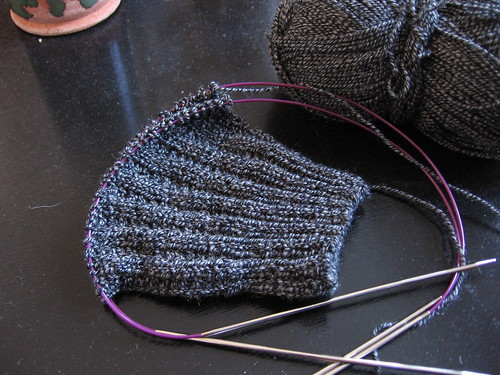
After working on never-ending projects with teeny tiny needles and sock-weight yarn, I’ve forgotten how quickly you can finish something if you use thicker yarn.

Project: Gretel Hat Attempt #2
Pattern: Ysolda's Gretel
Yarn: Cascade 220 in Black
Needles: Size 4 for the ribbing; Size 6 for the cable section
Size: Knit size regular but omitted rows 6-9 in the "Regular and Slouchy Only" section
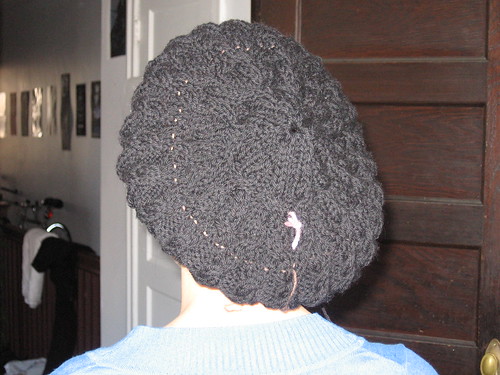
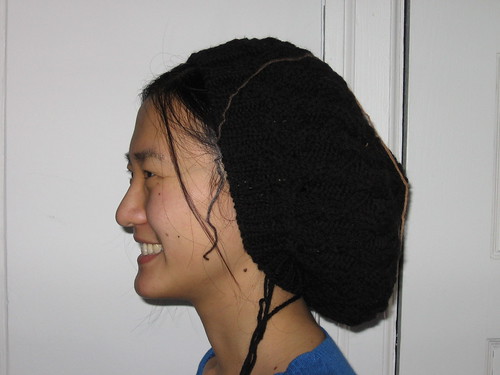
After a failed attempt to knit this hat earlier this year, my second attempt turned out fairly successfully. The hat fits well, does not make my head look like a gigantic balloon, will be warm and does not clash with my coat or scarves. In my book, that counts as a success. More photos can be found here and here.


Project: Very Fetching Mitts
Pattern: Fetching on Knitty.com
Yarn: Patons Australia Merino Deluxe DK (a gift from Australia from Matt)
Needles: Size 4 circulars
Modifications: Added an extra set of cabling at the wrist.
Yet another pair of fingerless mitts to protect me from the cold that will be our house this winter. These ones are thicker, looser and cover less of my fingers than my other pair. We'll see which one ends up being more practical. This project was also incredibly quick to knit! It only took me about 4 days of regular knitting. I believe the hat took about 1-2 weeks of regular knitting.

In comparison, normal socks take me about 3-4 weeks of regular knitting. Fancy socks take about 4-8 weeks. And good old tangled yoke cardigan is probably going to take me 20+ weeks of regular knitting to make, if not more.

I guess if I like instant gratification, I should try sewing more.


*Note: Photos are courtesy of hubby whose status as a rock star has made his blog more popular than mine. I am slightly jealous. Every blogger secretly dreams that he or she can blog full time and earn a living, and then win a Pulitzer Prize for "Serial Online Commentary".

Tuesday, August 18, 2009

bursting at the seams

I almost forgot that I will be going up to Boston this weekend for a wedding. Aside from good times with friends, the long road trip will translate into plentiful mindless knitting time. This fall may turn out to be insanely busy on the books/words/intangibility facet of my life, so I’m trying to take advantage of these last few summer weeks to spend extra time on the tangible side of things.
On this trip to Boston, I hope to make progress on my Tangled Yoke Cardigan. I have been lusting after this cardigan ever since I started knitting almost three years ago. I have been working on it since March, even hauling it over to Europe. The sleeves are finished and I am about a third of the way up the body, so perhaps only halfway done overall. I am excited about completing the sweater, but not so much about wearing it. That’s my unfortunate gripe with knitting – there’s no instant gratification, so often by the time I finish a project, I no longer like it. My Ms. Marigold sweater vest is currently languishing in the bottom of a dresser drawer, on the verge of being donated if it weren’t for sentimental reasons (it fits small to medium, does anyone want it?), and my purple short-sleeve cardigan is experiencing the frustrations of being a short-sleeve heavy sweater, weather appropriate for only two hours out of two days of the year.

Meanwhile, I’ve been able to complete two other projects that will hopefully be more useful:
Herringbone socks for my husband which turned out beautifully despite many sloppy errors that I will choose not to disclose. The pattern and the yarn went together perfectly. As beautiful as the final sock turned out, I will never use this pattern again, because it was too annoying to knit. It requires you to knit two stitches, slip them back to the left needle, slip another stitch over, and then slip two stitches back. These socks probably took three times longer than usual to knit. The pattern also requires your full attention and yet was boring to knit. (Usually, boring things to knit don’t require attention so you can watch TV or read at the same time, while things that do require attention are quite interesting to knit).
Blue & blue endpaper mitts to keep my hands warm in the winter, since our house will be kept frigid now that we’re paying the actual heating bill. They are slightly tight, but will hopefully loosen with wear. My first colorwork project.

In examining the stitch quality of the endpaper mitts, I’ve noticed that my colourwork skills seem to atrophy quickly, so I’ve already started working on the gorgeous Selbu Modern hat in lovely lavender and white to keep up my technique. This is all with the end goal of knitting in the distant future the Autumn Rose sweater, which I now anticipate, I will no longer like once I have spent 500+ hours knitting it.

I also plan to re-complete my Gretel hat, after my previous sizing disaster. I’ve started it, but I’m currently stalled in my usual state of indecision about which size to knit.

Otherwise, once the Tangled Yoke Cardigan is complete, I may hunt for another sweater project (currently considering: Farmer's Market Cardigan, Millefiori Cardigan, Oriel Lace Blouse, Carnaby Street Pullover, Lace Cardigan, Printed Silk Cardigan and a few sweaters from Feminine Knits) but I may also get started with stash-reduction and gift and charity knitting. In this pile of lovely yarn, I see socks, lace shawls, hats and scarves! (There's actually two drawers, not just one, filled with yarn). I may even try to design something myself again. If you praise my knitting enough, you may receive something, but no promises.

In the sewing world, I finally mustered up the courage to install my walking foot and quilted two placemats. After weeks of procrastination because I couldn’t find an appropriate quilting pattern, I improvised, which proved to be easy, fun and successful.

Unfortunately, this also means I no longer have an excuse to avoid working on my Bento Box Quilt, which I started in June 2008. The quilt top is complete. I just have to sew and measure the backing and then it should be ready to quilt. I still have no idea how to quilt it beyond ‘stitching in the ditch’ (in other words, stitching along the seamlines), but hopefully if I stare at the quilt long enough, inspiration will strike.

I also need to muster up the motivation to complete this New Look halter dress, which I also began last summer. After frustrating alterations to the bust, I gave up and let the dress sit. It would be nice to be able to wear it before another autumn rolls around.

I’ve also noticed that I’m more interested in alterations to clothing, rather than sewing them from scratch. I’m not sure whether this is related to wanting instant gratification or whether there’s something intimidating about starting with just cloth and tissue paper. We shall see. Meanwhile, despite a few thrift store alteration failures, there have been a few successes. Perhaps I will post pictures in the weeks to come.

Phew! Now it felt good to get that all out! I can pretend to be all intellectual, writing about society and culture and smart stuff like that, but what really gets me going is talking about my knitting, my sewing and what I ate last night. If you don’t believe me, you can just ask my husband. He spends plenty of time listening to my endless mundane ramblings sans theoretical or philosophical musings. Or atleast I think he's listening...

Saturday, August 08, 2009

cleaning and purging


I have finally admitted that it takes me longer to figure out what to throw away than it does for me to just pack it up. Fortunately, I have discovered that it's easier to throw things out after you move, when you realize that despite moving into a larger space, there's still not enough space for all your crap.

So continues my constant struggle not to hoard, lest I become this Asian woman. (There are better photos here and here). I know I already have a tendency to hoard up plastic bags because they’re so “useful”.

Going through my stuff and living in a lower-income neighbourhood reminds me of how wealthy I am. (And it's about what you own, not just what you make). And I am trying to think about what I actually need versus what I think I need.

In addition to recognizing my wealth, I also have to acknowledge my snootiness. Apparently, I like smart people books.

Then again, what makes a good life is rarely tied with wealth or worldly achievement, but rather relationships and social adjustment. I’m sure a healthy marriage would help to that effect.

But if history and statistical research determines my life, then I may have a few more husbands in store. In the meantime, I am thankful to be in an egalitarian marriage and not an extreme complementarian one.

But I’m still glad I’m a girl, just not in the way that this book would suggest. The book now sells for $270 on Amazon.

And if you can’t get enough of learning more about your gender, you can try the Exciting Career Game for Girls. Your options are endless: model, actress, ballerina, nurse, teacher or airline stewardess! Sure beats becoming a fallen Disney princess.

And a random list:

Monday, July 13, 2009

life on hiatus

(written last week)

After 14 days on tour with my husband’s band, it’s a bit of a shock to be back home. While the first few day were challenging, I grew accustomed to packing up my bag every morning and moving on to the next location every night. Towards the end, I felt like I could continue indefinitely. Wake up. Walk around and explore. Pack my bag. Get in the van and go on to the next location. Repeat. Again and again.

Life is simple. Everything I needed fit into one bag. The immediacy of each location kept me from worrying about the elusive future. So despite constant change and movement, and little sleep, the trip ended up being mentally refreshing.

And now I’ve returned to my boxes upon boxes of possessions, a 9-5 desk job, a mortgage, and all those other lovely American dream promises that seemed so distant while I was gone.

Monday, June 01, 2009

confession: I like clothes*

Question: Is it less superficial and materialistic to like clothes if I make them myself?

I’ve spent a lot of time recently altering and reconstructing thrift and consignment store clothing that I’ve purchased in the last few years. (In some ways, I’m on a permanent Wardrobe Refashion Pledge—I only buy used clothing). While this activity is a creative and technical process, it also conveniently gratifies my constant craving for new clothing.

I may escape some elements of shopaholism, but some minor (or major) spirit of clothing consumption still holds me captive.

In any case, I have been working on a blog post or series of blog posts relating to fashion and clothing, which may eventually see the light of the internet. As luck would have it, I got stopped on the street today, photographed in an awkward pose by SnapGlow TV from Philly.com because my outfit “was fantastic”. Now I am the laughing stock of my husband, if I wasn’t already.


* And I suppose I have to add purses and shoes to that list.
** The dress above was sewn by yours truly using Amy Buter's Lotus Dress pattern. Sewing your own clothing from new fabric is unfortunately not terribly economical. I probably spent $50 on the fabric for the dress, though there is plenty left-over. The pattern also cost about $10 or $15. Sewing clothing using fabric from thrift store clothing, however, can be quite budget-friendly.

Sunday, May 03, 2009

my destiny*

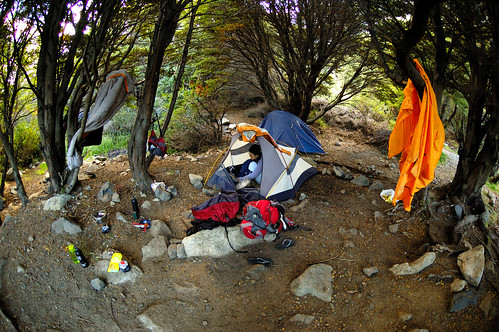
Sometimes I feel like I will spend my entire life longing to go back to Torres del Paine.

It’s been over a year since Matt and I flew halfway around the globe and trekked Torres del Paine National Park in Chile. The memory of being there – instead of fading with time--- has grown to mythical proportions.

I think about the place a lot. I can still hear the thunder of ice breaking off from the glaciers during the night. The stream water still tastes refreshingly cold. And I remember that even though I felt exhausted each night from the hours of hiking, I felt restored and cleansed from breathing the fresh air. But I most vividly remember the sense of awe I felt as I was surrounded by the towering mountains and endless pampas. Confronted with something I had no category to understand, I felt small and frail. And yet, I felt safe and comforted within something so much greater than myself.

There are very few times in my life where I actually behold the immensity of God’s power. And when I do, I long to live those moments again.


* This entry is melodramatic. Except it’s not. I actually feel this way.
** Photos were taken by Matt. More of his photos can be found here. Maybe I'll post some more on my flickr photostream, but it will have to compete against my knitting pictures for bandwidth. It'll be a tough battle.

Saturday, May 02, 2009

late night thoughts

David Brooks' article Genius: The Modern View echoes the great words of wisdom of Thomas Edison: Genius is one percent inspiration and 99% perspiration. Genius is not produced by inherent, divine talent, but by methodical practice. Which is to say, that my aspirations to be come a world-famous writer will not be realized unless I blog more often :P.

But seriously, my knitting has improved significantly since I first started over two years ago, but I spend anywhere from half an hour to three or four hours knitting every day. To be fair, most of those hours are spent knitting during movies or Star Trek The Next Generation episodes, but I am still practicing. It makes me wonder: How would the quality of my ideas and communication improved had I made a similar commitment to writing?

If Edison's words are true, then I am not sure if we are to be encouraged or discouraged. It is encouraging to know that anyone with slightly above-average skill in some area can become a "top performer", but it is discouraging to confront the amount of time and discipline required to develop that excellence. It makes me wonder if it's too late for me to excel in any area and to reverse my current trajectory of becoming jack of all trades and master of none. But it also makes me wonder how much is it worth sacrificing to become the best of the best?*


* A professor once told my friend that she was capable of becoming a leading history scholar. She would just have to pick a good area and master everything written on that topic. Of course, her research may also require her to spend several months away from her family each year. Not an easy price to pay.

Saturday, February 07, 2009

exercises in futility*

Ohhh knitting, you are such an exercise in futility. I spend hours upon hours knotting you with gentle care and love, eagerly anticipating the beautiful final product and then you let me down. And I must resign myself to the fact that I will have to pull out all those individually placed loops and roll you back into a ball.

My most recent failure: remember the lovely cabled hat that I was excited about? Well, it turns out that it’s just a tad too big and looks like a rasta hat.

So…. whenever I can muster up the courage to unravel it, I will have to reknit it with smaller needles, but I don’t think I have the persistence to do that before warm spring days roll around. So I will be taking a nice long break from it.

Knitting requires quite a bit of unraveling to fix stitch or sizing mistakes. Luckily, most knitting can be undone and redone, but it can be quite frustrating to spend hours working on something, only to discover that it has to be undone and redone again. Unfortunately, making mistakes doesn’t go away as you become a more seasoned knitter (atleast not in my experience). In fact, I rarely complete a knitting project without some unraveling and re-knitting. I suppose it builds character.

So after a failed project that has required quite a bit of concentration, I’ve been unmotivated to embark on anything new. I’ve been trying to finish up some simple part-tedious, part-relaxing gifts.

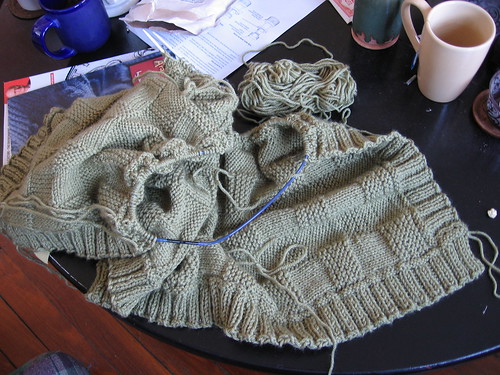
Since November, I have been working on a Collared Wrap for my mother.


It’s in a jumbled mess in this photograph, because the shawl is over 50 inches long and I’m currently doing the edges, which have probably over 300 stitches. (That sounds like a lot, but gorgeous lace shawls with teeny tiny cobweb yarn often have over 1000 border stitches). While easy to knit, it hasn’t been too enjoyable because the yarn is acrylic, (Lion Brand Vanna’s Choice-- I believe that is Vanna White’s Vanna’s Choice) and not as pleasant as wool. I would love to knit my mother something out of nice wool, but she likes to use her washing machine.

I’ve also started on a pair of Garter Rib socks for my dad out of the book Sensational Knitted Socks by Charlene Schurch (a sensational knitting book by the way because it provides charts to help you figure out the sock sizing based on your gauge). Tiny needles, tiny stitches. I have yet to knit my dad anything as a gift and I think these will be nice and useful.


*Or exercises in humility depending on your predisposition towards half-full or half-empty glasses of water.

Thursday, January 01, 2009

lists*


I've been digging through boxes of my old diaries, photos and other knickknacks while at my parent's house. They are planning to sell their house in California, so I am trying to throw away more of my stuff stored at their place. Actually, this is not a new activity for me. I go through these boxes twice a year in my semiannual family visits in an attempt to cut down on the pamphlets and trinkets I've collected over the years. Every year, the vast majority of these inanimate objects end up back in their boxes because they are attached to some event or person-- I am afraid that if I throw the stuff away the memories will disappear along with them. I let go of these objects by photographing them. Yet this time, even after photographing old Playbills and movie stubs, I still stuffed a few travel brochures and postcards back into a box for old time's sake. Though I've managed to whittle down the contents of two dressers, two bookshelves, and two closest full, 12 boxes remain as a testament to my packrat qualities.

In glancing through my old diaries, I noticed several “year in review” entries at every New Year’s, birthday and even diary-end. (I used to personify my diaries, like Anne Frank, except I would name them after crushes—some parts of my past are perhaps better forgotten). I would write long reflections about the prior year and interpret my personal life themes. I abandoned that practice of self-contemplation and reflection towards the end of college. But 2008 was an important year, a milestone year in my nearly quarter-of-a-century long life, so perhaps I will inaugurate the new year with some lists.

memories of 2008 (the good, the bad and the ugly):
altar cloth scorch marks.
moving speeches from fathers.
nights climbs by flashlight up rocky slopes.
shiny kitchen gadgets.
warm tights.
hardwood floors, drafty windows and sunlight.
American citizenship and voting.
Martin Buber.
20,000 at 52nd and Locust.
Wall-E.
Phillies World Series Win.
Alan Greenspan.
Sarah Palin.
$700 billion dollars.
Bear Stearns, Lehman Brothers and many others… R.I.P.
$4 gas and $1.50 gas.
Foreclosures
Casino zoning in Philadelphia Chinatown.

hopes and dreams for 2009:
daily journaling and prayer (though I’ll settle for three times a week)
read read read write write write (and actually make submissions!)
knit knit knit sew sew sew
more blogging with more photos
using dried beans instead of canned beans
figure out what to do with my life
a growing awareness in our culture of institutional/systemic guilt and responsibility
executive compensation caps
a better economic system
world peace and an end to hunger and poverty
finish writing our wedding thank-you notes
finding a good pair of black flats
start practicing pilates again (I think the odds are for world peace over this)


* As a result of reading William Zinsser’s On Writing Well, I would like to make a concerted effort to write better. I will be experimenting with different writing styles so my entries may be hit or miss in the next while.

Tuesday, October 14, 2008

exercises in cynicism and hope (3)

Today is Tuesday October 14th. The era of the large investment banks and excessive trading and easy credit is coming to an end. Our banks are getting partially nationalized. Senator Obama is ahead in the polls.*

Just as the Great Depression marked the acceptance of Keynesian economics and the economic stagflation of the 70s ushered in several decades of deregulation and trickle-down economics, this year’s economic crisis will shift the prevailing economic and social policies of this country.

By no means do I want nationalization of major industries** or excessive redistribution of income, but I do hope for a new era of politics that does not confer disproportionate power to large corporations, but rather encourages appropriate government regulation, and more equitable and socially responsible economic growth.

Today, I’m feeling a bit more hopeful.
(Oh, and the Phillies are one win away from being in the World Series.)


* Sorry, Palin sealed the deal. My respect for McCain has only gone down since then.
** Though I do want universal health care coverage. (I'm still Canadian!)

Monday, October 06, 2008

exercises in cynicism and hope (2)

sometimes I wonder whether deep down at the core of my being, I am just cynical -- that I superficially espouse all these nice sounding platitudes about how all these all these great organizations and groups are doing all this great world in the world in order to cope with the fact that I actually believe that all these institutions are corrupt at the core and no true change will ever come of them. (we are just in survival mode. the least common denominator).

or whether I really do believe that good is possible and that hope is real and that we can create a more whole, in the sense of shalom, way of living in this world, and that anyone can be an agent of this change.

Tuesday, August 19, 2008

how to identify a hipster*

that is if you care…

In the movie Adaptation (starring Nicolas Cage and Meryl Streep), New Yorker magazine writer Susan Orlean ends up in an affair with John LaRoche, an unlikely match given that he lacked the sophistication and cosmopolitanism of her usual circle of friends, who seemed rather concerned about hosting interesting dinner parties and mocking others. Perhaps what drew Susan to John was precisely what her group of worldly and successful friends did not possess—a passion for something. Susan notes in the movie: I suppose I do have one unembarrassed passion. I want to know what it feels like to care about something passionately.

If I were to find a distinguishing characteristic that would separate a hipster from someone who is not, that is what it would be. Someone who cares passionately, genuinely and sincerely about something other than themselves is not part of this death movement of Western civilization.

And sometimes I find myself precariously on the edge of that distinction—as noted in my profile, I have many “hip” interests, amongst which are riding bikes, buying thrift shop clothing, listening to independent music, knitting and sewing. In addition, I live in a trendy neighborhood and work for a nonprofit. I don’t think I am cool, but no hipster ever admits to being one.**

But what troubles me most is how hard it can be for me to care passionately about something. There are definitely people/themes/ideas that spark my care—urban poverty, labor injustice, food economics, sex trafficking and immigration. However, it’s been hard to turn those moments of thought and emotion into more concrete and consistent action, especially in a society that writes off those who care passionately about something as obsessive and extreme (perhaps we do this so that we don’t need to confront how meaningless our lives actually are). Our society preaches moderation, balancing passions with security so that we can live in guilt-free comfort.

But I know that Jesus called his disciples to abandon their fishing nets (their livelihood), and rely upon him, without the security around which they had built their former lives. And in knowing this, in my comfortable post-college life, I find myself craving something to care about passionately.

So I hope this time of unrealized good intentions will be an incubating period for a more defined passion. Of the many things that I could be (the existential crisis afforded to me by my privilege and education), I would like to be something other than hip. I want to commit myself passionately to something, so that I can live for more than just myself, or rather, so that I can be part of something that is greater than myself. And I guess therein lies the answer, I can start by caring passionately (once again) about God, and maybe everything else will fall into place.


* You might also try the book Field Guide to the Urban Hipster (a little outdated now though as the book's usage of the category hipster is more broad)
** Consider for instance this conversation, from the Adbusters article:
Standing outside an art-party next to a neat row of locked-up fixed-gear bikes, I come across a couple girls who exemplify hipster homogeneity. I ask one of the girls if her being at an art party and wearing fake eyeglasses, leggings and a flannel shirt makes her a hipster.
“I’m not comfortable with that term,” she replies.
Her friend adds, with just a flicker of menace in her eyes, “Yeah, I don’t know, you shouldn’t use that word, it’s just…”
“Offensive?”
“No… it’s just, well… if you don’t know why then you just shouldn’t even use it.”
“Ok, so what are you girls doing tonight after this party?”
“Ummm… We’re going to the after-party.”

Monday, August 18, 2008

in praise of being like a child (as opposed to acting like one)

Today’s consumerism has made possible an extended childhood, justifying selfish pursuits and immediate gratification in the guise of self expression, customer satisfaction and economic growth. However, many seem to be waking up from their shopping frenzy, realizing that it is perhaps time to grow up.*

But I don’t think our only problem is that we act too much like children—we also need to become more like children. I don’t want to idealize childhood innocence—I don’t believe it exists as any parent would note how quickly a child learns how to say “No!” and “Mine!”. However, there is a quality of being a child, that seems to get lost in the endless deluge of evaluation and judgment to follow from peers, parents, and authority figures over the course of one’s coming to age.

When I flipped through short stories I wrote in elementary school, I remember how free I felt printing out those characters on paper, and how I never wondered whether or not it was actually good writing. I wrote because I loved to write and not because I desired any acclaim or approval from others.

I remember spending hours playing make-believe in my own backyard and journaling fantasy worlds in my diaries, unashamed of what a silly “waste of time” that must have all been. It was fun and it didn’t matter what the rest of the world thought.

I remember crawling into my parent’s bed on a Saturday morning, to cuddle and feel safe. I was free from worry about whether or not they would put food on the table or a roof over my head. It would be done. I could depend on them.

Where has all this freedom disappeared to? When did it get lost in all the worries of the world? Now instead, I am stuck in the adult world of second guessing, pride and shame, doubting, mistrust and approval-seeking. Childish in my wants and complaints, but unchildlike in my faith and hope.

I don’t really want to grow up and become an adult. That is not a desirable solution for my childishness. I don’t want to feel like I am in control and capable of managing my own life, hiding my insecurities with a paper fort of resume achievements. In fact, there are moments when I am quite glad that my entry into the “real world” has been beset by confusion and surprise, instead of success and clear direction. I am glad because it has given me the opportunity to become smaller and more child-like, so that God can become larger.


* Some interesting articles on this topic:

From Adbuster’s Too Comfortable to Take Risks:

Social critic Mariko Fujiwara blames the breakdown on the collapse of the family system, among other factors. The baby-boomer parents achieved a level of middle-class comfort. They had fewer children so they could sustain that comfort – and they gave their children everything, except the strength and guidance to navigate the myriad choices and uncertainties of the twenty-first century.

“Japanese kids today feel that if anything goes wrong for them, it will be disastrous for the entire family,” says Fujiwara. “So they don’t even want to try. There is a mismatch between their aspirations and their willingness to work to achieve them ‘no matter what.’ They thought material and digital connections would be enough, but they’re discovering that they and their parents were wrong. Today’s Japanese kids are incredibly unhappy.”

What if Japan, the face of the future, is showing us who we are becoming – as a kind of proverbial ‘canary in a coal mine,’ a Cassandra of our trans-cultural futures. Consumerist, protectionist Japan is now celebrated worldwide as the Asian arbiter of cool, even chic. But at home, endless consumer choice and cleverness is starting to look hollow.

Evangelion auteur Hideaki Anno, now 47, believes that the problem may not lie exclusively with Japan’s younger generation. Instead, he says, there is no adulthood for them to grow into. “We are a country of children,” Anno recently told a reporter from The Atlantic Monthly. “We don’t have any adult role models in Japan.”

I predict that the dilemma facing Japan – how to create a sophisticated adult culture in a capitalist society that has less need or room for one will – become commonplace in the coming years.

From Against August from David Warren Online (article courtesy of Nick):

It might even be said that the “rights of childhood” -- I am trying to form this idea in contemporary terms -- have been transferred, by successive Acts of Parliament, from children to the childless.

What are these rights? Chiefly, the right to play, often away from mature supervision; the right to breathe, away from traffic and similar threats; the right to live in a fantastical world of one’s own invention; the right to refuse responsibilities; the right to demand entitlements, and to receive the fruits of others’ sacrifices; the right to be taken care of, and empathized with, whenever something goes wrong.

These were all, in previous generations, among the solemn rights of children, but today belong almost exclusively to a much older class with large disposable income, which is to say, “Dinks” (double income, no kids). To which we might add, “Shinkeroaks” (single high income, no kids, eschewing relationships of any kind). And I have noticed that the sound of a noisy child is extremely unwelcome in the environments they have created for themselves.

While this last remark might be taken as carrying a political edge -- and it is true that the (mostly urban) childless provide the demographic backbone for all “liberal” and “progressive” parties today -- it should be said explicitly that the Left has no monopoly on dinkish and shinkeroaksome behaviour. It is available to anyone who wants to buy into what the late Pope called “the culture of death,” in which we live only for ourselves, and for the moment.

Adbusters also has a feature article on hipsters, the Dead End of Western Civilization, the epitome of today's culture that combines childish consumerism with adult cynicism:

An artificial appropriation of different styles from different eras, the hipster represents the end of Western civilization – a culture lost in the superficiality of its past and unable to create any new meaning. Not only is it unsustainable, it is suicidal. While previous youth movements have challenged the dysfunction and decadence of their elders, today we have the “hipster” – a youth subculture that mirrors the doomed shallowness of mainstream society.

...

We are a lost generation, desperately clinging to anything that feels real, but too afraid to become it ourselves. We are a defeated generation, resigned to the hypocrisy of those before us, who once sang songs of rebellion and now sell them back to us. We are the last generation, a culmination of all previous things, destroyed by the vapidity that surrounds us. The hipster represents the end of Western civilization – a culture so detached and disconnected that it has stopped giving birth to anything new.


Speaking of hipsters, have you checked out the hipster Olympics yet? Or the appropriately named Stuff Hipsters Don't Like.

Thursday, August 07, 2008

garbage dump

I’ve just returned from vacation in cool California and am returning to the humid weather of Philadelphia and my overflowing “Word Document” where I amass all the articles and quotes for this blog. So I thought I would clean my plate as I did previously before posting again (currently in the pipeline are some scribblings on the birth, adolescence and middle age of Philadelphia, crafting and consumerism, and rather reluctantly, on the topic of being Asian American, since I am technically now an American. I suppose I could consider taking topic suggestions as well).

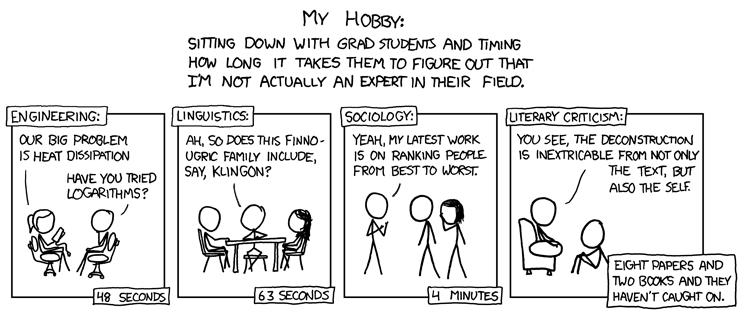
First of all, this cartoon is incredible, though I can’t seem to remember where it is from:


A similar graph from this White Courtesy Telephone blog post also suggests the inanity of much research.


Also, on an academic note, it’s been all over the news that Peter Enns has resigned from Westminster Theological Seminary (WTS) in what appears to be a theological difference. In my completely amateur opinion, it marks WTS’ move away from academic scholarship and more as a denominational training ground. Institutions, like cities, have personality and character. They are born, they change, they age, and eventually they also will die.

There’s been more talk about the students who are receiving elite educations. An adjunct faculty writes about the spirit of entitlement that dominates Harvard University. The article has been hotly contested and debated, so if you’re interested, run some searches on it or check the additional links on aldaily.com.

So given the state of today’s academic environment, the recent passing of Russian writer Alexander Solzhentisyn should merit attention. Solzhentisyn was a bold writer who openly criticized and denounced the Russian communist regime, in particular writing about the horrors of the gulags. Articles from the Inquirer and the Economist.

It was also refreshing to see an SFMOMA exhibit on China “Half Life of a Dream”. The artwork seemed meaningful because it actually seemed to have something relevant to say – perhaps because China has more of a contradictory national narrative, than the postmodern fragmentation of the American narrative in recent years. The Philadelphia Inquirer has featured three stories spanning two decades about a Chinese woman who has now become a corporate executive. 2008, 1999, 1987.

Speaking of China, the Olympic Games are coming up. I’ve never been super into watching these competitions—and part of me is always devastated by the amount of havoc it can wreak upon a city—economically and ecologically. For the 2010 Vancouver Olympic Games, the city plans to bulldoze through a rare forest. There’s more coverage of China’s Olympic Games and the corresponding environmental and societal issues at the same site.

On the environmental note, as gas prices hike, bicycling has also finally been gaining the spotlight. There’s a useful Philadelphia Inquirer article with practical tips about bike commuting, as well as an Economist article on bicycling and its implications on street planning and safety.

My few words of advice from my on year of experiencing the indignities of commuting by bike: it is okay to wear skirts that are longer than skirt length, changing after you get to work is highly advisable, and it’s better to be slow and safe. Be respectful of motorists (e.g. don’t run red lights when they are trying to get through the intersection) but remember that you have a right to be on the road. However, if your safety is threatened (e.g. angry, aggressive driver), you may need to slow down and get off the road.

Meanwhile, I am reminded of Tom Wolfe’s Bonfire of the Vanities with a recent Mercedes hit and run accident in the Philadelphia area. Hit and run accidents make me very angry. However, the murder of a four year old this week strikes an entirely different level of emotion, something akin to numbness.

Despite the violence in this area, Philadelphia still remains a great city to live in. Surprisingly, it is a lot safer than what one might imagine. Props to this recent college graduate who wrote for the Inquirer why he has decided to stay in Philadelphia and contribute to my continued ambivalence about the gentrification of this city.

Speaking of Philadelphia, I have been fairly satisfied with Nutter as our mayor, but that did not prevent me from feeling saddened about reading about the death of Jesus White, a homeless man who ran in the mayor primaries last year.

It’s especially striking that Jesus White worked a regular job, but still had no home. It saddens me that when the economy does well, it takes years for the minute benefits to “trickle down” to the poor. Yet when the economy suffers, the impact is felt immediately and most severely by the poor.

Speaking of policies, Barack Obama’s recent support of faith-based programs has also been on the minds of many. This
Opinion article Why Obama seized the faith-based mantle by Amy Sullivan from USA Today traces the history of faith-based initiatives, something that surprisingly despite being one of Bush’s signature policies, stemmed from the Democratic party.

This other opinion article from the Baltimore Sun makes a argument against more funding for faith-based programs, but instead advocates more collaboration between religious congregations and secular nonprofit organizations. The writer’s argument is solution-oriented and forward-looking, which I appreciate, but he also assumes the necessity to professionalize care, something that I am not entirely comfortable with. While professional help may be valuable and important, we run the risk of evading responsibility ourselves, and pushing it off to a third party, outsourcing compassion if you will. While Bush’s ‘compassionate conservatism’ has not been successful, I am pretty sure that putting the burden of caring for the poor entirely on the shoulder of the government will also fail. Institutionalized compassion will not bring about transformation. (Does institutionalized care even qualify as true compassion?)

All this talk about politics makes me remember once again that I am now a U.S. citizen and will be voting in the upcoming election! Perhaps more significantly, I have almost been married to this man for 6 months.

On a lighter note, Wordle.net is quite amusing. I ended up with this for this blog:


I'm also tired.

Thursday, July 24, 2008

what if philadelphia ceases to be philadelphia?

In his novel Invisible Cities, Italo Calvino writes about changes to the city of Maurilia:

In Maurilia, the traveler is invited to visit the city and, at the same time, to examine some old postcards that show it as it used to be: the same identical square with a hen in the place of the bus station, a bandstand in the place of the overpass, two young ladies with white parasols in the place of the munitions factory. If the traveler does not wish to disappoint the inhabitants, he must praise the postcard city and prefer it to the present one, though he must be careful to contain his regret at the changes within definite limits: admitting that the magnificence and prosperity of the metropolis Maurilia, when compared to the old, provincial Maurilia, cannot compensate for a certain lost grace, which, however, can be appreciated only now in the old postcards, whereas before, when that provincial Maurilia was before one’s eyes, one saw absolutely nothing graceful and would see it even less today, if Maurilia had remained unchanged; and in any case the metropolis has the added attraction that, through what it has become, one can look back with nostalgia at what it was.

Beware of saying to them that sometimes different cities follow one another on the same site and under the same name, born and dying without knowing one another, without communication among themselves. At times even the names of the inhabitants remain the same, and their voices’ accent, and also the features of the faces; but the gods who live beneath names and above places have gone off without a word and outsiders have settled in their place. It is pointless to ask whether the new ones are better or worse than the old, since there is no connection between them, just as the old post cards do not depict Maurilia as it was, but a different city which, by chance, was called Maurilia, like this one.

I find myself with a funny set of wants—I want more college graduates and professionals to stay or to come to Philadelphia, to work here and contribute to the economy, and to make this a better city. Yet I also know that this very revitalization is playing an integral role in the gentrification in my neighbourhood, destroying historic black communities in West Philadelphia.

I deeply desire to see this city revitalized, to become the “next great city”—for its “soul-stirring desolation” as Jonathan Franzen put it, to be turned into soul-stirring hope and community. But when does Philadelphia cease to be Philadelphia? When does some other minor deity saunter in and takes its place and its name, while the old Philadelphia is put in a body bag and dumped into the Delaware River? In hoping for Philadelphia’s life, am I also wishing its destruction?

As Philadelphia changes, the spirit of this city will change. But I want to see the soul of Philadelphia grow out of its sighs and tears and into something wise and beautiful, with history and complexity, rather than see it squeezed out and left to die, while some other young, fashionable imposter comes to stretch its personality over these streets.*


* There’s been an interesting series in the Philadelphia Inquirer on homeless men sleeping, eating, bathing and having sex in Rittenhouse Square. I’ve blogged about this park and my appreciation for the diversity of its users. Sometimes, when I try to imagine what Philadelphia would look as a person, I picture a homeless man, dirty and filthy, staggering through the streets (I have other images too). I don’t want this homeless man shut away in a shelter far, far way—I want him to find a job, build a family and live in a home. As for the Rittenhouse Square issue, I understand the local residents’ aversion to having their local park overrun by homeless at night, and I also understand the need to provide the homeless with more permanent housing options than park benches, but something about excluding before including, hiding before healing, and ultimately separating without ever integrating, strikes me as being the wrong approach. And I hope that we do not take the same approach to the poor (of pushing them out to suburbs rather than including them in a vital way) as we try to bring new life to Philadelphia.
** On a lighter note, I think I may be breaking a significant trend with this post. Have you noticed that I will post frequently for a month, and then I will go on hiatus for the next month before resuming frequent posts again? Somehow, I’ve managed this time to only wait about two weeks before the posts resume again.

Wednesday, July 23, 2008

I am gentrifying my neighbourhood

It’s frightening how we find ourselves swept up in large social changes. We act, thinking that our actions are our entirely own, only to find that so many others are making the same decisions. I begin to wonder to what degree are my decisions my own (or God’s) and to what degree have I swallowed the ideas, values and assumptions prevalent in society.

I watch the rapid gentrification of my neighborhood—I knew it would happen eventually but I would not have anticipated the speed. To put it bluntly, six months ago there were not this many white people walking around. So property prices are increasing, rents are rising, and houses are being renovated. While I can say that I am part of the neighbourhood’s revitalization, I am also displacing plenty of lower income families, and representing the arrival of yuppies and hipsters.

The gentrification in many ways seems inevitable. And if Matt and I had not chosen to live where we are now, and opted to live in, well, an already gentrified area, the neighborhood would have changed anyways. But that does not take away from the fact that we are part of urban process now that is moving lower-income, underprivileged families further out to the periphery.

So what do we do when we recognize that our actions, by no evil intent, are hurting others? To what degree do we go with the flow and recognize that this may not be one of the battles that we are called to fight and that we are not responsible? (Is that resignation?) Or, how do we stand up against the river when we feel like a little pebble being tossed about in the current?

In some ways this question is a moot point for the time being, as Matt and I have already signed our lease. For the time being, we are called to love and care for our neighbors, whatever ethnic or class background they may be from. But when it comes to buying a house* (something that is on the radar for the next few years), how are we to tread? Even if we try to tread softly, our footprints seem to sink far deeper than we would ever want them to.


* We can’t really afford a house in the wealthier sections of the city. Do we buy a house in this already gentrifying area and continue to contribute to this inevitable process? Or, do we buy a house in a predominantly black lower-income neighborhood and risk setting off gentrification there, because our very presence will change the way that the neighborhood is viewed? (And I question the latter option critically—it can easily be done with a sense of pride and self-righteousness, instead of faith, love, and a specific calling).

Sunday, July 06, 2008

book reviews second quarter 2008

Married life has certainly ushered in different rhythm of life. I was hoping that with no wedding to plan anymore, I’d have more time to read, but other things (of the nature of arts and crafts, cooking and household chores) have filled that space. That being said, I am quite glad that wedding and honeymoon planning is done and over with—everything except photos and thank you notes that is. And I’m hoping to continue to make more time to read over the next little while, especially as I may be taking a class at Penn this fall, and may no longer have the luxury of reading whatever I feel like reading.

In any case, of late, I’ve been digging my elbows deep in sociology and urban studies non-fiction (prompted perhaps by Planet of the Slums and Bowling Alone), but I think I may spend the summer months with a bit more fiction. Next on the list: The Road by Cormac McCarthy, and perhaps C.S. Lewis’ Space Trilogy. Reviews are also posted on Goodreads.com.

Fiction

*** The Watchmen (Alan Moore)
Heralded as one of the best graphic novels ever, The Watchmen is a very intense and dark story of the lives of former costumed vigilantes (superheroes without superpowers). It begins with the investigation into the mysterious murder of one of them. It’s extremely well-written and well-told, but requires quite a bit of thought and attention to follow along. I won’t say too much, but I will say that the Watchmen defies the genre, by being an anti-superhero story.

** Straight Man (Richard Russo)
This book recounts a week in the life of a professor of English in Railton, Pennsylvania. It is focused on the drama of his department, the university (facing extreme budget cuts), and his family. The book is meant to be humorous, and succeeds most of the time, though sometimes the events end up being a bit absurd. It was decently/mildly entertaining to read, especially as it mocks academic culture. Summed up, the book is about: “Only after we’ve done a thing do we know what we’ll do, and by then whatever we’ve done has already begun to sever itself from clear significance, at least for the doer.” It’s nothing life changing but if you’re looking for a light, quick, funny read, and you have a soft spot for the university, this might work out well.

*** Housekeeping (Marilynne Robinson)
This is a beautifully written novel about two sisters coping with the death (apparent suicide) of their mother in the small town of Fingerbone. The prose reads like poetry and the quiet, somber, dreamy reflections on life and death weave their way into the narrative. However, that very reverie-like prose made it difficult to connect more deeply with the characters—they seemed like beautiful ghostly abstractions rather than real flesh and blood individuals (but I suspect that may be the author’s intentions). In any case, it was enjoyable to read, and perhaps can be very inspiring to an aspiring writer.

Non-Fiction

*** Bowling Alone: The Collapse and Revival of American Community (Robert Putnam)
This book summarizes substantial amounts of empirical studies on American community, which is broadly defined to include civic engagement, participation in different interest groups, church attendance, philanthropic giving, volunteering, or simply hanging out with friends. After Putnam clearly demonstrates the decline of American community since the 1950s, he spends a good portion of time investigating the various factors that may have caused it, including suburban sprawl, television, less free time, generational change etc… He spends the last few chapters on a hopeful note, mentioning the spurt in community involvement after the growing injustices of the late 1800s.
Though he didn’t leave me entirely convinced, Putnam posits a series of societal changes that could have substantial impact on community involvement, ones that are very well in the realm of possibility. Putnam does spend quite a bit of time detailing methodology, but overall the book is not technically bogged down. My favourite chapter was probably the one detailing the detrimental effects of television.

*** The Sabbath (Abraham Heschel)
Heschel is a Jewish theologian and this short book is his reflection on the role of Sabbath in Jewish religious life. The Sabbath is a day of holiness, a palace of time, a way to commune with God. While I found most of this book less applicable to me as a Christian (though it did help me start to understand better Jewish culture), the first two chapters and the last one are absolutely phenomenal. In these chapters, Heschel reflects on society’s tendency to devalue time, which it cannot so easily control, in order to acquire more of space, that which seems so much easier to possess.

**** Final Exam: A Surgeon’s Reflections on Mortality (Pauline Chen)
This is a beautifully written book by a surgeon. Chen recounts her training and her practice as a doctor, narrating the ways in which she and her fellow medical students or doctors confronted or avoided confronting death. While Chen touches upon policy-oriented issues, such as the need for palliative care, better M & M conferences, better medical training, her book reads best as a memoir of her own personal and emotional struggles. I found most moving Chen’s narrations of how she responded to a husband or a wife dying to a chronic disease, while his or her partner watched and waited. Chen writes both vividly and compassionately. This book touched me more personally than most, perhaps as I have been reflecting more on how hard it would be to lose my husband (or for him to lose me) after the recent death to cancer of a church member with a husband and young children.

**** The Death and Life of Great American Cities (Jane Jacobs)
Written in the 1960’s, Jane Jacobs revolutionized the way we viewed and studied the city. She summarizes her approach in her final chapter—cities are not to be studied as objects of simplicity (e.g. simple relationships, more open space = better neighborhoods), nor objects of disorganized complexity (e.g. statistical approaches), but are to be treated as a living organism—incredibly complex yet organized and interrelated. She advocates the “microscopic” approach to looking at the city—digging in very deeply, instead of relying on high flying theories. She concludes that the success of a city is not dependent on any single component (e.g. open space, broken windows, etc…), but on a complex interaction of various factors, which she outlines in her book.
However, for most of the book though, Jacobs rarely talks to high-brow metaphor, but remains incredibly practical, concrete, realistic and easy to understand. She relies heavily on examples from Boston, New York, Philadelphia and Chicago. She focuses on several elements that in combined, including mixed and diverse uses (e.g. commercial and residential areas mixed together), shorter blocks, ideal density and lack of large borderlands/abandoned spaces (which can be parks!), and diversity. Her book was long to read, but definitely provided me with a new framework with which to observe and understand the city.

***** Sociological Imagination (C. Wright Mills)
The first 100 pages of this book were really hard to get through, and even after that, the book was very dense and took quite a bit of effort to understand. All that being said, this has been one of the most thought-provoking and academically-inspiring books I have read in the past year. Mills was a prominent sociologist of the earlier half of the twentieth century (if I’m not mistaken, he coined the phrases “WASP” and “white collar”).
In this book, Mills criticizes the two dominant methods of studying sociology (grand theory and abstracted empiricism), and then goes on to delineate the sociological imagination—a way of studying society that factors in historical, political and individual factors, that does not get too lofty with grandiose theories and abstractions nor too mired in the numbers and statistics of abstracted empiricism. He then writes about the need for the sociological imagination in today’s society, in relation to our reason and freedom, our democracy and politics. The appendix provides some guidance on how to conduct such research. Though Mill had a few touches of elitism to him, it was so refreshing to read someone who had a vision for social sciences (and for the academy) that mandates relevance to society at large and the individual.
To summarize his stance on the subject: “Our public life now often rests upon such official definitions, as well as upon myths and lies and crackbrained notions. When many politics- debated and undebated – are based on inadequate and misleading definitions of reality, then those who are out to define reality more adequately are bound to be upsetting influences. … Such is the role of mind, of study, of intellect, of reason, of ideas: to define reality adequately and in a publicly relevant way. The educational and the political role of social science in a democracy is to help cultivate and sustain public and individuals that are able to develop, to live with, and to act upon adequate definitions of personal and social realities.

Rating scale
* didn’t like it
** it was ok
*** liked it
**** really liked it
***** it was amazing