Tuesday, September 09, 2008

unequal measures of inequality

My most recent blog entry related to how the manner in which knowledge is produced within the university system is subject to a set of assumptions and methodologies. This became quite evident in this example drawn from my first class in Professor Lamas’ Community Economic Development.*

In looking at these statistics relating to income, taken from the U.S. Census Bureau, what would you conclude about equality in America?


Income of Households 2002


Race/EthnicityIncome
White alone or in combination$45,350
White alone$45,390
White alone, not Hispanic$47,194
Black alone or in combination$30,032
Black alone$29,982
Now take a look at these statistics concerning wealth in America, now what would you conclude?
Median Value of Assets for Households 2000


RaceNet Worth
White$58,716
White Not of Hispanic Origin$67,000
Black$6,166

Percent Distribution of Household Net Worth 2000


RaceNet Worth

Zero or Negative $500,000 and Over
White12.7%9.3%
White Not of Hispanic Origin11.3%10.0%
Black29.1%0.6%
In the first case, inequality America is significant but is not of an outrageous proportion. However, looking at wealth, this picture is dramatically different. The median wealth of a white American household is over 10 times that of a black household. Furthermore, three times as many blacks than whites have zero or negative net worth.

The poverty debate both in America and around the world has been framed around the question of income (what one earns) rather than wealth (what one owns less what one owes). Two professors can both earn the same amount each year, but their lives may look very different depending on the inheritance they may or may not have received from their parents.

Because the poverty problem is framed in terms of income, the policy solutions suggested are also directed towards raising income. Our grand solutions to poverty in America seemed centered around raising minimum wages and providing better education (so that people can receive higher paying jobs). But if we were to think of the problem differently, how would our solutions change?

Interestingly enough, the major wealth-based solution to poverty has not been particularly successful. Home ownership has often been promoted as a way of increasing wealth and gaining economic success. However, this has played out into the context of income segregated neighbourhoods, disparate quality of education in public schools, and foreclosures. Home ownership has not created additional wealth especially in cases of stagnant or declining real estate prices or growing costs of maintaining a home.

I'm sure there will be more to follow on this subject.


*In fact, this entire entry is drawn from the discussion in today’s class. I guess you know it’s a good class if I come home and immediately write a blog entry.

Monday, September 01, 2008

simulating knowledge (2)

knowledge is not knowing

If today’s institutions of higher education are the factories for the “production of knowledge,”* then the assembly lines are lined with hunched over graduate students and junior faculty, managed over by tenured professors, journal publications and academic deans. Conferences, papers, books and other publications roll off the conveyor belt into this nebulous expanse known as “knowledge”.

The research, or perhaps more precisely, the knowledge produced, is not a result of some objective process, but a product of a certain set of assumptions, procedures and methodologies that are generally accepted by the said management of the university assembly line. That is not to say that none of the research is valid, but that it is subject to assumptions and processes particular to its academic field—generally accepted principles for how to conduct research and come up with conclusions.

Likewise, the knowledge produced within the walls of the ivory tower, is not necessarily more relevant, more important or more valuable than our own “knowing” as individuals. It is easy to get caught up in the abstractions of statistics, theories and categories to the extent that they become more real than the world they were supposed to study.

Case in point in these two excerpts. Excerpt one comes from Jane Jacobs Life and Death of Great American Cities, where she recounts the recounts the then prevalent urban planning mindset of privileging park space:

When I saw the North End again in 1959, I was amazed at the change. Dozens and dozens of buildings had been rehabilitated. Instead of mattresses against the windows there were Venetian blinds and glimpses of fresh paint…

But I could not imagine where the money had come from for the rehabilitation, because it is almost impossible today to get any appreciable mortgage money in districts of American cities that are not either high-rent or else imitations of suburbs. TO find out, I called a Boston planner I know.

“Why in the world are you down in the North End?” he said. “Money? Why, no money or work has gone into the North End. Nothings’ going on down there. Eventually, yes, but not yet. That’s slum!”

“It doesn’t look like a slum to me,” I said.

“Why, that’s the worst slum in the city. It has two hundred and seventy-five dwelling units to the net acre! I hate to admit we have anything like that in Boston, but it’s a fact.”

“Do you have any other figures on it?” I asked.

“Yes, funny thing. It has among the lowest delinquency, disease and infant mortality rates in the city. It also has the lowest ratios of rent to income in the city. Boy, are those people getting bargains. Let’ see… the death rate is low, 8.8 per thousand, against the average city rate of 11.2. The TB death rate is low, less than 1 per ten thousand, can’t understand it, it’s lower even than Brookline’s. In the old days the North End used to be the city’s worst spot for tuberculosis, but all that has changed. Well, they must be strong people. Of course it’s a terrible slum.”

“You should have more slums like this, “ I said, “Don’t tell me there are plans to wipe this out. You ought to be down here learning as much as you can from it.”

“I know how you feel, I often go down there myself just to walk around the streets and feel that wonderful, cheerful street life. Say, what you ought to do, you ought to come back and go down in the summer if you think it’s fun now. You’d be crazy about it in the summer. But of course, we have to rebuild it eventually. We’ve got to get those people off the streets.”

Here was a curious thing. My friend’s instincts told him that North End was a good place, and his social statistics confirmed it. But everything he had learned as a physical planner about what was good for people and good for city neighborhoods, everything that made him an expert, told him that North End had to be a bad place.

This other excerpt comes from C.S. Lewis’s novel That Hideous Strength, recounting the mind of a sociologist:

..his education had had the curious effect of making things that he read and wrote more real to him than things he saw. Statistics about agricultural labourers were the substance; any real ditcher, ploughman or farmer’s boy, was the shadow. Though he had never noticed it himself, he had a great reluctance, in his work, ever to use such words as “man” or “woman.” He preferred to write about “vocational groups,” “elements,” “classes” and “populations”: for, in his own way, he believed as firmly as any mystic in the superior reality of things that are not seen.


* Though this I suspect is changing with the growing role of the internet. In fact, Wikipedia is still bookmarked as TRUTH on my internet toolbar.
** For awhile, I think I was doing pretty well on writing entries that weren’t entirely based on quotes. I guess I’m finally breaking that streak now. It’s hard to say things when you keep finding people who write everything you would want to write, but do it much better than you ever would.

Friday, August 22, 2008

when words signify nothing

I'm frustrated. I've been trying for months to write something thoughtful about crafting, production and consumption, to go along with these pictures, but I've only ended up irritated with my own writing.

It made me think of this passage from Thomas Merton's New Seeds of Contemplation:

If you write for God you will reach many men and bring them joy.
If you write for men-- you may make some money and you may give someone a little joy and you may make a noise in the world, for a little while.
If you write only for yourself, you can read what you yourself have written and after ten minutes you will be so disgusted that you will wish that you were dead.

So perhaps I post this entry somewhere between "writing" for myself, for men and for God: Disgusted with my own words, craving to make some noise, but also sensing a deep joy from being able to create these objects that I know comes from God. And because of that latter joy, maybe these pictures can give you some pleasure as well, as they certainly give me child-like delight to post. (Past pictures can be found here)

So perhaps, it's appropriate that I limit my words in an entry that's designed to be about what cannot be made with words.

(By the way, if you feel so inspired to learn to knit, I'd be more than happy to show you. The offer doesn't stand for sewing though, because I'm still fumbling about. I am writing a lot for an entry that isn't supposed to be about words... )

Note: For some reason, a huge space is showing up between the text and the pictures on my browser. I have no idea how to fix it. Sorry!


charade socks knit as a christmas present for my mother


socks knit for matthew during our move-in; they were started during a very tense afternoon of combining and attempting to organize our book collection...


socks knit for matthew during our honeymoon


elijah the elephant, also dubbed roger the republican because it is an election year; knit for my brother as a birthday present


ms. marigold; knit for myself; I started the vest in august of 2007 and did not finish until june 2008 because I was intimidated by the prospect of picking up stitches for the neckline


the backside


reversible winter capelet; knit for myself after two failed attempts of using that same yarn to make a halter top


clementine shawl; knit as a belated mother's day gift this year; this is a picture of it blocking on my ironing board; lace shawls require blocking in order to stretch out the holes and give the pattern more definition


the finished product


a quilt made for charity, completed at quilting group at narberth presbyterian church; my real first sewing project


an apron for myself; the first thing I made with my sewing machine-- this apron is incredibly good use considering the amount of mess I make when I cook & eat


a rosetta t-shirt converted into a halter top


a basic a-line skirt made in a class at the sewing shop spool located at 19th and south in philadelphia


a pincushion :)


the start of another quilt for charity; this is just the top-- it still has to be combined with the batting and the back and then quilted

Wednesday, August 20, 2008

imagining china

If cities have gods, then so must nations. With the 24 hour NBC coverage of the Olympic Games, I can’t help but think what mythical being presides over the vast land of China? What is the spirit that guides this imagined community?*

Let me caveat all this by saying that I make this sketch of China from my very biased and limited viewpoint, amalgamated from my own impressions of the country, conversations with upper middle-class Chinese family and friends and perhaps a few taxi drivers and shop owners, and my reading of American media, which seems quick to pounce on China's weaknesses. Nevertheless, this is my opinion of China, a country for which I still feel a strange affinity for, perhaps indicated by my slightly inability to fully cheer for the American nearly all blond women’s gymnastics team.** The faces of the Chinese women’s gymnastics teams strike me both as familiar and foreign, reminding me of my elusive birthplace that I have only visited as a tourist.

On the surface, China’s deity stands proud. It has come a long way since the devastating mass famines of the 1950s or the social upheavals (the closing down of schools, the relocation to the countryside) of the Cultural Revolution. My parents left China in the mid-eighties. At that time, few families possessed any common household appliances that marked America’s successful 50s: microwave, refrigerator, television set, washing machine etc… However, when my parents returned in 1993 and 1994, they were amazed to find that nearly all their relatives owned them. They remarked that there was little they had that the Chinese did not (aside from having two children!). In little more than a decade or so, many, my extended family included, have risen out of poverty and have decent middle class lives, no longer living cramped six people to a room with no running water.

And visually, China’s cities reflect this economic success-- the impressive glowing skylines, the rapidly expanding network of highways, the sleek shopping centers and lively nightlife. As a result of both this and the continued nationalistic propaganda (if I’m not mistaken, elementary school textbooks still include numerous flattering portraits of Mao ZeDong and other key revolutionary heroes), many feel proud of what China has been able to accomplish from so little.

But China’s pride may also prove to be its downfall. Pursuing some unrealistic vision of modernization, China has been demolishing historic slum-like inner city neighborhoods and replacing them with sleek high rises and shopping malls. While America tries to lower automobile usage, China promotes it, restricting bicycle usage on certain streets. Its rapid industrialization has also filled the skies up with smog. Some may have profited from the economic development, but many remain left behind, supplying the labor for the sweatshop factories and filling in the informal economy.

Its nationalistic pride also suggests hidden insecurity. Though China lavishly demonstrates to the world its success and power, it also seems to yearn for praise and acceptance. Its previous attempts at manufacturing and coordinating a utopian society have failed. Communism in China was a disaster that killed millions. Previous state-down attempts at controlling the population with the one-child policy have created a new set of problems, with the increased pressure on only children to support their parents, and the outnumbering of males to females.

Perhaps China is so quick to curb criticism and repress free speech because it needs to continue to sustain its own myth. Exiled Chinese author Ma Jian, as cited in this article, comments that in China, there is "inflated pride; the fusion of years of nationalistic propaganda, with the economic powerhouse China has become, has created a feeling that it's now the centre of the world, and that foreigners come to them with begging hands." However, "the root of this desire to put on a great show stems from the authorities' own loss of faith in themselves. And they also realize that, despite the great rise in nationalism, the people don't believe in this empty ideology either."

And so China’s shiny, proud exterior façade (like the recently erected walls designed to hide Beijing slums) conceals an interior disillusionment and insecurity. While Chinese Olympic athletes who win gold take home glory and wealth, what happens to the 249,550 (with injured bodies and insufficient education) who do not?*** What other bodies are lost in the spectacle of those chiseled, carved and engineered Olympic bodies?

The state already disappointed the people with the collapse of the communist dream. Along with that, many promises, including health care, state pensions, welfare, jobs, justice, and equality, have been broken. Individual well-being is always curtailed for some purported collective good and elusive nationalistic glory. (Service and sacrifice for the nation is always enforced, rarely voluntary). While China celebrates hosting the Olympic games, factory owners are forced to close up shop, slum-dwellers suddenly find walls surrounding their neighborhoods, and students are told to stay away from Beijing during this time. When China was awarded the privilege (not the right) of hosting the Olympic games, it was partly for the hope of improving the human rights situation in the country. But many have commented that the situation has only worsened.

The Chinese people may rhetorically display plenty of nationalist pride in their imagined community, but their actions suggest otherwise. A spirit of practicality dominates the real China. From my aunt who questioned me on why I did not take a job with a higher salary, to a Chinese Chinatown bus companion who kept insisting that I must do business with China because I spoke both Chinese and English and could become very wealthy, it all comes down to money and security for oneself, and one’s family.

Students spend their childhoods and adolescence confined to classrooms and study halls, preparing for their college entrance exams. Other families make huge personal sacrifices in order to send their children abroad. Factory workers choose to work long, grueling hours in order to provide better for their families. Individuals rarely make true financial sacrifices for the sake of their nation. Over one billion people scramble to try to make ends meet, and improve their standard of living, perhaps without any thought as to whether or not they are serving or bettering their country.

And so perhaps China really is just an imagined community—a story , a fable, a myth, a distant deity to whom one pays homage, but certainly not a god who will come to one’s rescue, no matter how desperate the prayer.****


* The term “imagined communities” comes from Benedict Anderson’s definition of nations. He describes nations as imagined "is imagined because the members of even the smallest nation will never know most of their fellow-members, meet them, or even hear of them, yet in the minds of each lives the image of their communion".
** Okay, I wrote that before the gymnastics all-around. I’ll admit it-- by the end, I was cheering for Nastia Liukins. After all I am a newly minted U.S. citizen! And if I don’t cheer for the US, what country can I cheer for? I can’t quite cheer for China, and Canada’s performance at this Olympics has been rather disappointing. “You have to be ambitious to win the Olympics,” says my mother, “The Canadians! They’re too laid-back!”. I also asked my mother which country she was cheering for more—US or China? She said it was tough, but the US more.
*** I’m averse to China’s state training of athletes where children as young as 3 can be taken from their families. But then I wonder about how sports often work in America—Children aren’t forced to train by the state, and yet only those who can afford the classes, the practice and the coaching make it to the top. I could spin it and say that atleast China gives children and families who have never had an opportunity a chance for Olympic Success. But once again, I must wonder about all those athletes who didn’t quite make it to the top but still had to subject themselves to the years of grueling training, injuries and separation from family. The New York Times article also suggests that even former medalists don’t always fare too well after the Olympics and the glory has faded.
**** I am cognizant of China’s demonstration (both government and individual) of care and compassion after the SiChuan earthquake, so I’m not saying that the government will not assist people at all. Once again, I am speaking of in general terms, so naturally exceptions exist.

Tuesday, August 19, 2008

how to identify a hipster*

that is if you care…

In the movie Adaptation (starring Nicolas Cage and Meryl Streep), New Yorker magazine writer Susan Orlean ends up in an affair with John LaRoche, an unlikely match given that he lacked the sophistication and cosmopolitanism of her usual circle of friends, who seemed rather concerned about hosting interesting dinner parties and mocking others. Perhaps what drew Susan to John was precisely what her group of worldly and successful friends did not possess—a passion for something. Susan notes in the movie: I suppose I do have one unembarrassed passion. I want to know what it feels like to care about something passionately.

If I were to find a distinguishing characteristic that would separate a hipster from someone who is not, that is what it would be. Someone who cares passionately, genuinely and sincerely about something other than themselves is not part of this death movement of Western civilization.

And sometimes I find myself precariously on the edge of that distinction—as noted in my profile, I have many “hip” interests, amongst which are riding bikes, buying thrift shop clothing, listening to independent music, knitting and sewing. In addition, I live in a trendy neighborhood and work for a nonprofit. I don’t think I am cool, but no hipster ever admits to being one.**

But what troubles me most is how hard it can be for me to care passionately about something. There are definitely people/themes/ideas that spark my care—urban poverty, labor injustice, food economics, sex trafficking and immigration. However, it’s been hard to turn those moments of thought and emotion into more concrete and consistent action, especially in a society that writes off those who care passionately about something as obsessive and extreme (perhaps we do this so that we don’t need to confront how meaningless our lives actually are). Our society preaches moderation, balancing passions with security so that we can live in guilt-free comfort.

But I know that Jesus called his disciples to abandon their fishing nets (their livelihood), and rely upon him, without the security around which they had built their former lives. And in knowing this, in my comfortable post-college life, I find myself craving something to care about passionately.

So I hope this time of unrealized good intentions will be an incubating period for a more defined passion. Of the many things that I could be (the existential crisis afforded to me by my privilege and education), I would like to be something other than hip. I want to commit myself passionately to something, so that I can live for more than just myself, or rather, so that I can be part of something that is greater than myself. And I guess therein lies the answer, I can start by caring passionately (once again) about God, and maybe everything else will fall into place.


* You might also try the book Field Guide to the Urban Hipster (a little outdated now though as the book's usage of the category hipster is more broad)
** Consider for instance this conversation, from the Adbusters article:
Standing outside an art-party next to a neat row of locked-up fixed-gear bikes, I come across a couple girls who exemplify hipster homogeneity. I ask one of the girls if her being at an art party and wearing fake eyeglasses, leggings and a flannel shirt makes her a hipster.
“I’m not comfortable with that term,” she replies.
Her friend adds, with just a flicker of menace in her eyes, “Yeah, I don’t know, you shouldn’t use that word, it’s just…”
“Offensive?”
“No… it’s just, well… if you don’t know why then you just shouldn’t even use it.”
“Ok, so what are you girls doing tonight after this party?”
“Ummm… We’re going to the after-party.”

Monday, August 18, 2008

in praise of being like a child (as opposed to acting like one)

Today’s consumerism has made possible an extended childhood, justifying selfish pursuits and immediate gratification in the guise of self expression, customer satisfaction and economic growth. However, many seem to be waking up from their shopping frenzy, realizing that it is perhaps time to grow up.*

But I don’t think our only problem is that we act too much like children—we also need to become more like children. I don’t want to idealize childhood innocence—I don’t believe it exists as any parent would note how quickly a child learns how to say “No!” and “Mine!”. However, there is a quality of being a child, that seems to get lost in the endless deluge of evaluation and judgment to follow from peers, parents, and authority figures over the course of one’s coming to age.

When I flipped through short stories I wrote in elementary school, I remember how free I felt printing out those characters on paper, and how I never wondered whether or not it was actually good writing. I wrote because I loved to write and not because I desired any acclaim or approval from others.

I remember spending hours playing make-believe in my own backyard and journaling fantasy worlds in my diaries, unashamed of what a silly “waste of time” that must have all been. It was fun and it didn’t matter what the rest of the world thought.

I remember crawling into my parent’s bed on a Saturday morning, to cuddle and feel safe. I was free from worry about whether or not they would put food on the table or a roof over my head. It would be done. I could depend on them.

Where has all this freedom disappeared to? When did it get lost in all the worries of the world? Now instead, I am stuck in the adult world of second guessing, pride and shame, doubting, mistrust and approval-seeking. Childish in my wants and complaints, but unchildlike in my faith and hope.

I don’t really want to grow up and become an adult. That is not a desirable solution for my childishness. I don’t want to feel like I am in control and capable of managing my own life, hiding my insecurities with a paper fort of resume achievements. In fact, there are moments when I am quite glad that my entry into the “real world” has been beset by confusion and surprise, instead of success and clear direction. I am glad because it has given me the opportunity to become smaller and more child-like, so that God can become larger.


* Some interesting articles on this topic:

From Adbuster’s Too Comfortable to Take Risks:

Social critic Mariko Fujiwara blames the breakdown on the collapse of the family system, among other factors. The baby-boomer parents achieved a level of middle-class comfort. They had fewer children so they could sustain that comfort – and they gave their children everything, except the strength and guidance to navigate the myriad choices and uncertainties of the twenty-first century.

“Japanese kids today feel that if anything goes wrong for them, it will be disastrous for the entire family,” says Fujiwara. “So they don’t even want to try. There is a mismatch between their aspirations and their willingness to work to achieve them ‘no matter what.’ They thought material and digital connections would be enough, but they’re discovering that they and their parents were wrong. Today’s Japanese kids are incredibly unhappy.”

What if Japan, the face of the future, is showing us who we are becoming – as a kind of proverbial ‘canary in a coal mine,’ a Cassandra of our trans-cultural futures. Consumerist, protectionist Japan is now celebrated worldwide as the Asian arbiter of cool, even chic. But at home, endless consumer choice and cleverness is starting to look hollow.

Evangelion auteur Hideaki Anno, now 47, believes that the problem may not lie exclusively with Japan’s younger generation. Instead, he says, there is no adulthood for them to grow into. “We are a country of children,” Anno recently told a reporter from The Atlantic Monthly. “We don’t have any adult role models in Japan.”

I predict that the dilemma facing Japan – how to create a sophisticated adult culture in a capitalist society that has less need or room for one will – become commonplace in the coming years.

From Against August from David Warren Online (article courtesy of Nick):

It might even be said that the “rights of childhood” -- I am trying to form this idea in contemporary terms -- have been transferred, by successive Acts of Parliament, from children to the childless.

What are these rights? Chiefly, the right to play, often away from mature supervision; the right to breathe, away from traffic and similar threats; the right to live in a fantastical world of one’s own invention; the right to refuse responsibilities; the right to demand entitlements, and to receive the fruits of others’ sacrifices; the right to be taken care of, and empathized with, whenever something goes wrong.

These were all, in previous generations, among the solemn rights of children, but today belong almost exclusively to a much older class with large disposable income, which is to say, “Dinks” (double income, no kids). To which we might add, “Shinkeroaks” (single high income, no kids, eschewing relationships of any kind). And I have noticed that the sound of a noisy child is extremely unwelcome in the environments they have created for themselves.

While this last remark might be taken as carrying a political edge -- and it is true that the (mostly urban) childless provide the demographic backbone for all “liberal” and “progressive” parties today -- it should be said explicitly that the Left has no monopoly on dinkish and shinkeroaksome behaviour. It is available to anyone who wants to buy into what the late Pope called “the culture of death,” in which we live only for ourselves, and for the moment.

Adbusters also has a feature article on hipsters, the Dead End of Western Civilization, the epitome of today's culture that combines childish consumerism with adult cynicism:

An artificial appropriation of different styles from different eras, the hipster represents the end of Western civilization – a culture lost in the superficiality of its past and unable to create any new meaning. Not only is it unsustainable, it is suicidal. While previous youth movements have challenged the dysfunction and decadence of their elders, today we have the “hipster” – a youth subculture that mirrors the doomed shallowness of mainstream society.

...

We are a lost generation, desperately clinging to anything that feels real, but too afraid to become it ourselves. We are a defeated generation, resigned to the hypocrisy of those before us, who once sang songs of rebellion and now sell them back to us. We are the last generation, a culmination of all previous things, destroyed by the vapidity that surrounds us. The hipster represents the end of Western civilization – a culture so detached and disconnected that it has stopped giving birth to anything new.


Speaking of hipsters, have you checked out the hipster Olympics yet? Or the appropriately named Stuff Hipsters Don't Like.

Thursday, August 07, 2008

garbage dump

I’ve just returned from vacation in cool California and am returning to the humid weather of Philadelphia and my overflowing “Word Document” where I amass all the articles and quotes for this blog. So I thought I would clean my plate as I did previously before posting again (currently in the pipeline are some scribblings on the birth, adolescence and middle age of Philadelphia, crafting and consumerism, and rather reluctantly, on the topic of being Asian American, since I am technically now an American. I suppose I could consider taking topic suggestions as well).

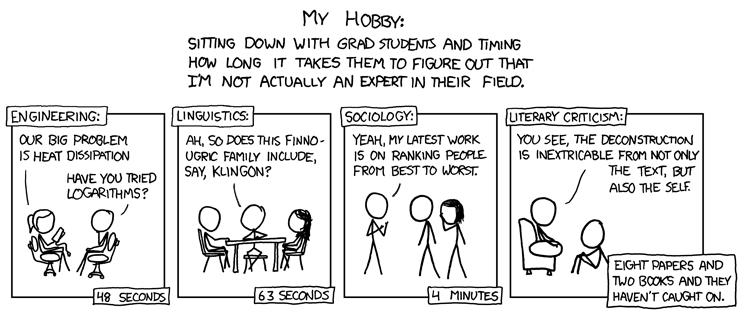
First of all, this cartoon is incredible, though I can’t seem to remember where it is from:


A similar graph from this White Courtesy Telephone blog post also suggests the inanity of much research.


Also, on an academic note, it’s been all over the news that Peter Enns has resigned from Westminster Theological Seminary (WTS) in what appears to be a theological difference. In my completely amateur opinion, it marks WTS’ move away from academic scholarship and more as a denominational training ground. Institutions, like cities, have personality and character. They are born, they change, they age, and eventually they also will die.

There’s been more talk about the students who are receiving elite educations. An adjunct faculty writes about the spirit of entitlement that dominates Harvard University. The article has been hotly contested and debated, so if you’re interested, run some searches on it or check the additional links on aldaily.com.

So given the state of today’s academic environment, the recent passing of Russian writer Alexander Solzhentisyn should merit attention. Solzhentisyn was a bold writer who openly criticized and denounced the Russian communist regime, in particular writing about the horrors of the gulags. Articles from the Inquirer and the Economist.

It was also refreshing to see an SFMOMA exhibit on China “Half Life of a Dream”. The artwork seemed meaningful because it actually seemed to have something relevant to say – perhaps because China has more of a contradictory national narrative, than the postmodern fragmentation of the American narrative in recent years. The Philadelphia Inquirer has featured three stories spanning two decades about a Chinese woman who has now become a corporate executive. 2008, 1999, 1987.

Speaking of China, the Olympic Games are coming up. I’ve never been super into watching these competitions—and part of me is always devastated by the amount of havoc it can wreak upon a city—economically and ecologically. For the 2010 Vancouver Olympic Games, the city plans to bulldoze through a rare forest. There’s more coverage of China’s Olympic Games and the corresponding environmental and societal issues at the same site.

On the environmental note, as gas prices hike, bicycling has also finally been gaining the spotlight. There’s a useful Philadelphia Inquirer article with practical tips about bike commuting, as well as an Economist article on bicycling and its implications on street planning and safety.

My few words of advice from my on year of experiencing the indignities of commuting by bike: it is okay to wear skirts that are longer than skirt length, changing after you get to work is highly advisable, and it’s better to be slow and safe. Be respectful of motorists (e.g. don’t run red lights when they are trying to get through the intersection) but remember that you have a right to be on the road. However, if your safety is threatened (e.g. angry, aggressive driver), you may need to slow down and get off the road.

Meanwhile, I am reminded of Tom Wolfe’s Bonfire of the Vanities with a recent Mercedes hit and run accident in the Philadelphia area. Hit and run accidents make me very angry. However, the murder of a four year old this week strikes an entirely different level of emotion, something akin to numbness.

Despite the violence in this area, Philadelphia still remains a great city to live in. Surprisingly, it is a lot safer than what one might imagine. Props to this recent college graduate who wrote for the Inquirer why he has decided to stay in Philadelphia and contribute to my continued ambivalence about the gentrification of this city.

Speaking of Philadelphia, I have been fairly satisfied with Nutter as our mayor, but that did not prevent me from feeling saddened about reading about the death of Jesus White, a homeless man who ran in the mayor primaries last year.

It’s especially striking that Jesus White worked a regular job, but still had no home. It saddens me that when the economy does well, it takes years for the minute benefits to “trickle down” to the poor. Yet when the economy suffers, the impact is felt immediately and most severely by the poor.

Speaking of policies, Barack Obama’s recent support of faith-based programs has also been on the minds of many. This
Opinion article Why Obama seized the faith-based mantle by Amy Sullivan from USA Today traces the history of faith-based initiatives, something that surprisingly despite being one of Bush’s signature policies, stemmed from the Democratic party.

This other opinion article from the Baltimore Sun makes a argument against more funding for faith-based programs, but instead advocates more collaboration between religious congregations and secular nonprofit organizations. The writer’s argument is solution-oriented and forward-looking, which I appreciate, but he also assumes the necessity to professionalize care, something that I am not entirely comfortable with. While professional help may be valuable and important, we run the risk of evading responsibility ourselves, and pushing it off to a third party, outsourcing compassion if you will. While Bush’s ‘compassionate conservatism’ has not been successful, I am pretty sure that putting the burden of caring for the poor entirely on the shoulder of the government will also fail. Institutionalized compassion will not bring about transformation. (Does institutionalized care even qualify as true compassion?)

All this talk about politics makes me remember once again that I am now a U.S. citizen and will be voting in the upcoming election! Perhaps more significantly, I have almost been married to this man for 6 months.

On a lighter note, Wordle.net is quite amusing. I ended up with this for this blog:


I'm also tired.

Thursday, July 24, 2008

what if philadelphia ceases to be philadelphia?

In his novel Invisible Cities, Italo Calvino writes about changes to the city of Maurilia:

In Maurilia, the traveler is invited to visit the city and, at the same time, to examine some old postcards that show it as it used to be: the same identical square with a hen in the place of the bus station, a bandstand in the place of the overpass, two young ladies with white parasols in the place of the munitions factory. If the traveler does not wish to disappoint the inhabitants, he must praise the postcard city and prefer it to the present one, though he must be careful to contain his regret at the changes within definite limits: admitting that the magnificence and prosperity of the metropolis Maurilia, when compared to the old, provincial Maurilia, cannot compensate for a certain lost grace, which, however, can be appreciated only now in the old postcards, whereas before, when that provincial Maurilia was before one’s eyes, one saw absolutely nothing graceful and would see it even less today, if Maurilia had remained unchanged; and in any case the metropolis has the added attraction that, through what it has become, one can look back with nostalgia at what it was.

Beware of saying to them that sometimes different cities follow one another on the same site and under the same name, born and dying without knowing one another, without communication among themselves. At times even the names of the inhabitants remain the same, and their voices’ accent, and also the features of the faces; but the gods who live beneath names and above places have gone off without a word and outsiders have settled in their place. It is pointless to ask whether the new ones are better or worse than the old, since there is no connection between them, just as the old post cards do not depict Maurilia as it was, but a different city which, by chance, was called Maurilia, like this one.

I find myself with a funny set of wants—I want more college graduates and professionals to stay or to come to Philadelphia, to work here and contribute to the economy, and to make this a better city. Yet I also know that this very revitalization is playing an integral role in the gentrification in my neighbourhood, destroying historic black communities in West Philadelphia.

I deeply desire to see this city revitalized, to become the “next great city”—for its “soul-stirring desolation” as Jonathan Franzen put it, to be turned into soul-stirring hope and community. But when does Philadelphia cease to be Philadelphia? When does some other minor deity saunter in and takes its place and its name, while the old Philadelphia is put in a body bag and dumped into the Delaware River? In hoping for Philadelphia’s life, am I also wishing its destruction?

As Philadelphia changes, the spirit of this city will change. But I want to see the soul of Philadelphia grow out of its sighs and tears and into something wise and beautiful, with history and complexity, rather than see it squeezed out and left to die, while some other young, fashionable imposter comes to stretch its personality over these streets.*


* There’s been an interesting series in the Philadelphia Inquirer on homeless men sleeping, eating, bathing and having sex in Rittenhouse Square. I’ve blogged about this park and my appreciation for the diversity of its users. Sometimes, when I try to imagine what Philadelphia would look as a person, I picture a homeless man, dirty and filthy, staggering through the streets (I have other images too). I don’t want this homeless man shut away in a shelter far, far way—I want him to find a job, build a family and live in a home. As for the Rittenhouse Square issue, I understand the local residents’ aversion to having their local park overrun by homeless at night, and I also understand the need to provide the homeless with more permanent housing options than park benches, but something about excluding before including, hiding before healing, and ultimately separating without ever integrating, strikes me as being the wrong approach. And I hope that we do not take the same approach to the poor (of pushing them out to suburbs rather than including them in a vital way) as we try to bring new life to Philadelphia.
** On a lighter note, I think I may be breaking a significant trend with this post. Have you noticed that I will post frequently for a month, and then I will go on hiatus for the next month before resuming frequent posts again? Somehow, I’ve managed this time to only wait about two weeks before the posts resume again.

Wednesday, July 23, 2008

I am gentrifying my neighbourhood

It’s frightening how we find ourselves swept up in large social changes. We act, thinking that our actions are our entirely own, only to find that so many others are making the same decisions. I begin to wonder to what degree are my decisions my own (or God’s) and to what degree have I swallowed the ideas, values and assumptions prevalent in society.

I watch the rapid gentrification of my neighborhood—I knew it would happen eventually but I would not have anticipated the speed. To put it bluntly, six months ago there were not this many white people walking around. So property prices are increasing, rents are rising, and houses are being renovated. While I can say that I am part of the neighbourhood’s revitalization, I am also displacing plenty of lower income families, and representing the arrival of yuppies and hipsters.

The gentrification in many ways seems inevitable. And if Matt and I had not chosen to live where we are now, and opted to live in, well, an already gentrified area, the neighborhood would have changed anyways. But that does not take away from the fact that we are part of urban process now that is moving lower-income, underprivileged families further out to the periphery.

So what do we do when we recognize that our actions, by no evil intent, are hurting others? To what degree do we go with the flow and recognize that this may not be one of the battles that we are called to fight and that we are not responsible? (Is that resignation?) Or, how do we stand up against the river when we feel like a little pebble being tossed about in the current?

In some ways this question is a moot point for the time being, as Matt and I have already signed our lease. For the time being, we are called to love and care for our neighbors, whatever ethnic or class background they may be from. But when it comes to buying a house* (something that is on the radar for the next few years), how are we to tread? Even if we try to tread softly, our footprints seem to sink far deeper than we would ever want them to.


* We can’t really afford a house in the wealthier sections of the city. Do we buy a house in this already gentrifying area and continue to contribute to this inevitable process? Or, do we buy a house in a predominantly black lower-income neighborhood and risk setting off gentrification there, because our very presence will change the way that the neighborhood is viewed? (And I question the latter option critically—it can easily be done with a sense of pride and self-righteousness, instead of faith, love, and a specific calling).

Sunday, July 06, 2008

book reviews second quarter 2008

Married life has certainly ushered in different rhythm of life. I was hoping that with no wedding to plan anymore, I’d have more time to read, but other things (of the nature of arts and crafts, cooking and household chores) have filled that space. That being said, I am quite glad that wedding and honeymoon planning is done and over with—everything except photos and thank you notes that is. And I’m hoping to continue to make more time to read over the next little while, especially as I may be taking a class at Penn this fall, and may no longer have the luxury of reading whatever I feel like reading.

In any case, of late, I’ve been digging my elbows deep in sociology and urban studies non-fiction (prompted perhaps by Planet of the Slums and Bowling Alone), but I think I may spend the summer months with a bit more fiction. Next on the list: The Road by Cormac McCarthy, and perhaps C.S. Lewis’ Space Trilogy. Reviews are also posted on Goodreads.com.

Fiction

*** The Watchmen (Alan Moore)
Heralded as one of the best graphic novels ever, The Watchmen is a very intense and dark story of the lives of former costumed vigilantes (superheroes without superpowers). It begins with the investigation into the mysterious murder of one of them. It’s extremely well-written and well-told, but requires quite a bit of thought and attention to follow along. I won’t say too much, but I will say that the Watchmen defies the genre, by being an anti-superhero story.

** Straight Man (Richard Russo)
This book recounts a week in the life of a professor of English in Railton, Pennsylvania. It is focused on the drama of his department, the university (facing extreme budget cuts), and his family. The book is meant to be humorous, and succeeds most of the time, though sometimes the events end up being a bit absurd. It was decently/mildly entertaining to read, especially as it mocks academic culture. Summed up, the book is about: “Only after we’ve done a thing do we know what we’ll do, and by then whatever we’ve done has already begun to sever itself from clear significance, at least for the doer.” It’s nothing life changing but if you’re looking for a light, quick, funny read, and you have a soft spot for the university, this might work out well.

*** Housekeeping (Marilynne Robinson)
This is a beautifully written novel about two sisters coping with the death (apparent suicide) of their mother in the small town of Fingerbone. The prose reads like poetry and the quiet, somber, dreamy reflections on life and death weave their way into the narrative. However, that very reverie-like prose made it difficult to connect more deeply with the characters—they seemed like beautiful ghostly abstractions rather than real flesh and blood individuals (but I suspect that may be the author’s intentions). In any case, it was enjoyable to read, and perhaps can be very inspiring to an aspiring writer.

Non-Fiction

*** Bowling Alone: The Collapse and Revival of American Community (Robert Putnam)
This book summarizes substantial amounts of empirical studies on American community, which is broadly defined to include civic engagement, participation in different interest groups, church attendance, philanthropic giving, volunteering, or simply hanging out with friends. After Putnam clearly demonstrates the decline of American community since the 1950s, he spends a good portion of time investigating the various factors that may have caused it, including suburban sprawl, television, less free time, generational change etc… He spends the last few chapters on a hopeful note, mentioning the spurt in community involvement after the growing injustices of the late 1800s.
Though he didn’t leave me entirely convinced, Putnam posits a series of societal changes that could have substantial impact on community involvement, ones that are very well in the realm of possibility. Putnam does spend quite a bit of time detailing methodology, but overall the book is not technically bogged down. My favourite chapter was probably the one detailing the detrimental effects of television.

*** The Sabbath (Abraham Heschel)
Heschel is a Jewish theologian and this short book is his reflection on the role of Sabbath in Jewish religious life. The Sabbath is a day of holiness, a palace of time, a way to commune with God. While I found most of this book less applicable to me as a Christian (though it did help me start to understand better Jewish culture), the first two chapters and the last one are absolutely phenomenal. In these chapters, Heschel reflects on society’s tendency to devalue time, which it cannot so easily control, in order to acquire more of space, that which seems so much easier to possess.

**** Final Exam: A Surgeon’s Reflections on Mortality (Pauline Chen)
This is a beautifully written book by a surgeon. Chen recounts her training and her practice as a doctor, narrating the ways in which she and her fellow medical students or doctors confronted or avoided confronting death. While Chen touches upon policy-oriented issues, such as the need for palliative care, better M & M conferences, better medical training, her book reads best as a memoir of her own personal and emotional struggles. I found most moving Chen’s narrations of how she responded to a husband or a wife dying to a chronic disease, while his or her partner watched and waited. Chen writes both vividly and compassionately. This book touched me more personally than most, perhaps as I have been reflecting more on how hard it would be to lose my husband (or for him to lose me) after the recent death to cancer of a church member with a husband and young children.

**** The Death and Life of Great American Cities (Jane Jacobs)
Written in the 1960’s, Jane Jacobs revolutionized the way we viewed and studied the city. She summarizes her approach in her final chapter—cities are not to be studied as objects of simplicity (e.g. simple relationships, more open space = better neighborhoods), nor objects of disorganized complexity (e.g. statistical approaches), but are to be treated as a living organism—incredibly complex yet organized and interrelated. She advocates the “microscopic” approach to looking at the city—digging in very deeply, instead of relying on high flying theories. She concludes that the success of a city is not dependent on any single component (e.g. open space, broken windows, etc…), but on a complex interaction of various factors, which she outlines in her book.
However, for most of the book though, Jacobs rarely talks to high-brow metaphor, but remains incredibly practical, concrete, realistic and easy to understand. She relies heavily on examples from Boston, New York, Philadelphia and Chicago. She focuses on several elements that in combined, including mixed and diverse uses (e.g. commercial and residential areas mixed together), shorter blocks, ideal density and lack of large borderlands/abandoned spaces (which can be parks!), and diversity. Her book was long to read, but definitely provided me with a new framework with which to observe and understand the city.

***** Sociological Imagination (C. Wright Mills)
The first 100 pages of this book were really hard to get through, and even after that, the book was very dense and took quite a bit of effort to understand. All that being said, this has been one of the most thought-provoking and academically-inspiring books I have read in the past year. Mills was a prominent sociologist of the earlier half of the twentieth century (if I’m not mistaken, he coined the phrases “WASP” and “white collar”).
In this book, Mills criticizes the two dominant methods of studying sociology (grand theory and abstracted empiricism), and then goes on to delineate the sociological imagination—a way of studying society that factors in historical, political and individual factors, that does not get too lofty with grandiose theories and abstractions nor too mired in the numbers and statistics of abstracted empiricism. He then writes about the need for the sociological imagination in today’s society, in relation to our reason and freedom, our democracy and politics. The appendix provides some guidance on how to conduct such research. Though Mill had a few touches of elitism to him, it was so refreshing to read someone who had a vision for social sciences (and for the academy) that mandates relevance to society at large and the individual.
To summarize his stance on the subject: “Our public life now often rests upon such official definitions, as well as upon myths and lies and crackbrained notions. When many politics- debated and undebated – are based on inadequate and misleading definitions of reality, then those who are out to define reality more adequately are bound to be upsetting influences. … Such is the role of mind, of study, of intellect, of reason, of ideas: to define reality adequately and in a publicly relevant way. The educational and the political role of social science in a democracy is to help cultivate and sustain public and individuals that are able to develop, to live with, and to act upon adequate definitions of personal and social realities.

Rating scale
* didn’t like it
** it was ok
*** liked it
**** really liked it
***** it was amazing

Saturday, July 05, 2008

simulated intelligence

American universities have done a decent job of churning out smart, technically astute and relatively capable individuals, but it is questionable whether they have taught us knowledge of true value-- how to understand our privilege and place in society. We’re taught to perform well on SATs and AP exams, which soon become MCATs, grad school applications and interviewing, but we’re not necessarily taught how to question the assumptions of our society, or to understand from a critical point of view, our role in the world. We’re taught how to succeed well in the system, but not taught how to question or change the system.

From the article The Disadvantages of an Elite Education quoted in my previous post:

The world that produced John Kerry and George Bush is indeed giving us our next generation of leaders. The kid who’s loading up on AP courses junior year or editing three campus publications while double-majoring, the kid whom everyone wants at their college or law school but no one wants in their classroom, the kid who doesn’t have a minute to breathe, let alone think, will soon be running a corporation or an institution or a government. She will have many achievements but little experience, great success but no vision. The disadvantage of an elite education is that it’s given us the elite we have, and the elite we’re going to have.

Not that this is anything new, famous sociologist C. Wright Mills writes of bureaucratization and the lack of big picture understanding amongst many intelligent individuals, many decades before we see its vivid instantiation in the swanky bars and clubs of New York City:

Great and rational organizations- in brief, bureaucracies- have indeed increased, but the substantive reason of the individual at large has not. Caught in the limited milieux of their everyday lives, ordinary men often cannot reason about the great structures- rational and irrational – of which their milieux are subordinate parts. Accordingly, they often carry out series of apparently rational actions without any ideas of the ends they serve, and there is the increasing suspicion that those at the top as well- like Tolstoy’s generals- only pretend they know. The growth of such organizations, within an increasing division of labor, sets up more and more spheres of life, work, and leisure in which reasoning is difficult or impossible. The soldier, for example, ‘carries out an entire series of functionally rational actions accurately without having any idea as to the ultimate end of this action’ (Mannheim, Man and Society) or the function of each act within the whole. Even Men of technically supreme intelligence may efficiently perform their assigned work and yet not know that it is to result in the first atom bomb.

Ortega Y Gasset in The Revolt of the Masses also projected a hint of it back in the 1930s. He was referring to the masses (and Europe), but I think the description, quoted from the article At the Forest’s Edge by Anthony Daniels can apply quite well to many of today’s recent graduates of elite universities:

The picture Ortega draws of the mass man is not an attractive or flattering one, but Ortega is not a snob who simply excoriates the appalling habits and tastes of those below him in the social scale. For him, mass man is the man who has no transcendent purpose in life, who lives in an eternal present moment which he wants to make pleasurable in a gross and sensual way, who thinks that ever-increasing consumption is the end of life, who goes from distraction to distraction, who is prey to absurd fashions, who never thinks deeply and who, above all, has a venomous dislike of any other way of living but his own, which he instinctively feels as a reproach. He will not recognize his betters; he is perfectly satisfied to be as he is.

Mass man accepts no fundamental limits on his own life. Any limits that he may encounter are purely technical, to be removed by future advance. He believes that life is and ought to be a kind of existential supermarket, that an infinitude of choices is always before him, in which no choice restricts or ought ever to restrict what is possible in the future. Life for mass man is not a biography, but a series of moments, each unconnected with the next, and all deprived of larger meaning or purpose.

Mass man does not have to be poor or stupid. He can be both highly paid and highly intelligent, in a narrow way, and he can also be very highly educated, or at least trained; indeed, as knowledge accumulates, and as it becomes more and more difficult for anyone to master more than the very smallest portion of human knowledge, so connected thought (of the kind of which mass man is incapable) becomes rarer and rarer. Mankind collectively knows more than ever before, says Ortega, but cultivated men grow fewer.


* I do not write this as someone who is better than and above all of this, nor do I write this as someone who claims to possess “true intelligence.” I have been frustrated with my college education at an elite institution, because it left me with a bunch of interesting questions, cocktail conversation topics, and scattered technical expertise, but no real knowledge. As a fairly recent college graduate and a Christian who is called to see the world as God sees it, I am fumbling about trying to gain some true knowledge and vision (and dare I say, wisdom?)

Wednesday, July 02, 2008

simulated opportunity (golden handcuffs)

on elite education, prestigious jobs and privilege

I just made a visit up to Manhattan this past weekend, and quickly find myself ushered back into the contradictory world of long work hours coupled with late nights out consisting of $50 dinners, multiple cab rides, and bar hopping.

I was saddened to find so many people who disliked their high-paying, prestigious banking and consulting jobs, but could not find the momentum to leave. Why do so many intelligent and talented people feel trapped in their jobs? (It’s so easy to end up in these jobs—the process is on campus and they give you an offer fall of senior year. It takes courage to turn down a secured job offer in exchange for the unknown).*

Is it because you have already built your life around a lifestyle that requires your current salary? Is it because all your friends make a similar salary and in order to continue living the way that you do, you can’t really take a job that pays less? (Would you be able to attend all those $100 birthday dinners? Would you be able to continue paying $1500 in rent for your apartment?)

Or is it more a matter of security and prestige? A sense that this New York finance job is a good opportunity and it would be a waste to throw it away?

For those of us who hail from immigrant families, this question becomes very real, because our parents worked so hard in order to give us good opportunities in this country. And for those of us who attended costly Ivy League or private universities, our parents have provided even further for us financially. I’ve been perceived as spoiled, because I tossed out a good opportunity in the corporate world in order to take a lower paying position at a nonprofit organization. Apparently, I couldn’t tough out the long hours and tough environment of the corporate job, so I did the irresponsible thing and quit.**

Have I thrown away my privilege? Am I not spoiled and have I not appreciated the sacrifices my family has made on my behalf? I remember the frustration of being drilled by my aunt: “So why did you quit your higher paying job to take a lower paying job? Why couldn’t you have found a job in Philadelphia that paid as much as your previous one?”

I probably still have a long ways to go to truly understand, appreciate and be grateful for the sacrifices my parents have made for me, but I do not believe that I have tossed out my privilege. In fact, it is my privilege that has given the freedom to change jobs and pursue something that I love.

In the very thought-provoking article, The Disadvantages of an Elite Education, Deresiewicz writes***:

If one of the disadvantages of an elite education is the temptation it offers to mediocrity, another is the temptation it offers to security. When parents explain why they work so hard to give their children the best possible education, they invariably say it is because of the opportunities it opens up. But what of the opportunities it shuts down? An elite education gives you the chance to be rich—which is, after all, what we’re talking about—but it takes away the chance not to be. Yet the opportunity not to be rich is one of the greatest opportunities with which young Americans have been blessed. We live in a society that is itself so wealthy that it can afford to provide a decent living to whole classes of people who in other countries exist (or in earlier times existed) on the brink of poverty or, at least, of indignity. You can live comfortably in the United States as a schoolteacher, or a community organizer, or a civil rights lawyer, or an artist—that is, by any reasonable definition of comfort. You have to live in an ordinary house instead of an apartment in Manhattan or a mansion in L.A.; you have to drive a Honda instead of a BMW or a Hummer; you have to vacation in Florida instead of Barbados or Paris, but what are such losses when set against the opportunity to do work you believe in, work you’re suited for, work you love, every day of your life?

Yet it is precisely that opportunity that an elite education takes away. How can I be a schoolteacher—wouldn’t that be a waste of my expensive education? Wouldn’t I be squandering the opportunities my parents worked so hard to provide? What will my friends think? How will I face my classmates at our 20th reunion, when they’re all rich lawyers or important people in New York? And the question that lies behind all these: Isn’t it beneath me? So a whole universe of possibility closes, and you miss your true calling.

My parents sacrifices have afforded me a better life—one in which I have plenty and one in which I have the freedom to choose a satisfying job that will not leave me in poverty. They have brought me to a country where I don’t have to fight tooth and nail to survive. They have given me an education that puts so many resources and options at my disposal. It would have been a waste to end up trapped in a job that made me feel dead on the inside, and to end up living a life that I never wanted to live.

* Obviously, this is generalization. Some do love their jobs and stay in the field and maybe they are meant to be there, while others tough out the travel and hours in order to learn what they can and then leave after a few years to follow less traditional paths. And some have chosen to stay in the job for a few years in order to honor their parents, but then go on to do something closer to their heart. I don’t know whether these people are right or wrong, nor should I be the judge of their decisions. (I will say that I do have special respect for the latter group). I am merely speaking in defense of my own decision, and against the mentality of “Since I’ve been given this great privilege and opportunity, I guess God wants me to take it.” There is opportunity in turning down opportunity.
** There is distinction between choosing a more satisfying job vs. just being lazy and continuing to live off your parent’s income. One is responsible and the other is not.
*** In fact, I like this article so much, I think it should be required reading for anyone who has or is considering an Ivy League education.
**** For related writings on this topic, please click on “new york city” in the archive by topics section.

Tuesday, June 24, 2008

the life and death of... nonprofit organizations

For many nonprofits, to be striving towards are mission, we are also striving towards our own deaths as organizations. While this may not be the case for arts and cultures organization or childcare centers, it is often so for social service and community development oriented organizations.

A transitional foster care home ultimately wants less kids staying at its facilities, because it means that more children are finding stable families to live with. A homeless shelter ultimately prefers that the homeless find affordable housing instead of staying at their temporary shelters.

Currently, a community development corporation has been very successful in revitalizing the area where it is located. The region is beginning to attract more population, tourism and income, and appears to be thriving from its dilapidated abandoned-by-industry state. The organization has watched its loan and mortgage business dwindle as the private sector has found it profitable to move in and take over. Small businesses in the area are thriving with new stores and attractions opening all the time. The question ahead remains: What is its role going forward? Has it accomplished its mission?

Death is not always bad and growth is not always the golden touch. Let’s hope that very successful non-profit organizations can acknowledge and celebrate their successes, and gracefully bow out when their time has come, so that resources can be directed elsewhere. Because though some areas may see improvement, there are still many poor amongst us.

Sunday, June 22, 2008

simulating nature

the life and death of great American suburbs

Part of the allure of the suburbs was that it promised an escape from the city. We wanted to be closer to nature-- we wanted green instead of concrete. But what we aspired for in our car-centric outer rings of cities, was rather some filtered simulation of the real thing. Jane Jacobs writes, that in the suburbs, “Nature is apparently assumed to consist of grass, fresh air, and little else.”

Nature is not the uniform, well-watered lawns and tended flowers of suburbia. Nature is not clean and tidy. It’s messy. Ticks, mosquitoes, mud, earthworms and beetles are all part of nature. And if you’ve ever camped out before, being in nature is not comfortable. It can be beautiful, breathtaking, enjoyable, amazing, but definitely not comfortable.

Jane Jacobs writes on the dangers of trying to recreate nature in the suburbs:

There are dangers in sentimentalizing nature. Most sentimental ideas imply, at bottom, a deep if unacknowledged disrespect. It is no accident that we Americans, probably the world’s champion sentimentalizes about nature, are at one and the same time probably the world’s most voracious and disrespectful destroyers of wild and rural countryside.

It is neither love for nature nor respect for nature that leads to this schizophrenic attitude. Instead, it is a sentimental desire to toy, rather patronizingly, with some insipid, standardized suburbanized shadow of nature—apparently in sheer disbelief that we and our cities, just by virtue of being, are a legitimate part of nature too, and involved with it in much deeper and more inescapable ways than grass trimming, sunbathing and contemplative uplift. And so, each day, several thousand more acres of our countryside are eaten by bulldozers and covered by pavement, dotted with suburbanites who have killed the thing they thought they came to find. Our irreplaceable heritage of Grade I agricultural land (a rare treasure of nature on this earth) is sacrificed for highways or supermarket parking lots as ruthlessly and unthinkingly as the trees in the woodlands are uprooted, the streams and rivers polluted and the air itself filled with the gasoline exhausts (products of eons of nature’s manufacturing) required in this great national effort to cozy up with a fictionalized nature and flee the “unnaturalness” of the city.


Jane Jacobs wrote this in The Death and Life of Great American Cities, which was first published back in the 60s. She saw through the myth of the suburb during a time when the picket fence dream was still live and vibrant.

There are times when the clean lawns, tidy houses, pleasant gardens, and the comfort of car transportation is very appealing to me, but I also know that the suburban landscape is probably not sustainable in light of rising gas prices, and not the type of ideal living arrangement that I would like to see.* I expect to see the decline of the suburb and the rise of the city again. (Though what I fear, is that the rich will come to live in the city, and the poor will be forced out to the suburbs).


*And there are other things about the suburbs that rub me the wrong way—for instance, that the safety of the suburbs seems to rely upon socio-economic segregation and automobile transportation (which ironically enough, kills thousands of people every year).

Saturday, June 21, 2008

on the uses of diversity (2)

or: the entry in which I reveal my political cards (not that it should be a surprise to anyone)

The Economist recently published an article on political segregation. More and more Americans are choosing to live in areas where their political beliefs are in line with everyone else’s:

For example, someone who works in Washington, DC, but wants to live in a suburb can commute either from Maryland or northern Virginia. Both states have equally leafy streets and good schools. But Virginia has plenty of conservative neighbourhoods with megachurches and Bushites you've heard of living on your block. In the posh suburbs of Maryland, by contrast, Republicans are as rare as unkempt lawns and yard signs proclaim that war is not the answer but Barack Obama might be.

At a bookshop in Bethesda (one of those posh Maryland suburbs), Steven Balis, a retired lawyer with wild grey hair and a scruffy T-shirt, looks up from his New York Times. He says he is a Democrat because of “the absence of alternatives”. He comes from a family of secular Jews who supported the New Deal. He holds “positive notions of what government actions can accomplish”. Asked why he moved to Maryland rather than Virginia, he jokes that the far side of the river is “Confederate territory”. Asked if he has hard-core social-conservative acquaintances, he answers simply: “No.”

In the back of my mind, I’ve been wondering for quite some time: do I currently support Barack Obama because I really do believe he’s the best choice for president? Or is it because almost everyone else around me also does (I’m surrounded by liberals :P)? There’s still many months until election time, so there’s time to assess thoroughly and decide. If I end up doing what everyone else is doing, I hope it’s not from following the herd. And if I do decide differently, I hope I’ll have the courage not to hide it from others, because I am worried about what they think of me.*

It’s a pity that there isn’t more contact and dialogue between people of different political preferences. It’s easy to become silo-ed in our own bubbles, comfortably feeling smug with our political opinions, and writing off those who different opinions as stupid/elitist/ignorant/absurd etc… If we are to find some viable solutions to the problems that we are facing, ones that will actually be implemented in Congress and not just dreamed about, we do need to be actively trying to dialogue with and understand others’ opinions. Instead of just writing off another's opinion as wrong, it’s good to ask: What are their assumptions? (As Nick has written about in his blog). And if those assumptions are different, we can ask: why are they different? how can we work through our differences? and how can we continue to respect them in light of their different beliefs?

All this is much harder when we socially separate ourselves from those who have different political preferences from us. Living as neighbors, colleagues or friends, humanizes those “liberals” or “conservatives” or “anarchists” or “socialists”. It becomes much harder to label them and see them under the stereotype of their political preferences.** It puts us in a position where we must at the very least interact with them, instead of having all our knowledge of them be mediated through the internet and the evening news.

The Economist article continues on the dangers of lack of diversity:

There is a danger in this. Studies suggest that when a group is ideologically homogeneous, its members tend to grow more extreme. Even clever, fair-minded people are not immune. Cass Sunstein and David Schkade, two academics, found that Republican-appointed judges vote more conservatively when sitting on a panel with other Republicans than when sitting with Democrats. Democratic judges become more liberal when on the bench with fellow Democrats.

“We now live in a giant feedback loop,” says Mr Bishop, “hearing our own thoughts about what's right and wrong bounced back to us by the television shows we watch, the newspapers and books we read, the blogs we visit online, the sermons we hear and the neighbourhoods we live in.”

Voters in landslide districts tend to elect more extreme members of Congress. Moderates who might otherwise run for office decide not to. Debates turn into shouting matches. Bitterly partisan lawmakers cannot reach the necessary consensus to fix long-term problems such as the tottering pensions and health-care systems.

America, says Mr Bishop, is splitting into “balkanised communities whose inhabitants find other Americans to be culturally incomprehensible.” He has a point. Republicans who never meet Democrats tend to assume that Democrats believe more extreme things than they really do, and vice versa. This contributes to the nasty tone of many political campaigns.

Interestingly enough:
The more educated Americans become, the more insular they are. Better-educated people tend to be richer, so they have more choice about where they live. And they are more mobile.


* It’s also still up in the air whether or not I will be able to vote in this historical election. I’m still in the process of applying for US citizenship. My civics exam is next week, and if I pass, I’m not sure when I will be sworn in. I haven’t voted before in my life, and so there’s a certain excitement in me about this upcoming election. I think in the past, I’ve taken voting too lightly, or ignored elections altogether, because it was something that I couldn’t be part of. But now, I might actually be part of this so-called democratic system, and I feel this growing sense of investment and care that I haven’t felt before.
** It’s ironic how “liberals” who are so sensitive about intolerance and racism, are rather quick to make generalizing comments about “conservatives”.